Board AI Governance: The Seba 12 Ps Framework Every Board Can Use
Give your board the clarity to govern AI with confidence. Translate responsible AI from aspiration into infrastructure your board can actually oversee.
Learn About Talk 02 | Schedule Board Briefing
Why Board AI Governance Matters Now
Your board oversees financial controls, risk management, compliance, and strategy. But AI governance? That’s often treated as “IT’s problem” — when it’s actually a board-level fiduciary responsibility.
The Board Governance Gap
Your board oversees financial controls, risk management, compliance, and strategy. But AI governance? That’s often treated as “IT’s problem” — when it’s actually a board-level fiduciary responsibility.
Without clear governance:
- Your board lacks visibility into AI risks and decisions
- Accountability is unclear (who decides? who’s accountable?)
- Compliance is reactive, not proactive
- Innovation gets bogged down in unclear approvals
What Your Board Needs to Know (But Probably Doesn’t)
What to govern: Not just “adopt AI safely” — but which AI decisions, which systems, which risks matter most?
Who decides: Is it the CIO? The CMO? A steering committee? What’s the decision framework?
How to stay accountable: What metrics, what monitoring, what incident readiness?
How fast to move: The board needs to know: are we moving at the pace of the business, or are we creating a brake?
The Real Opportunity
AI Governance done right isn’t a brake on innovation — it’s the confidence to move fast. The organizations winning with AI aren’t the ones adopting fastest. They’re the ones who can trust what they deploy.
That capability is governance. Done right, it’s a source of competitive advantage, not risk.
The Seba 12 Ps of Responsible AI Oversight
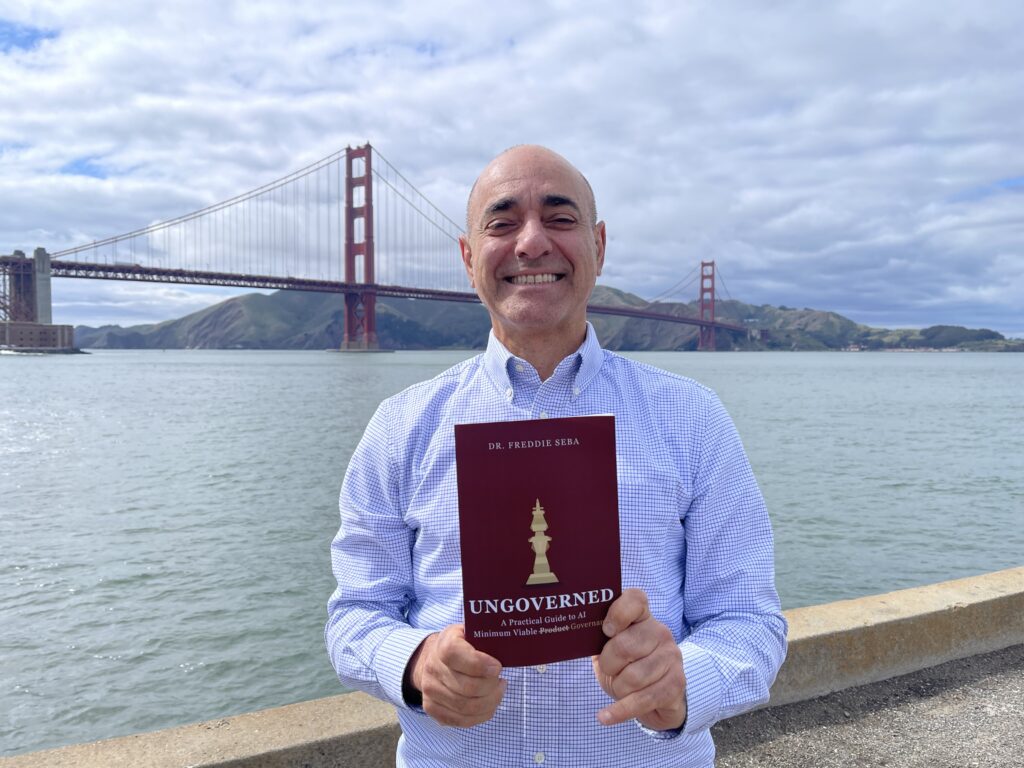
A board-ready framework that translates AI governance from aspirational to actionable. Each “P” represents a governance domain your board needs to oversee. This framework is detailed in Dr. Seba’s book Ungoverned: A Practical Guide to AI Minimum Viable Governance.
WHY: Strategy & Values
1. Purpose
Advance mission and the public good. Is this AI system aligned with your organization’s core mission? Does it create value for your stakeholders, or does it just maximize extraction? Your board needs to ensure every AI deployment serves the mission, not just the bottom line.
2. Problems
Solve real needs, not shiny demos. Are you deploying AI because it solves an actual problem, or because it’s trendy? What problem does this system solve? Is it addressing a gap or creating one?
3. Profits
Create value without externalizing harm. Who benefits from this AI? Who bears the costs? Are you shifting risk onto customers, employees, or communities? How are you capturing and distributing value fairly?
WHO: Stakeholders & Impact
4. People
Protect dignity, agency, labor. Who is affected by this AI? Are you protecting human dignity and agency? What happens to jobs and labor as AI scales? How are you accounting for workforce impacts?
5. Planet
Measure costs; mitigate, don’t ignore. What are the environmental costs of training, deploying, and running this AI? Are you accounting for them in your ROI? What’s your mitigation strategy?
HOW: Execution & Safety
6. Process
Design → deploy → monitor → retire. Do you have a clear process for the AI governance lifecycle? How do you deploy responsibly? How do you monitor ongoing? Do you have an exit strategy?
7. Policy
Align with evolving rules and norms. Is this deployment compliant with current regulations? How will you adapt as AI governance rules evolve? What’s your regulatory monitoring plan?
8. Protections
Guardrails + kill switch before scale. What safeguards are in place? Do you have a “kill switch” to stop an AI system if it goes wrong? What’s your circuit breaker?
9. Privacy
Minimize, secure, define retention. What data does this AI require? How are you minimizing data collection? How long do you retain it? What’s your data deletion policy?
10. Provenance
Track sources, authorship, grounding. Can you trace AI decisions back to data sources and assumptions? Who built this system? What’s your grounding? Can you explain your model?
11. Preparedness
Drill incidents + escalation. Do you have an incident response plan? Have you drilled it? What’s your escalation path when something goes wrong? Who’s in the war room?
12. Product Ownership
One accountable owner who can resource—and stop—it. Who owns this AI system? Who is accountable if something fails? Do they have authority to stop deployment? Is accountability clear?
Result: A board that can govern AI with clarity. An organization that can move fast because it knows what it’s doing.
Talk 02: The Seba 12 Ps of Responsible AI Oversight {#talk-details}
A framework every board can use to govern AI with clarity and confidence.
Quick Facts
For
- Boards & Trustees
- Governance Committees
- Compliance Officers
- Financial Services & Healthcare
Duration
- 60–90 minutes
- Can be adapted for keynote (45 min) or workshop (half or full day)
Audience Size
- 8–250 people
- Board only, or all-hands briefing
Format
- In-person board briefing
- Virtual keynote
- Hybrid workshop
What Attendees Will Learn
✓ The Seba 12 Ps Framework
Each domain of AI governance your board needs to oversee, with examples from healthcare, fintech, and higher education.
✓ Board Decision Rights
What decisions belong to the board vs. management. What are board-level risks? What requires board approval?
✓ Risk Inventory & Tiering
How to identify which AI systems are mission-critical, which carry regulatory risk, and which can move fast.
✓ Governance Checklist
A board-ready checklist: questions to ask before deploying AI, metrics to monitor, incident readiness.
✓ Vendor Accountability
How to structure AI vendor contracts so your board knows who’s responsible for what — data, incidents, performance.
✓ From Aspiration to Infrastructure
Concrete steps to move from “we want responsible AI” to “here’s how we actually govern it.”
Investment
Board Briefing (60–90 min, board only): $3,000–$8,000
Keynote (45–60 min, all-hands): $5,000–$15,000+
Full-Day Workshop (6–8 hours, governance deep-dive): $15,000–$25,000+
Investment varies by audience size, location, travel, and customization.
Book Talk 02 or Schedule Board Briefing
What Leaders Say
Technology innovation done right isn’t a brake on innovation — it’s the confidence to move fast. The organizations winning with AI aren’t the ones adopting fastest. They’re the ones who can trust what they deploy.
That capability is governance. Done right, it’s a source of competitive advantage, not risk.
Ready to Bring Board-Ready AI Governance to Your Organization?
Whether you need a board briefing, a full-day governance workshop, or ongoing advisory guidance, let’s talk about what makes sense for your board.
Book Talk 02 or Schedule Board Briefing | View All Pricing Options
Or schedule a 15-minute call to discuss your board’s specific needs.
Other Signature Talks
Talk 01: Ungoverned
For C-suite and founders who need a governance framework they can implement now.
Talk 03: Governing the Agentic Era
For CIOs and technical leaders navigating autonomous AI governance.
Talk 04: Healthcare AI Governance
For health systems and boards with healthcare-specific AI risks.
Talk 05: Higher Education AI Governance
For academic institutions and trustees navigating AI in higher ed.
FAQ: Board AI Governance
Is this talk just for boards, or can we invite the full executive team?
Either works. The Seba 12 Ps framework scales beautifully. We can do a board-only briefing (focused on oversight and decision rights) or expand it to executives (focused on implementation). Many organizations do both — board briefing first, then executive workshop.
Can this be a virtual briefing?
Yes. Virtual board briefings work well and typically cost $3K–$6K (less than in-person because there’s no travel). The framework translates well to virtual, and we optimize for board-specific needs (confidentiality, focused Q&A, etc.).
What if our board has no AI background?
That’s the point. The Seba 12 Ps framework is specifically designed for boards who don’t need to be AI experts — it translates AI governance into the board’s language (oversight, risk, accountability, decision-making). We start from first principles.
Can we customize this for our industry or specific risks?
Absolutely. That’s standard. Pre-event consultation focuses on your board’s context (healthcare vs. fintech vs. higher ed), your specific AI risks, and your governance maturity. We tailor examples and focus accordingly.
Do we get materials for the board?
Yes. Included: the Seba 12 Ps framework (printable), board governance checklist, risk inventory template, vendor accountability checklist, and post-briefing materials. We also recommend Ungoverned: A Practical Guide to AI Minimum Viable Governance as a reference for your board.
How do we combine this with an executive workshop?
Great question. Many organizations do: Board briefing first (focus: oversight + decision rights), then executive workshop 2-4 weeks later (focus: implementation + governance building). This creates alignment top-down. We can bundle these at a discount.
What if we’re just starting with AI — is this too advanced?
No. Start here. The Seba 12 Ps framework gives your board clarity on what to oversee before you have major AI deployments. This prevents governance debt. If your board needs first-principles context, Talk 01 (Ungoverned) is a good starting point, then Talk 02 for deeper governance.
Can we make this part of our annual board calendar?
Yes. Many boards now have annual AI governance briefings. You can book quarterly updates, annual deep-dives, or refresh the checklist annually. We can also structure this as ongoing advisory.
Next Steps
Step 1: Determine your format
Board-only briefing (60–90 min)? Keynote for all-hands (45–60 min)? Full-day workshop (6–8 hours)? Or combination?
Step 2: Check board calendar
When would this fit best? Many boards do this quarterly or annually.
Step 3: Get a quote
Contact us, and we’ll send a proposal based on format, audience size, customization, and timeline.
Step 4: Schedule a 15-minute call
Discuss your board’s specific AI governance needs and how the talk can address them.
Step 5: Confirm & book
Once the timeline & scope are clear, a 50% deposit holds your date.