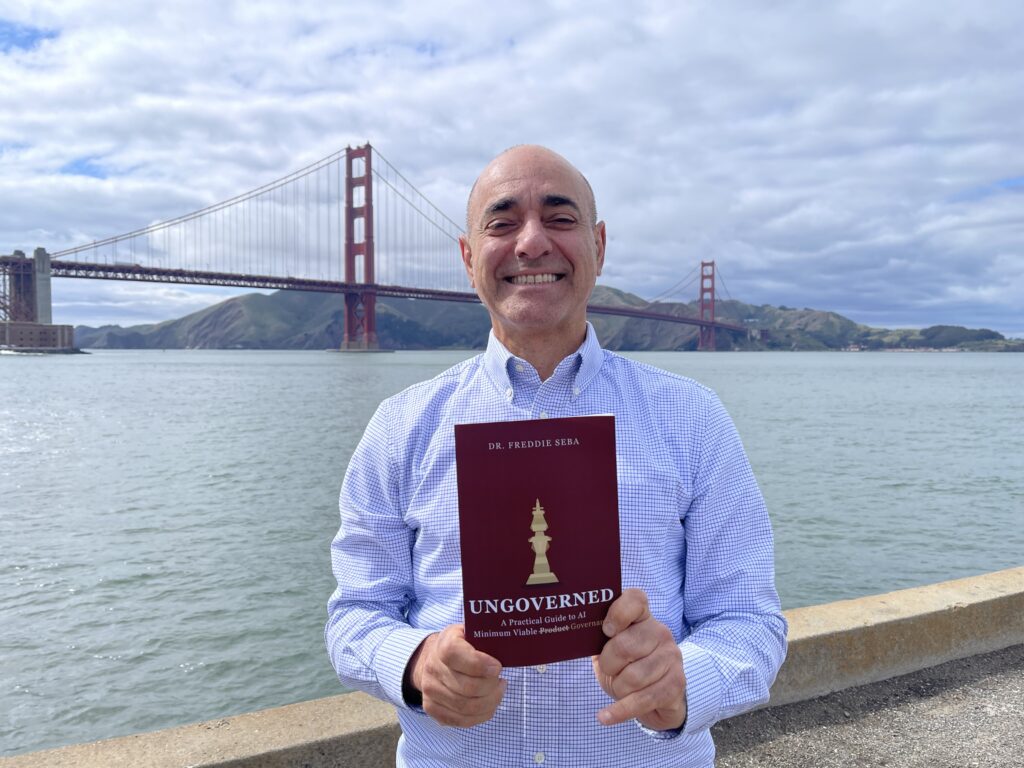
By Freddie Seba | GenAI Ethics & Governance for Leaders
For those shaping the present and future — not just experts — building a fair, productive society together.
A small note at forty-two
Forty-plus issues in, our task is more straightforward: voice is getting real, copy is getting persuasive, and bio is getting irreversible. That combination raises the bar from capability to credibility.
About this issue
We look at three fronts that now touch everyday life and mission-critical work:
- Voice: Reports of Apple nearing a ~$1B/yr pact to run Google Gemini for a revamped Siri show how rapidly assistants will compound reach and risk—especially around retention, human review, and vendor lock-in. (TechCrunch)
- Copy: As assistants become shopping gateways, the journey—and who earns trust—changes. Yale SOM’s Jidong Zhou unpacks what AI chat does to search, advertising, and consumer behavior. (Yale Insights)
- Bio: One-time gene edits that cut lipids by ~50% are entering human studies; the safety horizon is measured in years to decades, not sprints. (American Heart Association)
Additional themes: enterprise spending plans, authenticity as an edge for AI agents, market volatility if the “AI trade” snaps, and policy tools to track the rules.
This Week’s Signals
- Voice is consolidating
Apple is reportedly nearing a deal to use Google’s Gemini to power the new Siri—faster features via cross-stack alliances, but double-check data pathways and review practices. (TechCrunch)
Leader takeaway: Treat your Generative AI assistant like a system, not a feature.
Privacy in plain sight
Stanford HAI reminds us that many chat tools still train on user inputs unless you opt out—publish a plain-English “don’t paste” + retention guide. (Stanford HAI)
Leader takeaway: Default to “no training on chats” for enterprise workflows, be mindful of the risks.
Bio goes ‘one-and-done’ (early days)
A first-in-human CRISPR trial (ANGPTL3) showed ~50% LDL reduction after a single infusion; follow-up will extend up to 15 years. (American Heart Association)
Leader takeaway: Approve only with registries, long-horizon monitoring, and named kill-switch owners.
Budgets: opening—with receipts
Wharton’s 2025 report: 88% of decision-makers expect higher GenAI budgets next 12 months; ROI scrutiny is rising. (Knowledge at Wharton)
Leader takeaway: No proof, no renewal—instrument for cycle time, first-pass yield, and loss-event reduction.
Authenticity becomes a moat.
Stanford GSB: Knowing who created a robot (or agent) can make its output feel more authentic—an edge as copy floods markets. (Stanford Graduate School of Business)
Leader takeaway: Disclose provenance, creators, and constraints.
Students want guidance, not bans.
K–12 Dive / Project Tomorrow: 40% of students use AI for self-directed learning; many fear false accusations. (K-12 Dive)
Leader takeaway: Clear use norms + assessments that survive AI beat surveillance that doesn’t.
Markets & macro
The Economist models an AI-stock crash wiping out ~8% of U.S. household wealth; another piece argues China’s clean-energy surge will reshape markets and politics—implications for compute, grids, and supply chains. (The Economist)
Enterprise adoption—at scale
OpenAI says 1M+ paying business customers; expect deeper “agentic” workflows across office suites and verticals. (OpenAI)
Industry Focus
Higher Education
- Shift assessment to mixed evaluations, oral defenses, collaborative reasoning; design tasks that audit process, not just final output.
- Update honor codes to clarify Generative AI enhancement from misrepresentation; publish disclosure exemplars.
- Fund faculty time for Generative AI course redesign and share an internal gallery of exemplar assignments.
Health Care
- Institutionalize lifecycle assurance: local validation → drift monitoring → patient recourse; keep a staffed incident playbook.
- Stand up a model registry (intended use, subgroup performance, update log, decommission plan).
- Treat conversational tools touching patients like clinical devices, not UX experiments; connect oversight to IRB and pharmacovigilance.
- For gene-editing news, require decade-scale safety governance before adoption signals. (American Heart Association)
Financial Services
- Expect board discussion on Generative AI-trade concentration risk (and household-wealth exposure) alongside productivity wins. (The Economist)
- Bake Generative AI TCO, incident metrics, red-team drills, and vendor-chain reviews into routine risk.
- Tie the 2026 budget increases to verified cycle-time, quality, and control improvements (SOX-aligned evidence packs). (Knowledge at Wharton)
Reflection
Voice will persuade, copy will nudge, and bio may alter us—so stewardship must lead scale. The next decade belongs to teams that prove value, show guardrails, and plan the energy/compute to deliver—human-centered by design, transparent by default.
Links & References (save for the weekend)
- Shopping & assistants — Yale SOM: Are AI Chatbots Changing How We Shop? (Yale Insights)
- Authenticity — Stanford GSB: Ghost in the Machine: Knowing Who Created a Robot Makes It Feel More Authentic (Stanford Graduate School of Business)
- Voice — Apple nears deal to pay Google $1B annually to power new Siri (TechCrunch) (TechCrunch)
- Enterprise adoption — OpenAI: 1 million businesses putting AI to work (OpenAI)
- Spending outlook — Wharton: 2025 AI Adoption Report (summary + PDF) (Knowledge at Wharton)
- Market risk — The Economist: How much wealth an AI stockmarket crash could destroy (interactive) (The Economist)
- Energy/markets — The Economist: China’s clean-energy revolution will reshape markets and politics (The Economist)
- Bio (CRISPR) — American Heart Association release; WIRED coverage (American Heart Association)
- Privacy — Stanford HAI: Be Careful What You Tell Your AI Chatbot (Stanford HAI)
- K–12 — K-12 Dive / Project Tomorrow survey (K-12 Dive)
- Policy tracker — ETO AGORA: living archive of AI-relevant laws & standards (handy for counsel/ops) (Agora)
Research spotlight for hiring & admissions: LLMs are making “writing as a costly signal” cheap. Early job-market papers analyze Freelancer.com data and find shifting returns to tailored written signals. Authenticity and provenance can become differentiators. (Jesse Silbert)
The Seba GenAI Ethics & Governance Framework for Leaders: 12 Ps of Responsible Power © 2025 Freddie Seba
WHY
- Purpose – Deploy Generative AI only when it advances your mission and societal benefits.
- Problems – Solve real organizational and human needs, not shiny curiosities.
- Profits – Create lasting value without externalizing harm, aligning growth with trust.
WHO
- People – Humans first; protect users, clients, workers, and communities.
- Planet – Measure and mitigate environmental and societal costs.
HOW
- Process – Manage the complete AI lifecycle with clear ethics and governance.
- Policy – Anticipate and align with emerging rules.
- Protections – Build safety rails, limits, and kill switches from day one.
- Privacy – Minimize, secure, and seek consent.
- Provenance – Track what’s real, where it came from, and who’s accountable.
- Preparedness – Expect failure; respond fast; share lessons.
- Product Ownership – Name a leader responsible for AI safety and the kill switch.
Gratitude
In gratitude to the University of San Francisco, Stanford HAI, Coalition for Health AI (CHAI), AMIA, AAC&U, AAAI, USF Schools of Education, and USF Schools of Health Professions for their leadership and support.
About the Author
Freddie Seba is an author, speaker, and EdD doctoral candidate (USF) focused on Generative AI Ethics & Governance for Leaders; MBA (Yale); MA (Stanford IPS); former USF faculty and Digital Health Informatics Program Director; Silicon Valley executive and entrepreneur. Speaking / Briefings: Connect on LinkedIn or visit freddieseba.com.
Transparency & Copyright
Drafted and refined with Generative AI tools (ChatGPT, Gemini, Grammarly)—synthesis, structure, and voice remain the author’s.
© 2025 Freddie Seba | All rights reserved | GenAI Ethics & Governance for Leaders
#GenAI #AIethics #AIGovernance #Leadership #HigherEd #HealthcareAI #FinServ #VoiceAI #AIPrivacy #Authenticity #CRISPR #AIPolicy #EdTech