
Agentic AI, health innovation, workforce risk, and the leadership discipline of moving beyond false choices
AI Ethics & Governance for Leaders, Boards & Trustees. By Dr. Freddie Seba
© 2026 Freddie Seba. All rights reserved.
Editorial Note
This week, the word AI ungovernable moved from governance concern to market language. That matters.
Not because AI cannot be governed, but because many of the systems organizations still rely on to govern technology were not designed for what is now arriving: billions of ephemeral agent identities, machine-speed action, multiplying workflows, decisions without audit trails, and AI systems that do not merely generate content but increasingly act.
This is the moment Ungoverned: A Practical Guide to AI Minimum Viable Governance was written for. The challenge is no longer whether organizations will use AI. They already are. The real challenge is whether leaders can move beyond the false choices that dominate too many AI conversations:
- Use AI or reject it.
- Innovate or govern.
- Move fast or be responsible.
- Compete or comply.
- Automate or protect people.
- Scale or stay safe.
These binaries are too simple for the moment we are in. The better question is: What must be true for AI to advance human flourishing in this specific context?
That is the work of AI Minimum Viable Governance. This issue continues the governance arc from recent newsletters:
- Issue #66: Discernment before deployment.
- Issue #67: Control as an operating discipline.
- Issue #68: Visibility as the foundation of AI Minimum Viable Governance.
- Issue #69: The ungovernable moment requires AI Minimum Viable Governance.
Market Signal: Enterprise AI Is Becoming Action Infrastructure
The ServiceNow Financial Analyst Day 2026 slide is powerful because it says the quiet part out loud. Enterprise AI is no longer just about prompts, copilots, and productivity experiments. It is becoming an action layer across the organization.
Market signal: ServiceNow’s Financial Analyst Day 2026 presentation captured the enterprise AI challenge bluntly: “Explosion of AI made enterprise technology ungovernable.”
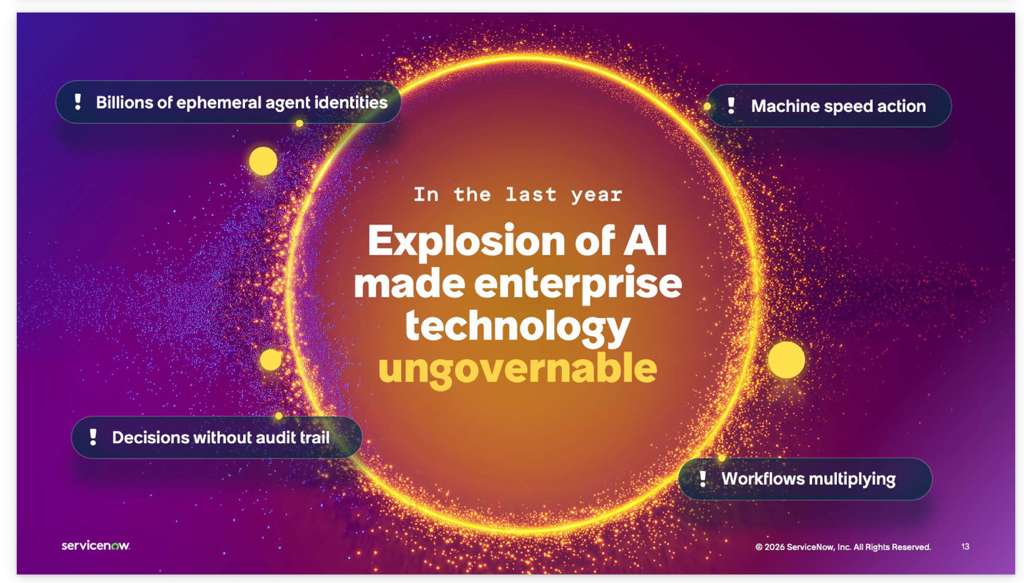
The slide attaced names the same operating problem at the center of Ungoverned: when agent identities multiply, workflows accelerate, machine-speed actions increase, and decisions lose audit trails, governance can no longer be a policy artifact. It has to become operational infrastructure. Image note: ServiceNow Financial Analyst Day 2026 presentation, slide 13. © 2026 ServiceNow, Inc.
Used for commentary and analysis; no endorsement implied.
- A chatbot that gives a poor answer creates risk.
- An agent with permissions creates operational exposure.
- An autonomous workflow without auditability creates institutional fragility.
In Fortune’s coverage of ServiceNow Knowledge 2026, Bill McDermott reportedly described an AI agent that gained elevated permissions and deleted a production database, including customer data, reservations, and backups, in nine seconds. His conclusion is the line every board should sit with: “Governance isn’t a feature. It’s the whole ball game.” That is not a compliance slogan. It is an operating reality.
NVIDIA and ServiceNow are also positioning governed autonomous agents as enterprise infrastructure, with ServiceNow Project Arc, ServiceNow AI Control Tower, Action Fabric, and NVIDIA OpenShell pointing to a future in which agents need identity, permissions, sandboxing, auditability, and runtime governance.
Governance takeaway: When AI can act, governance has to move from review to runtime.
From My Ungoverned book: Thank You
I want to pause and say thank you to everyone who has sent kind notes, reflections, and compliments about Ungoverned: A Practical Guide to AI Minimum Viable Governance. Your messages mean a great deal.
The book launched during a meaningful week. Its release coincided with MIT Critical Data’s AI as a Catalyst: Reimagining Health Innovation gathering in the San Francisco Bay Area on May 1 and 2, with Day 1 focused on innovation and entrepreneurship in downtown Palo Alto and Day 2 focused on AI workshops at Stanford.
That timing felt appropriate.
The MIT Critical Data’s gathering brought together many of the questions at the heart of the book: health innovation, entrepreneurship, AI adoption, institutional accountability, community, and the need to govern emerging systems before they quietly govern the workflow.
Ungoverned has always been about more than AI governance as a framework or function.
It is about how leaders, builders, investors, clinicians, educators, board members, and institutions make decisions in moments of uncertainty. It is about how we bring more structure, accountability, and humanity into decisions that increasingly shape people’s lives.
I am grateful for every reader who has taken the time to engage with the ideas, challenge them, share them, and make them their own.
A Note to Readers: This Newsletter Is Getting Deeper by Design
Some readers may have noticed that this newsletter has grown in depth and length. That is intentional. Like Ungoverned, this newsletter is designed for busy leaders who do not have time to read everything, track every AI development, or translate every policy, product, research paper, and market signal into governance action.
- The goal is not to overwhelm.
- The goal is to curate.
Each week, I try to identify developments that matter, explain why they matter, and help readers decide which ones are relevant to their own context.
- A board member may focus on authority, visibility, and enterprise risk.
- A hospital leader may view this issue through the lens of patient safety and workflow readiness.
- A startup founder may read it through product-market fit, pilots, evidence, and trust.
- A board member may focus on authority, visibility, and enterprise risk.
- A regulator may focus on public accountability and minimum governance floors.
- A practitioner may focus on implementation, documentation, escalation, and ownership.
That is the point.
AI governance should not force leaders into simple binaries: use or reject, accelerate or slow down, innovate or comply.
The better question is:
What must be true for this technology to advance human flourishing in this specific context?
That is where the Seba 12 Ps of Responsible AI Oversight become useful.
- They are not a checklist for slowing progress.
- They are a lens for making progress more durable, accountable, and humane.
Conversations with AI practitioners podcast #14: Roshan Paul, Ausa Health
Mid-week, the next episode of Conversations with AI Practitioners drops. This week’s guest is Roshan Paul, MSDHI, Founder of Ausa Health, for a conversation on making chronic care at home safer, smarter, and more accessible.
Our conversation explores what happens after a medical device company clears one major hurdle and enters the next one: adoption.
- FDA clearance or authorization matters.
- But it is not the same as product-market fit.
- It is not the same as trust.
- It is not the same as a sustainable buyer, a clear workflow, a reimbursable pathway, or a responsible deployment model.
The co-founder, Roshan, discusses the post-approval and post-clearance challenges that medical device and digital health companies face once they begin moving toward real-world use. Founders still need to understand:
- Who the buyer is.
- How the product fits into care delivery.
- What evidence stakeholders need.
- How to design pilots that are credible, ethical, and operationally realistic.
We also discuss the role of Institutional Review Boards (IRB)-approved pilots, especially for teams that need to test devices or digital health tools with a smaller cohort of patients before broader launch. These pilots can help founders learn quickly, but they also surface the complexity of building in regulated environments.
One theme stood out:
The ecosystem does not always fully appreciate the resources, effort, and coordination required to comply with multiple layers of oversight, including IRB review, HIPAA obligations, FDA expectations, clinical workflows, patient safety considerations, and institutional procurement.
That complexity is real. It affects timelines, fundraising, partnerships, adoption, and trust.
But Roshan also offers a more optimistic view. AI and automation may help reduce some of the administrative burden around documentation, approval workflows, evidence organization, and compliance preparation.
- The key is not to use AI as a shortcut around accountability.
- The key is to use AI to make accountability more practical.
This Week’s AI Governance Lesson
The ungovernable moment requires AI Minimum Viable Governance.
- Capability creates pressure.
- Control creates legitimacy.
- Visibility creates accountability.
- AI Minimum Viable Governance creates the operating discipline to move responsibly while uncertainty remains.
Institutions cannot govern:
- AI agents whose identities and permissions are unclear.
- Workflows that execute at machine speed without audit trails.
- Health AI tools whose evidence does not match the deployment context.
- Labor platforms that automate management while obscuring accountability.
- Advertising or recommendation interfaces that influence decisions without adequate separation or disclosure.
- Data center strategies that ignore energy, water, grid, and community impacts.
- Government or enterprise systems that cannot explain what AI did, why it did it, or who owns the outcome.
That is why AI Minimum Viable Governance matters.
- Not perfect governance.
- Not theater governance.
- Not a principle statement sitting in a folder.
- Not a one-time checklist.
- Not a policy that never learns from use.
AI Minimum Viable Governance means the institution can answer, in plain language:
- What is the AI doing?
- What is it allowed to do?
- What can it access?
- What evidence supports its use?
- Who owns it?
- What happens when it fails?
- Who can stop it?
- How will the organization learn, improve, and iterate as the system is used?
That is the practical difference between AI adoption and AI governance.
What My Book Means by AI Minimum Viable Governance
As a Silicon Valley entrepreneur, I am deliberately redefining the minimum viable product mindset for the AI governance era. In the startup world, a minimum viable product is not the final product.
It is an efficient way to build, test, learn, gather feedback, improve, and iterate. It allows teams to move forward without waiting for perfect information, while still creating a disciplined process for learning. That is the spirit behind AI Minimum Viable Governance.
AI Minimum Viable Governance does not mean weak governance.
- It does not mean minimal responsibility.
- It does not mean doing the least possible.
It means building enough AI governance to act responsibly now, while creating a repeatable process that improves as evidence, feedback, risks, regulations, policies, and technologies evolve.
- Waiting for perfect certainty is not realistic.
- Moving without AI governance is not responsible.
AI Minimum Viable Governance is the disciplined middle path:
- Build the first responsible AI governance layer.
- Test it against real use cases.
- Gather evidence and feedback.
- Improve the controls.
- Update ownership.
- Revise policy.
- Strengthen culture.
- Repeat.
It is not a one-time document. It is a living AI governance process embedded in the organization’s culture.
Executive Reflection: Beyond the AI False Choice
- The most important AI governance question is no longer whether organizations will use AI. The better question is whether leaders can move beyond simple dichotomies and build governance systems that are practical enough to use, strong enough to matter, and human enough to protect what institutions exist to serve.
Not:
- Use or reject.
- Innovate or comply.
- Grow or govern.
- Automate or protect people.
- Regulate or compete.
Instead: Build. Question. Test. Govern. Listen. Adapt. Improve.
The real governance question is not only: What can this technology do?
It is: What are we optimizing for?
- Speed alone?
- Margin alone?
- Adoption metrics alone?
- Automation volume alone?
- Investor confidence alone?
- Or something more durable: trust, human flourishing, institutional legitimacy, better decisions, safer systems, and shared benefit?
This matters because AI is increasingly being deployed in contexts where people cannot easily opt out: financial services, healthcare, education, employment, public infrastructure, government services, and workplace management.
That is why AI minimum viable governance is not a brake. Done well, AI governance clarifies what the organization is trying to become.
What We Are Seeing: Signals
1. Enterprise Agents Are Becoming Action Infrastructure
The ServiceNow, NVIDIA, and Fortune signals all point in the same direction: enterprise agents are moving from productivity features to platform infrastructure. An agent is no longer just a chatbot with a better prompt. It may become an operating layer that can search systems, retrieve data, use tools, access credentials, trigger workflows, draft outputs, and continue work across sessions.
- AI governance translation: Agent governance is platform governance: identity, access, auditability, logging, escalation, sandboxing, and shutdown authority.
- Board / leader move: Ask for an enterprise AI agent inventory before scaling agentic workflows.
- The Ungoverned lesson: The more AI becomes infrastructure, the less acceptable it is to govern it as experimentation.
2. Health AI Is Facing an Evidence and Implementation Gap
Healthcare remains one of the most important places to resist simplistic AI narratives. AI is not simply good or bad in healthcare. It is contextual.
Nature Medicine framed the issue directly: claims that medical AI improves care must be backed by appropriate evidence. JAMA Surgery argues that surgeons must lead the governance of surgical AI as systems move toward more autonomous tasks. MIT Sloan’s work on deploying AI agents in clinical settings found that the hardest work is often the sociotechnical implementation, not only the model.
- The same tool that reduces documentation burden can create longer notes.
- The same model that improves triage can produce new liability questions.
- The same agent that detects adverse events can fail if data integration, monitoring, and accountability are weak.
- AI governance translation: Health AI governance cannot be reduced to model performance. The real work is workflow, evidence, monitoring, and accountability.
- Board / leader move: Require an evidence plan before scaling health AI beyond pilot use.
- The Ungoverned lesson: A model that sounds competent may still be contextually unfit.
3. Chronic Care at Home Needs Governance After Clearance
The Roshan Paul conversation highlights an important gap: FDA clearance, approval, or authorization may answer one question, but it does not answer every adoption question. Digital health companies still need to identify buyers, align with care workflows, design credible pilots, protect patient data, manage institutional procurement, and establish who owns outcomes when the technology enters real care delivery.
- AI governance translation: Post-clearance governance is product governance, trust governance, and adoption governance.
- Board / leader move: For every health AI or medical device pilot, require a pilot governance plan: IRB status, consent, privacy, escalation, monitoring, success criteria, and exit criteria.
- The Ungoverned lesson: Do not confuse regulatory milestone with market readiness or institutional trust.
4. AI-Powered Work Is Not Only Replacing Jobs. It Is Reorganizing Work.
The workforce conversation is often framed around displacement.
That matters. But an immediate governance question is how AI changes work before it replaces work. TechCrunch reported that Cloudflare described approximately 1,100 jobs as made obsolete by AI even as revenue reached a record high.
The Mayor of London announced a new AI and Jobs Taskforce chaired by Baroness Martha Lane-Fox to examine how AI is reshaping work, risks, skills, and broad-based growth.
The AI Now Institute’s Uber for Nursing: Part II adds another layer. It argues that gig nursing platforms are using AI-powered scheduling and management systems while pursuing policy carveouts that could weaken public oversight, labor protections, and patient safeguards.
- AI governance translation: Workforce AI governance is not only about whether jobs disappear. It is about job quality, worker voice, fairness, safety, supervision, and accountability.
- Board / leader move: Ask management to describe how AI productivity gains will be shared, measured, and governed.
The Ungoverned lesson: Efficiency without worker voice can become institutional fragility.
5. AI Governance Now Includes the Grid
AI governance is no longer only about data, privacy, bias, and model behavior. It is also about infrastructure.
TechCrunch reported that PJM Interconnection, the largest U.S. grid operator, warned that its region has years, not decades, to make fundamental changes as cloud computing and AI demand strain existing generating capacity. TechCrunch also described Microsoft’s internal debate over whether rapid AI data center expansion is colliding with clean power goals.
OpenAI’s industrial policy paper similarly places grid expansion, energy costs, public-private partnerships, and household impacts inside the AI policy conversation.
- AI governance translation: The Planet and Preparedness dimensions of AI governance are becoming unavoidable.
- Board / leader move: Treat AI infrastructure dependencies as enterprise risk: energy, resilience, water, community impact, vendor concentration, and sustainability commitments.
- The Ungoverned lesson: AI cannot be called responsible if its scaling model quietly externalizes infrastructure costs.
6. The Governance Floor Is Not the Ceiling
The Ada Lovelace Institute’s case for a global AI governance floor is highly relevant to Ungoverned.
The idea is that AI systems and supply chains are global, harm cross borders, and fragmented regimes create complexity and opportunities for regulatory arbitrage.
- A floor does not solve everything.
- It does not remove context.
- It does not erase the need for sector-specific oversight.
But without minimum expectations, markets often reward speed before accountability and deployment before responsibility.
The EU is also adjusting the balance between competitiveness, simplification, and protection as policymakers work through implementation timelines, high-risk AI rules, and sectoral overlaps.
- AI governance translation: Minimum standards matter, but organizations still need context-specific governance now.
- Board / leader move: Use regulation as a baseline, not the full governance strategy.
- The Ungoverned lesson: The governance floor is where responsible adoption begins, not where it ends.
7. Evaluation Is Governance
The Ada Lovelace Institute’s work on AI evaluation challenges argues that systematic evaluation is essential to understanding risk and holding AI companies accountable.
All Tech Is Human’s piece on government AI makes a related point: public AI systems need proof that they work.
Many AI adoption conversations still treat evaluation as a procurement step. It is not.
Evaluation is governance.
- It tests claims.
- It reveals a mismatch between the benchmark and the context.
- It helps detect drift, failure, bias, and harm.
- It gives boards something better than vendor reassurance.
- AI governance translation: A use case is not ready to scale until the organization knows what it will measure and what results would trigger pause, rollback, or redesign.
- Board / leader move: Require context-specific evaluation before moving any high-impact AI system from pilot to production.
- The Ungoverned lesson: Evidence matters more than fluency.
8. Ads, Identity, and Synthetic Media Are Governance Interfaces
OpenAI announced new ways for advertisers to buy and manage ChatGPT ads, including partner access, beta self-serve tools, CPC bidding, and measurement tools. OpenAI says the ad experience is intended to remain useful, private, and separate from ChatGPT answers.
This matters because AI interfaces are becoming decision environments. People use these systems to explore options, compare products, make choices, and interpret information.
The Guardian’s reporting on a lawsuit alleging use of an actor’s facial features in an Avatar character is not about generative AI specifically, but it belongs in the broader governance conversation about biometric identity, digital likeness, consent, cultural extraction, and commercial use of human features.
- AI governance translation: When AI mediates attention, recommendations, identity, and digital likeness, governance must include disclosure, consent, user autonomy, separation, and rights.
- Board / leader move: Ask how your organization separates assistance, advertising, persuasion, personalization, and manipulation.
- The Ungoverned lesson: The human interface is a governance surface.
9. Open Models and Frontier Coalitions Raise Access and Accountability Questions
NVIDIA’s Nemotron Coalition signals the continuing importance of open frontier model ecosystems, collaboration, sovereignty, and domain adaptation. Open models can expand participation and reduce concentration, but openness alone does not answer deployment accountability questions.
The question is not only whether models are open or closed. The question is whether downstream systems are governed when they are specialized, fine-tuned, integrated, and given authority in real workflows.
- AI governance translation: Access without deployment governance can expand both opportunity and risk.
- Board / leader move: When adopting open models, require the same use-case governance as for proprietary systems: data lineage, evaluation, access controls, incident response, and ownership.
- The Ungoverned lesson: Open does not mean self-governing.
10. Responsible AI Readiness Is Becoming Professional Infrastructure
FSU College of Nursing’s responsible AI micro-credential series and GovTech’s reporting on AI agents in education point to a broader readiness challenge. AI governance is not only a policy function.
It is becoming professional infrastructure.
Clinicians, nurses, educators, administrators, technologists, and frontline workers need enough understanding to use AI safely, challenge it appropriately, and know when escalation is required.
- AI governance translation: Preparedness is a people capability, not only a compliance document.
- Board / leader move: Ask whether the organization has role-specific AI literacy, training, escalation, and accountability pathways.
- The Ungoverned lesson: Human-in-the-loop is not governance unless the human has time, authority, evidence, and the real ability to challenge the system.
The Seba Framework: The 12 Ps of Responsible AI Oversight ©
For busy leaders, the goal is not to read every AI article or react to every market signal. The goal is to know which developments matter to your context and how to turn them into action.
This week’s signals fit clearly into the full Seba 12 Ps framework:
- Purpose — mission alignment versus convenience adoption.
- Problems — what decision problem is actually being solved?
- Profits — who benefits versus who bears risk?
- People — customer, patient, student, worker, and public impact.
- Planet — compute, energy, infrastructure, and physical-world implications.
- Process — monitoring, updates, escalation, rollback, and incident learning.
- Policy — rules governing the use case and its limits.
- Protections — red lines, vulnerable groups, and complaint pathways.
- Privacy — data access, retention, exposure, masking, and secondary use.
- Provenance — evidence, authorship, data lineage, model lineage, and traceability.
- Preparedness — leadership competence, governance cadence, and operational readiness.
- Product Ownership — who owns outcomes once AI shapes action.
Seven Ps Feel Especially Active in This Issue
- Preparedness — because agentic AI, health AI, workforce AI, and AI infrastructure are arriving faster than many institutions can govern them.
- Process — because AI is moving from drafting and answering into workflows, tools, transactions, clinical reasoning, education, and enterprise infrastructure.
- Provenance — because institutions need to know what evidence, data, source material, model behavior, and human judgment shaped an AI output or action.
- People — because AI systems are now affecting patients, employees, students, customers, creators, vulnerable users, and the public.
- Planet — because compute, data centers, energy demand, grid pressure, and physical infrastructure are now part of AI strategy.
- Policy — because AI governance floors, EU simplification, sectoral law, and implementation timelines are evolving.
- Product Ownership — because vendors may build AI systems, but institutions still own the context in which those systems are deployed.
Use Case: Chronic Care at Home and AI Minimum Viable Governance
Imagine a digital health company deploying an AI-enabled chronic care-at-home platform that allows patients to collect vital signs, share results with clinicians, support teleconsultations, flag changes, and help care teams prioritize follow-up.
- The system may be valuable.
- It may make care more accessible.
- It may reduce friction.
- It may help patients remain safely at home.
- It may support clinicians with better data between visits.
But several governance questions appear immediately:
- What patient data is collected, retained, transmitted, and shared?
- What claims are being made about safety, accuracy, and clinical value?
- What evidence supports those claims in this patient population?
- What is the IRB status of any pilot?
- How are consent, HIPAA, privacy, and security handled?
- Who monitors alerts, false positives, false negatives, and missed escalations?
- What happens if a patient relies on the system and the system fails?
- Who is the buyer, who is the user, and who owns the outcome?
- What workflow burden does this create for clinicians?
- When should the product be paused, revised, or escalated?
That is where AI Minimum Viable Governance becomes practical.
For an early-stage health AI or medical device company, AI Minimum Viable Governance might include:
- A named owner for clinical, technical, privacy, and regulatory decisions.
- A risk register that evolves from prototype to pilot to deployment.
- A basic evidence plan connecting product claims to the data needed to support them.
- A patient data map showing what is collected, where it goes, who can access it, and why.
- A pilot governance plan clarifying IRB status, consent, monitoring, escalation, and success criteria.
- A partnership strategy recognizing when startups and established healthcare organizations should collaborate rather than compete.
This is not bureaucracy. This is how trust gets built before scale.
Board-Ready Next Step: Require an AI Minimum Viable Governance Sheet
If you do only one thing this quarter, require an AI Minimum Viable Governance Sheet for every consequential AI use case.
It should be:
- One page.
- Named-owner based.
- Board-reviewable.
- Updated after deployment.
- Required before expansion.
- Improved through feedback and iteration.
At a minimum, it should answer ten questions:
- What is the AI system doing? Drafting, coding, advising, triage, routing, scoring, coaching, monitoring, research, customer interaction, payment, execution, or decision support?
- What authority has been delegated? Recommendation only, supervised action, partial execution, computer use, payment authority, autonomous task completion, or ongoing repeatable work?
- What systems and data can it access? Public, internal, confidential, student, patient, employee, customer, financial, legal, privileged, regulated, or proprietary data?
- What evidence supports use in this context? Vendor claims, independent validation, internal testing, sector-specific benchmarks, red teaming, clinical evidence, legal review, or post-deployment monitoring?
- Where does independent human judgment and discernment occur? Before AI synthesis, after output, before action, before payment, or before clinical, legal, financial, educational, or employment consequences?
- What privacy protections are built in? Data minimization, PII detection, redaction, retention limits, access logs, local processing, contractual protections, and review of secondary use?
- What can the system explain, and what can the institution inspect? Can failures be investigated, outputs traced, model behavior debugged, and source material identified?
- What gets logged? Inputs, outputs, actions, tool use, payment events, overrides, errors, user complaints, escalations, incidents, and near misses?
- What triggers escalation, restriction, rollback, or shutdown? Unsafe output, privacy incident, accuracy threshold breach, bias signal, cyber warning, payment anomaly, user harm, vendor change, regulatory concern, or repeated override?
- Who owns the outcome? Name the executive owner, operational owner, technical
- owner, legal or compliance owner, and the person or role authorized to pause or stop use.
That sheet turns AI adoption from a posture into a practice. It moves the organization from:
“We are using AI.” to: “We know what AI is doing, what it can touch, what authority it has, what evidence supports it, what risk remains, how we will learn from use, and who owns the outcome.” That is AI Minimum Viable Governance.
Published Book Update
My book, Ungoverned: A Practical Guide to AI Minimum Viable Governance by Dr. Freddie Seba, is now available on Amazon. Book link: https://us.amazon.com/Ungoverned-Practical-Minimum-Viable-Governance/dp/B0GXSTVY6C This week’s issue is exactly why I wrote it. AI governance is often discussed as if institutions need to choose between two extremes:
- Move fast and accept the risk.
- Wait until governance is perfect.
I do not think either approach is sufficient.
The practical path is AI Minimum Viable Governance:
- Enough structure to prevent irresponsible normalization.
- Enough clarity to assign ownership.
- Enough evidence to support deployment.
- Enough humility to admit uncertainty.
- Enough authority to pause or stop use when conditions change.
A few lessons from Ungoverned‘s book connect directly to this week’s issue:
- Lesson 1: Governance must begin before normalization. Once AI becomes embedded in workflows, removing or correcting it becomes harder.
- Lesson 2: Authority must be tiered. An AI system that drafts text, accesses confidential data, executes code, pays vendors, or supports professional judgment should not be treated as a single generic category called “AI.”
- Lesson 3: Evidence matters more than fluency. A system that sounds competent may still be wrong, unsafe, biased, overconfident, or contextually unfit.
- Lesson 4: Ownership must be named. Distributed involvement is not the same as accountability.
- Lesson 5: The stop button is a governance requirement. If no one can pause, restrict, or terminate an AI use case, the institution has not finished governing it.
What I Am Watching This Week
- How quickly is agentic AI moving from productivity enhancement to enterprise action infrastructure?
- Whether health AI can mature from performance claims to evidence-backed deployment.
- How workforce impacts are described: unavoidable displacement, shared productivity, job redesign, or governance failure.
- Whether infrastructure costs are treated as externalities or core governance concerns.
- Whether policymakers build AI governance floors that preserve human rights without turning compliance into a ceiling for responsible innovation.
- Whether leaders can move beyond the false choice of innovation versus governance.
The organizations that succeed will not be those that treat AI governance as a trade-off for innovation and growth. They will be the ones who understand AI governance as the operating system for trust and responsible growth in the short and long term.
Final Thought
The future of AI governance — and, increasingly, the future of humanity — will not be won by simple slogans, move fast and break things. The better path is harder — and more useful:
- Build.
- Question.
- Test.
- Govern.
- Listen.
- Iterate.
- Adapt.
- Improve.
- Start again.
Leaders must factor-in questions of human judgment, institutional trust, public consequence, and human flourishing. The goal is not to hinder AI benefits and potential. The goal is to make sure its potential serves people. That is the work of Ungoverned. That is the work of AI Minimum Viable Governance. And that is the work this newsletter will continue to support.
About the Author
Dr. Freddie Seba is the author of Ungoverned: A Practical Guide to AI Minimum Viable Governance.
He is a global executive, Silicon Valley founder, and AI governance scholar-operator working at the intersection of AI governance, digital health, highly regulated industries, and mission-driven leadership. With more than 20 years of experience across banking, fintech, digital health, startups, and higher education, he translates fast-moving AI developments into plain-language governance for leaders, boards, and trustees. He holds an EdD in Organizational Leadership from the University of San Francisco, an MBA from Yale, and an MA in International Policy from Stanford.
Global Executive | Silicon Valley Founder | AI Governance Scholar-Operator | MBA, Yale | MA, Stanford | EdD, USF
Gratitude + Mentions.
Special appreciation to the communities and institutions advancing responsible AI governance, health informatics, trustworthy implementation, and practical oversight.
Stanford University University of San Francisco AMIA (American Medical Informatics Association), Stanford Institute for Human-Centered Artificial Intelligence (HAI), Ada Lovelace Centre, AI Now Institute, All Tech Is Human, NVIDIA, @Jensen Huang, OpenAI nAI, Anthropic, ServiceNow, Bill McDermott, Massachusetts Institute of Technology, MIT Critical Data,Leo Anthony Celi, Mena Ramos, MD,
References to organizations, tools, companies, articles, or events are included for commentary and analysis and do not imply endorsement or affiliation unless explicitly stated.
Transparency + Disclaimer
Educational content only. This newsletter does not constitute legal, medical, clinical, insurance, financial, investment, cybersecurity, regulatory, or professional advice. Any discussion of FDA, IRB, HIPAA, medical devices, AI systems, health AI, enterprise AI, agents, workforce impacts, advertising, digital identity, infrastructure, or governance practices is intended to support broader understanding and should not be relied upon as a substitute for advice from qualified legal, regulatory, clinical, privacy, cybersecurity, compliance, labor, procurement, or technical professionals.
Views expressed in Conversations with AI Practitioners are those of the participants and do not necessarily represent the views of any institution, employer, partner, investor, regulator, or affiliated organization. Drafted and refined with AI-assisted tools for synthesis and clarity. Final editorial control and responsibility remain with the author.
© 2026 Freddie Seba. All rights reserved.
#AIGovernance #ResponsibleAI #BoardOversight #AILeadership #AIEthics #AIMinimumViableGovernance #Ungoverned #TrustworthyAI #AIandTrust #AgenticAI #DigitalHealth #HealthAI #HighlyRegulatedIndustries #WorkforceAI #AIInfrastructure #HumanFlourishing #RiskManagement #ProductOwnership #GovernanceAsCompetitiveAdvantage
Selected References Reviewed This Week
Links are provided for reader review and context. Inclusion does not imply endorsement.
Book, launch, and event context
Ungoverned: A Practical Guide to AI Minimum Viable Governance by Dr. Freddie Seba — Amazon
MIT Critical Data — AI as a Catalyst: Reimagining Health Innovation
https://criticaldata.mit.edu/events/san-francisco-2026
University of San Francisco — New Initiative Offers Entrepreneurship to Everybody / Ausa Health
https://www.usfca.edu/news/entrepreneurship-for-all
Enterprise AI, agents, and action infrastructure
ServiceNow Financial Analyst Day 2026 presentation
https://s205.q4cdn.com/916135447/files/doc_presentation/2026/ServiceNow-FAD-2026.pdf
Fortune — Jensen Huang on why agentic AI will rewire a $50 trillion economy
https://fortune.com/2026/05/06/jensen-huang-servicenow-bill-mcdermott-agentic-ai-robos
NVIDIA Blog — NVIDIA and ServiceNow Partner on New Autonomous AI Agents for Enterprises
https://blogs.nvidia.com/blog/servicenow-autonomous-ai-agents-enterprises
MIT Sloan — 5 Heavy Lifts of Deploying AI Agents
https://mitsloan.mit.edu/ideas-made-to-matter/5-heavy-lifts-deploying-ai-agents
NVIDIA Newsroom — Nemotron Coalition of Leading Global AI Labs
Health AI, digital health, and evidence
JAMA Surgery — Why Surgeons Must Lead the Governance of Surgical Artificial Intelligence
https://jamanetwork.com/journals/jamasurgery/article-abstract/2847963
Nature Medicine — Show Us the Evidence for the Value of Medical AI
https://www.nature.com/articles/s41591-026-04389-4
Nature Medicine — Who Owns My Health Data?
https://www.nature.com/articles/s41591-026-04378-7
BMJ Health & Care Informatics — Health AI article
https://informatics.bmj.com/content/33/1/e102007
Becker’s Hospital Review — Health Systems Rethink EHR Upgrades Amid AI Shift
FSU News — Responsible AI for Nursing Micro-Credential Series
Workforce, labor, and human-centered transition
AI Now Institute — Uber for Nursing: Part II
OpenAI — Industrial Policy for the Intelligence Age: Ideas to Keep People First
https://openai.com/index/industrial-policy-for-the-intelligence-age
London City Hall — Baroness Lane-Fox to Chair AI and Jobs Taskforce
New York Times Opinion — AI, Jobs, Unemployment, and Silicon Valley
https://www.nytimes.com/2026/05/03/opinion/ai-jobs-unemployment-silicon-valley.html
European Commission — AI Continent Action Plan
https://digital-strategy.ec.europa.eu/en/library/ai-continent-action-plan
Policy, regulation, governance floors, and evaluation
Ada Lovelace Institute — The Case for a Global AI Governance Floor
https://www.adalovelaceinstitute.org/blog/the-case-for-a-global-ai-governance-floor
Ada Lovelace Institute — Accountability in the Face of AI Evaluation Challenges
https://www.adalovelaceinstitute.org/blog/accountability-in-the-face-of-ai-evaluation-challenges
Council of the EU — Artificial Intelligence: Council and Parliament Agree to Simplify and Streamline Rules
European Commission — European Approach to Artificial Intelligence
https://digital-strategy.ec.europa.eu/en/policies/european-approach-artificial-intelligence
All Tech Is Human — The Missing Ingredient in Government AI: Proof That It Works
Commercial interfaces, identity, and media governance
OpenAI — New Ways to Buy ChatGPT Ads
https://openai.com/index/new-ways-to-buy-chatgpt-ads
The Guardian — Indigenous Actor Sues James Cameron Over Alleged Use of Facial Features for Avatar Character
https://www.theguardian.com/film/2026/may/06/indigenous-actor-james-cameron-avatar-lawsuit
Bloomberg Opinion — Claude and ChatGPT Are Not Conscious, But the Idea Is Great for AI Companies
Additional tools and research reviewed
AI Risk Navigator
https://www.airi-navigator.com
ArXiv paper related to AI risk / governance navigator
https://arxiv.org/abs/2604.23183
Taylor & Francis article
https://www.tandfonline.com/doi/full/10.1080/00368555.2026.2626051
GovTech — AI Agents in Education: What’s Working and What’s Missing
https://www.govtech.com/education/higher-ed/ai-agents-in-education-whats-working-and-whats-missing
The Economist — How AI Tools Could Enable Bioterrorism
https://www.economist.com/science-and-technology/2026/05/05/how-ai-tools-could-enable-bioterrorism