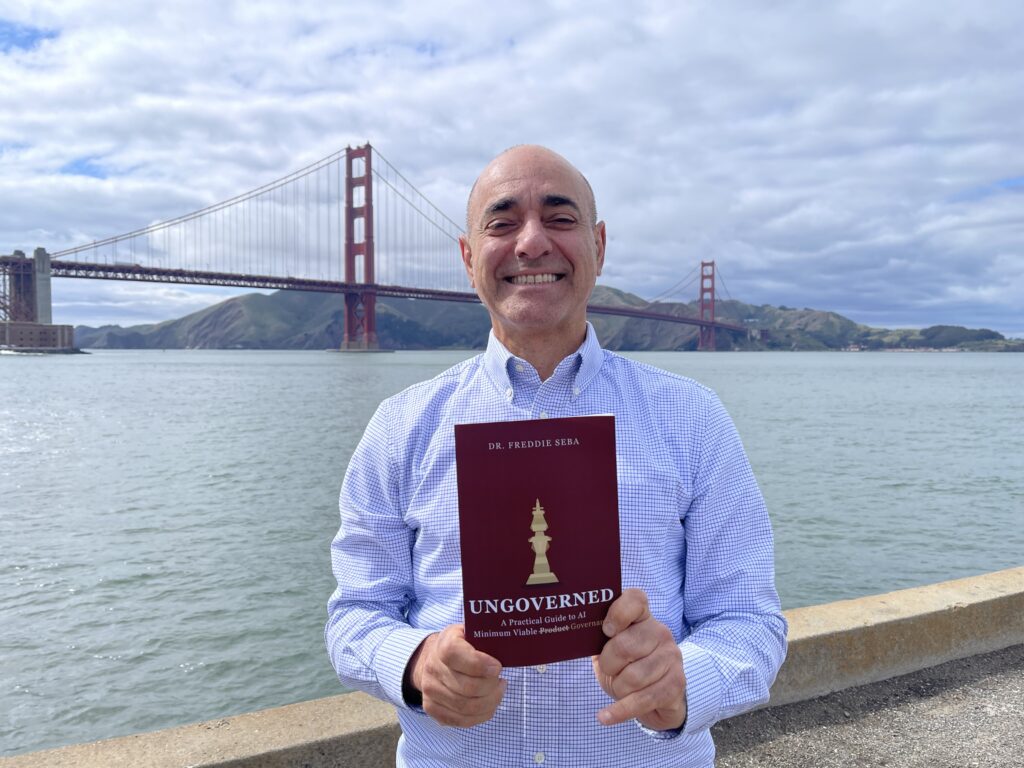
Ungoverned: AI Ethics and Governance for Leaders, Boards and Trustees By Dr. Freddie Seba
© 2026 Freddie Seba. All rights reserved.
AI helps the students who least need it — and quietly sets back the ones who need it most. That is this week’s clearest evidence, and it is a warning for every institution deploying AI. New data show that when students use AI, those who already know how to think pull ahead, and those who reach for the answer before thinking fall behind.
An old pattern underlies this. The assignment was never about the essay — it was the artifact we built to produce thinking, the way a medieval city built walls to produce safety. When technology outruns the artifact, we face a choice we rarely make consciously: the walls no longer stop the cannon, and AI can now produce the essay without the thinking — yet we keep the artifact, because it defines what learning, or safety, or judgment means to us. The danger is keeping the wall and losing what it was for. That is the governance question this week hands every institution, and it is one I argue at length in my book and doctoral research.
The pattern is not confined to classrooms. The capital markets are financializing AI compute at an unprecedented scale, concentrating ownership of the infrastructure everyone else must rent. Hospitals are deploying autonomous tools faster than they can govern them. The same question runs underneath it all: when AI does the work — the thinking, the drafting, the diagnosing, the deciding — who actually learns, who actually benefits, and who is accountable when the shortcut becomes the harm? This issue reads that divergence through the Seba 12 Ps.
THIS ISSUE IN 60 SECONDS
A note on balance: this week’s evidence is unusually concentrated in education — the domain of my book and doctoral research — so I read it deliberately as a lens on every sector, not only schools. We reviewed roughly 55 sources this week — peer-reviewed learning studies, education reporting, lab and vendor disclosures, capital-markets filings, hospital governance reporting, and international policy. The signals converge on one pattern: AI is now doing the cognitive work — tutoring, drafting, diagnosing, deciding — and the benefit is splitting sharply between those equipped to use it well and those it quietly displaces.
The anchor is education. New evidence finds AI adoption among students has reached near-saturation — 94% in Britain, 93% in Germany — yet the learning effect divides along a single line: students who use AI as a tutor to work through hard concepts hold their results; students who use it to skip the thinking lose ground. Around that anchor sit the same dynamics elsewhere: an unprecedented $500 billion push to turn AI compute into an investable asset class, healthcare systems deploying autonomous tools ahead of full visibility, and a research record increasingly polluted by AI-enabled fraud. The governance question is the one my book keeps returning to: AI is already inside your institution — the real work is deciding who is accountable for what it does, and who it leaves behind.
ONE ACTION
Before deploying any AI system that does cognitive work on behalf of your people — tutoring, drafting, diagnosing, analyzing — decide who it is likely to help, who it is likely to leave behind, and who is accountable for closing that gap rather than widening it. A tool that benefits only those already equipped to use it well is not a democratizing tool. It is an inequality engine with good marketing.
ONE SENTENCE FOR YOUR BOARD
AI now does the thinking inside your institution—for students, clinicians, analysts, and staff—and governance means deciding who learns and benefits from it, who is left behind, and who is accountable for the difference, before the gap becomes structural.
Q&A FOR YOUR BOARD
Q: Does AI close the skills gap or widen it? A: The evidence this week says widen. AI amplifies the students, analysts, and institutions already equipped to direct it well, and disadvantages those without the scaffolding. Left ungoverned, it concentrates advantage rather than distributing it.
Q: Is “we disclosed AI use” the same as “we governed it”? A: No. Disclosure is the floor. Governance is naming who the tool helps, who it harms, and who is accountable for the gap — before the gap becomes structural.
Q: What is the single question that tests whether we govern our AI? A: For every AI system doing cognitive work in our institution, can we name the human accountable not for its performance, but for who it leaves behind? If not, we are deploying a tool that divides, and calling it progress.
AI GOVERNANCE AS LEADERSHIP
For eighty-four weeks, this newsletter has held one argument: AI governance is a leadership discipline, exercised deliberately, not a compliance function bolted on afterward. This week clarifies why it is also a question of equity. When AI does the cognitive work, it does not distribute its benefits evenly. It amplifies the capabilities of those already equipped — the student with a parent to guide how they use the tutor, the analyst who knows which answer to trust, the hospital with the governance to deploy safely — and it quietly disadvantages those without that scaffolding.
The deeper truth, which I argue in Ungoverned and my doctoral research, is that AI is already inside your institution, whether leadership planned for it or not. Students are using it. Clinicians are using it. Analysts and staff are using it — often before any policy exists. This is where AI Minimum Viable Governance earns its place. AI-MVG is not a ceiling; it is the defensible set of capacities every leader should have in place for any system doing cognitive work — a named owner, a who-benefits assessment, and a stop mechanism — established before scale, not after the divide. The Seba 12 Ps of Responsible Oversight Framework are how you apply that discipline to what is already there: not a gate you pass before adoption, but the questions you use to lead the AI already inside the institution — and, this week especially, to ask who it is helping and who it is leaving behind. Governance as Leadership means refusing to let a tool that could close a gap widen it instead, because no one was named to answer for the difference.
THE SEBA 12 Ps OF RESPONSIBLE OVERSIGHT FRAMEWORK: WHO LEARNS WHEN AI DOES THE THINKING
Not every P surfaces this week. The Ps are the fixed lens; these are the signals the week illuminates. The sector tags each it surfaced in, because the pattern is the same across all of them.
PEOPLE — Education: The Learning Divide
The anchor evidence is unambiguous about adoption and sharp about effect. Student AI use has reached near-saturation — 94% in Britain, 93% in Germany. But learning outcomes split along how the tool is used. The drop in exam scores was concentrated among students who rushed their homework; those who used AI but spent as long on assignments as non-users paid little penalty. The students who held their results were not copying and pasting—they used chatbots as a personal tutor to explain difficult concepts and work through problems. A corroborating study from Middlebury College (Vermont, USA) found students who learned an unfamiliar topic with a chatbot scored higher on tests, with the advantage persisting a week later. The evidence points one way: AI boosts learning productivity, but only for those who use it intelligently — and the students most likely to use it that way are those with the parents, tutors, and scaffolding to be taught how. People governance means an institution decides who its AI is equipping and who it is quietly leaving behind — before the gap becomes structural. Sources: The Economist, “Does AI stop children from learning?” (August 18, 2026); Contractor & Reyes, Middlebury College (Vermont, USA) learning study, 2026.
PURPOSE — Education: What Is School — or Work — For, When AI Does the Task?
Near-universal adoption forces a prior question the technology cannot answer: what is the purpose of the exercise? If the point of homework was never the finished essay but the thinking that produced it, then a tool that delivers the essay without the thinking has not helped — it has hollowed out the purpose while appearing to serve it. This is the artifact problem: the assignment is a structure built to produce a human capability, and AI can now produce the output without producing the capability. Research on AI tutoring suggests the technology can genuinely deepen learning when designed to make students think more, not less. The same question faces every institution: when AI can produce the deliverable, leaders must be explicit about what the work was actually for, or risk optimizing away the very capability the work was meant to build. Purpose governance means naming what a task is truly for before letting AI perform it — the deliverable, or the human capability the deliverable was building—sources: Stanford SCALE Initiative tutoring research; related peer-reviewed learning studies, 2026.
PROTECTIONS — Education / Consumer Tech: Safeguarding Minors, After the Fact
This week OpenAI launched ChatGPT for Teens — with the telling detail that it arrives years after millions of teenagers had already begun using the platform for schoolwork and companionship. The launch followed lawsuits over chatbot safety, including cases tied to teen suicides. Notably, the new experience addresses the learning divide directly: a Study Mode gives teens guiding questions and step-by-step support to understand material rather than skip it, and homework reminders surface when a teen appears to be trying to cheat instead of learn. OpenAI’s own rationale names the dynamic — teens are already using AI, so the choice is a safer experience or a less safe one elsewhere. But the sequence is the governance lesson: protections for a vulnerable population, retrofitted only once the harms became undeniable. Protection governance means the safeguards for the humans a system affects — especially minors — are designed in before deployment, not bolted on after the harm surfaces. Source: OpenAI, “Introducing ChatGPT for Teens” (August 18, 2026); TechCrunch, CNBC, Axios reporting.
PROBLEMS — Education & Research Integrity: Cheating, Fraud, and the Integrity Blind Spot
The shortcut scales into outright fraud at both ends of the education system. At the student end: Denmark is confronting AI cheating in schools, and reporting documents college students using autonomous AI agents to complete entire online courses. At the research end: an investigation into “paper mills” describes a shadow industry that lets people pay to be listed as authors of fraudulent research, with AI accelerating the volume—polluting the scientific record institutions rely on. And MIT Sloan’s survey of 272 experts on the most urgent AI risks frames the wider stakes. The through-line: when AI can produce work indistinguishable from earned work, the integrity systems built for a slower world stop functioning. Problem governance means identifying, before deployment, the integrity failures a system makes possible — and building the verification the old safeguards no longer provide. Sources: The Guardian (Denmark schools, August 6, 2026); Futurism (AI-agent course cheating); The Guardian and Nature (paper mills, August 16, 2026); MIT Sloan (272 experts), 2026.
PROVENANCE — Publishing / Training Data: Whose Knowledge Trains the Machine That Teaches
A disturbing signal names the provenance question literally: reporting documents Amazon destroying rare physical books to digitize them for AI training data. The machine increasingly used to teach is built from knowledge whose origin — and whose consent — is often invisible to the learner using it. Paired with the paper-mill pollution above, the picture is of a knowledge base simultaneously being enriched (rare works digitized) and corrupted (fraudulent research injected), with neither traceable by the student, clinician, or analyst downstream. Provenance governance means an institution can account for where the knowledge its AI depends on came from — and whether it can trust it. Sources: 404 Media; TechCrunch, “Amazon… is destroying rare books to train AI models” (August 16–17, 2026).
PROFITS — Financial Services / Capital Markets: Financializing the Infrastructure Everyone Must Rent
NVIDIA announced partnerships with six of the world’s largest financial institutions — Apollo, BlackRock, Blackstone, Brookfield, Goldman Sachs, and KKR — to mobilize over $500 billion of third-party capital, turning AI compute into an investable asset class treated like commercial real estate or toll roads to borrow against, with compute as collateral for debt issued through special-purpose entities. Jensen Huang framed NVIDIA’s shift from chip company to builder of “investable infrastructure: AI factories.” Two governance facts matter: no partner has yet disclosed a dollar commitment and no first project is named — the platforms remain subject to final agreements — and the push arrived just after a July market swoon in which investors began questioning whether AI investments would pay off. The infrastructure that classrooms, hospitals, and boardrooms now depend on is being financialized at unprecedented scale and concentration, while its returns remain unproven. Profit governance means an institution understands who owns and finances the AI infrastructure it depends on, and what its exposure is if the economics do not hold. Source: NVIDIA press release (August 10, 2026); CNBC corroboration.
PROCESS — Healthcare: Deployment Ahead of Oversight
The tool is already running; the governance is being improvised behind it. Healthcare offers the sharpest picture. Reporting on Epic’s AI rollout describes CIOs reacting to a “blistering pace” of deployment — capability arriving in clinical workflows faster than institutions can build the review, monitoring, and human checkpoints around it. It is the same pattern as the classroom and the teen chatbot: the how of adoption improvised after the tool is already live, rather than defined before. Process governance means the machinery of adoption — review, procurement, human checkpoints, monitoring — is defined before the system is live, not reconstructed after. Source: Becker’s Hospital Review, “‘A blistering pace’: CIOs react to Epic’s AI rollout speed,” 2026.
PLANET / PEOPLE — Healthcare: Autonomy Enters the Body, and the C-Suite
Two healthcare signals show the boundary moving. The FDA authorized the Aletta, the first standalone robotic device that draws blood from a patient’s arm without hands-on operator intervention — AI-directed action on the body, with a phlebotomist (the trained technician who draws blood) initiating each session and able to oversee up to three devices. Cleared through the De Novo pathway on clinical data showing success rates comparable to or better than human phlebotomists, it is framed as a response to the phlebotomist shortage; notably, the FDA’s announcement did not disclose study size or numerical success rates — a transparency gap worth naming. In parallel, a survey of 23 health-system leaders describes a radically expanded CEO job description: today’s health-system CEO is expected to steer AI strategy, prepare for cyberattacks, shape culture, advocate in statehouses, protect employees from workplace violence, address affordability, and serve as a trusted community voice. That expansion is governance-as-leadership made literal — accountability for AI now sits explicitly in the top job. Healthcare governance means naming the human accountable for autonomous systems that act on patients — and recognizing that AI oversight is now a core leadership responsibility, not a delegated technical one. Sources: FDA press release (August 19, 2026); Becker’s Hospital Review, “The new health system CEO job description, per 23 leaders,” 2026.
POLICY — Government / Cross-Sector: Governing the Unknown
Law is being written for a technology that outruns the assumptions law is built on. Governments are moving to govern systems whose behavior no one fully predicts. The U.S. federal government is reportedly expanding its AI policy; RAND’s “Law Meets the Unknown” examines how legal systems handle AI’s unpredictability; and the UK is reportedly examining the economic exposure of losing access to frontier AI models. This is an observation of governance activity, not a judgment of any administration or approach. Policy governance means reading these evolving frameworks as operating conditions your institution must navigate — and preparing your people for different accountability standards across the jurisdictions you touch. Sources: Wired; RAND, “Law Meets the Unknown”; Financial Times, 2026.
PRODUCT OWNERSHIP — Cross-Sector: The Accountable Human
Every signal this week resolves into one principle. The student left behind by a tutor they were never taught to use, the teen exposed before protections arrived, the patient under an autonomous device, the analyst renting compute owned by six financial giants, the reader of a polluted research record — each is a case where “who owns this outcome?” either has an answer or does not. Every AI system that does cognitive work for an institution needs a named human accountable not for the technology but for its consequences: who decided to deploy it, who verified who it helps and who it harms, who is accountable for the gap it opens, who has the authority to stop it. Governance does not end at procurement. It runs the life of the system — and, when the system does the thinking, it must answer for who was left unable to. This is where the Seba 12 Ps converge.
THE COMMON THREAD: The Shortcut That Divides
The clearest lesson of the week came from the classroom, but it belongs to every institution. AI is extraordinarily good at doing the work — and that is precisely the danger. When a tool thinks, the people who benefit are those already equipped to direct it well, and the people who fall behind are those who needed the thinking most. The student with a guiding parent pulls ahead; the rushed student loses ground. The capital concentrates among six financial giants; everyone else rents. The hospital with governance deploys safely; the one without discovers the harm after. In every case, the tool did not close the gap. It widened it — quietly, while appearing to help.
Return to the artifact. The assignment, the exam, the analyst’s model, the clinician’s note, the board memo — each is a wall built to produce a human capability: thinking, judgment, understanding. AI can now produce the output of each without producing the capability. The governance question is whether your institution is deciding, deliberately, what those artifacts were for — keeping the ones that still build the capability, redesigning the ones that no longer do, and naming who is accountable for the difference — or whether it is letting AI hollow the structures out while leaving the walls standing, and discovering only later that the thinking they were built to produce is gone.
Not after the divide. Before.
THE BOARD-READY ACTION: The Who-Benefits Standard
Five questions every board should answer about any AI system that does cognitive work for its people.
- Who benefits. For each AI system we deploy, who is equipped to use it well — and who is likely to be left behind or harmed by it? Have we actually looked, or assumed even distribution?
- The scaffolding. What are we providing so people who could be disadvantaged are taught to use the tool as a tutor, not a shortcut—rather than leaving that to whoever already has support?
- The retrofit test. Are we building protections before deployment, or are we the institution that will “add a safer version years after they started using it”?
- The dependency. Do we understand who owns and finances the AI infrastructure we depend on — and our exposure if the economics or access change?
- The named owner. Is there a named human accountable not just for the system’s performance, but for who it helps, who it harms, and the gap between them?
If leadership cannot answer these, the institution is not governing its AI. It is deploying a tool that divides, and calling it progress.
WHAT I AM WATCHING
- Whether schools and universities move from banning or ignoring AI to teaching students how to use it as a tutor — the only intervention the evidence supports
- Whether the equity gap in AI-assisted learning becomes a measured, governed concern or a silent widening of existing advantage
- Whether the $500 billion compute-financing push concentrates AI infrastructure ownership in ways that reshape every institution’s dependency and cost
- Whether healthcare’s autonomous-tool deployment gets ahead of its safety frameworks, or continues to trail them
- Whether the pollution of the research record by AI-enabled fraud forces new provenance standards on the institutions that rely on it
- Whether boards begin asking “who does this help and who does it leave behind” as a standard governance question, not an afterthought
CLOSING THOUGHT
The most important finding of the week is deceptively simple: AI helps those who already know how to think, and harms those who reach for the answer first. That is not a fact about chatbots. It is a fact about every institution now letting AI do its cognitive work. The tool amplifies what is already there — capability where it exists, and its absence where it does not. Left ungoverned, it does not democratize. It concentrates: advantage among the equipped, capital among the few, safety among the well-run.
The medieval city kept its walls after the cannon made them obsolete, because the walls defined it. We are keeping our artifacts — the assignment, the exam, the memo — while AI quietly removes the thinking they were built to produce. The governance choice is whether your institution decides, on purpose, what those artifacts are for and who they must still serve — or whether it lets the shortcut divide quietly and discovers the cost only once the divide is permanent. The tool will think. The question is whether anyone is thinking about who that leaves behind.
Not after the divide. Before.
GRATITUDE AND ACKNOWLEDGMENTS
This issue draws on the researchers illuminating how AI actually affects learning — including the education economists and learning scientists whose evidence separates the tutor from the shortcut; on the reporters documenting AI’s reach into classrooms, hospitals, and the research record; on the health-system leaders naming their governance gaps; and on the analysts tracking the capital reshaping AI’s infrastructure. This work is also informed by the professional communities I participate in and whose thinking sharpens this research — among them AMIA, CHAI, AAC&U, Stanford HAI, and the AI research community at USF. Special appreciation to the boards, trustees, educators, clinicians, and public servants asking not “Can we use these tools?” but “Who does this help, and who does it leave behind?” And thank you to the readers who have engaged with this work for eighty-four consecutive weeks. The conversation continues.
REFERENCES
• The Economist. “Does AI stop children from learning?” (August 18, 2026). • Contractor, Z., & Reyes, G. (Middlebury College, Vermont, USA). Chatbot-assisted learning study (2026). • Stanford SCALE Initiative. AI tutoring research (2026). • OpenAI. “Introducing ChatGPT for Teens.” (August 18, 2026); TechCrunch, CNBC, Axios reporting. • The Guardian. “Students, AI and cheating in Denmark’s schools.” (August 6, 2026). • Futurism. College students using AI agents to cheat online courses (2026). • The Guardian. “Shadowy paper mills let you pay to be a published author of fraudulent research.” (August 16, 2026); Nature, related reporting. • MIT Sloan. “The most urgent AI risks, according to 272 experts.” (2026). • 404 Media / TechCrunch. “Amazon… is destroying rare books to train AI models.” (August 16–17, 2026). • NVIDIA. “NVIDIA Partners With Apollo, BlackRock, Blackstone, Brookfield, Goldman Sachs and KKR…” (August 10, 2026); CNBC corroboration. • Becker’s Hospital Review. “‘A blistering pace’: CIOs react to Epic’s AI rollout speed”; “The new health system CEO job description, per 23 leaders.” (2026). • U.S. Food and Drug Administration. “FDA Authorizes First-Of-Its-Kind Robotic Blood Draw Device.” (August 19, 2026). • Wired. “The White House is going to expand its AI policy.” (2026); RAND, “Law Meets the Unknown” (2026); Financial Times, “UK examines economic hit from loss of access to frontier AI models” (2026). • Seba, F. (2026). Ungoverned: A Practical Guide to AI Minimum Viable Governance.
ABOUT DR. FREDDIE SEBA
Dr. Freddie Seba helps boards, trustees, and executive leadership teams build practical AI governance before AI poses strategic risk and harm.
Scholar-operator, author, and global executive. EdD (University of San Francisco) · MBA (Yale University) · MA (Stanford University, International Policy Studies). He brings doctoral rigor and practical urgency to AI governance questions, grounded in understanding how international policy constraints shape institutional decisions.
His work focuses on AI Governance as Leadership, AI Minimum Viable Governance (AI-MVG), and the Seba 12 Ps of Responsible Oversight Framework—all grounded in doctoral research, institutional practice, and real-world governance challenges across healthcare, financial services, higher education, and technology.
Non-vendor. Non-partisan. Doctoral rigor, practical urgency.
His book Ungoverned: A Practical Guide to AI Minimum Viable Governance and this newsletter extend research conducted across institutional settings, conversations with AI practitioners, and ongoing engagement with boards and leaders asking governance questions before crises force them to.
Connect: freddieseba.com · LinkedIn: @freddiesebaprofile · www.freddieseba.com · Substack: Ungoverned · Podcast: AI Governance with Dr. Freddie Seba (Spotify, Apple Podcasts, YouTube)
DISCLOSURE AND TRANSPARENCY
This newsletter is written the way I argue AI should be used — critically, grounded in human judgment, for people, not in place of them. AI tools, including Anthropic’s Claude, OpenAI’s ChatGPT, and Google’s Gemini, support research synthesis, source verification, and drafting. Output may carry AI watermarks; a watermark confirms processing, not authorship. The frameworks, analysis, and editorial judgment are mine. Signals come from my Silicon Valley and global expert networks, peer-reviewed research, and primary sources I read myself, analyzed with doctoral rigor and practical urgency.
Not legal advice — for information and education only; consult your own legal, compliance, and domain advisors before acting—disclosure, not endorsement. Final editorial judgment and responsibility are mine alone.
© 2026 Freddie Seba. All rights reserved.
Leave a Reply