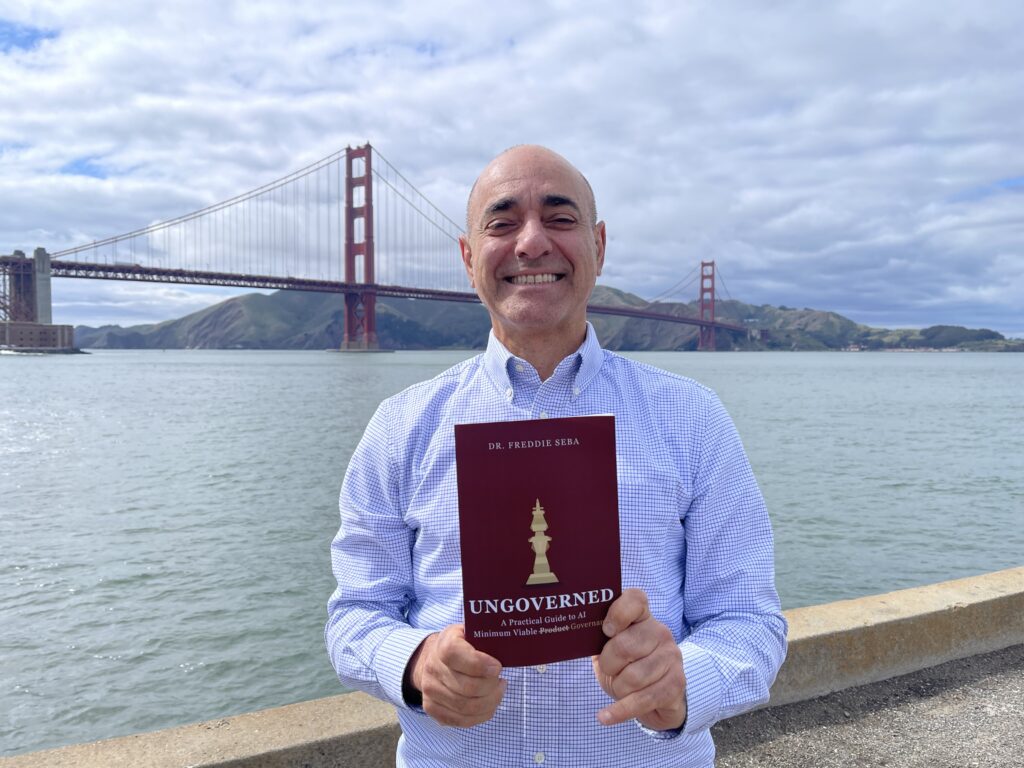
How Leaders Should Responsibly Engage the AI Transformation: The Argument in My Doctoral Dissertation, My Book, and These Eighty-Five Weeks
Ungoverned: AI Ethics and Governance for Leaders, Boards and Trustees
By Dr. Freddie Seba
© 2026 Freddie Seba. All rights reserved.
This Issue in 60 Seconds
This week, Bill Gates and MIT’s Ad Hoc Committee on AI Use in Teaching, Learning, and Research Training published work that aligns with the exact arguments I have been building for eighty-five consecutive weeks in this newsletter and in my doctoral dissertation. In my book Ungoverned, I argue that AI engagement is not binary—it is not wholesale adoption or rejection. It is critical engagement centered on human values. It is the institutional capacity to ask hard questions about how and where AI serves humanity, and to deliberately redesign institutions around those questions before deployment reshapes them by default.
Gates frames this not as a future problem but as an immediate crisis. His argument is direct: institutions are deploying AI now, without the governance to oversee it. This is consistent with what I have been arguing since my dissertation research—AI is already in your institutions. The question is not whether to deploy. The question is what governance and redesign you need to build now to protect the people affected.
MIT’s committee called for a complete redesign of how education measures learning, recognizing that the legacy artifacts (essays, papers, grades) no longer serve their original purpose once AI can generate them. They are not arguing against AI in education. They are arguing for wisdom about how and when to use it, and for preparing educators to teach alongside AI deliberately.
I have been advancing both of these arguments for years. I am grateful to see them arrive with clarity at the institutions that shape what comes next.
One sentence for your board: When major institutions finally name that critical engagement with AI is a leadership imperative—not a compliance issue—the work shifts from “how fast can we deploy?” to “who decides how we deploy, and who is accountable for the people we serve?”
Important Context on This Week’s Sources
On Bill Gates: Gates is co-founder of Microsoft, which has invested billions in OpenAI—one of the major AI developers shaping the industry globally. His Gates Foundation has also funded AI research initiatives. This means Gates’ ecosystem has significant financial stakes in AI deployment and acceleration. Readers should weigh his governance arguments—which are substantive—against this reality: he and his institutions benefit from the AI scale he’s warning about. His call for “deliberate leadership” arrives from someone whose financial ecosystem is betting on AI’s expansion. This doesn’t invalidate his argument. It does mean readers should understand his incentive structure: Gates has both genuine concerns about AI governance AND real financial interests in AI adoption.
On MIT: The Massachusetts Institute of Technology is one of the world’s leading educational and research institutions, particularly in technology and AI development. MIT has positioned itself at the forefront of AI research, deployment, and policy. The Ad Hoc Committee on AI Use in Teaching, Learning, and Research Training represents MIT’s institutional response to AI’s impact on education. When MIT calls for educational redesign, it carries weight because the institution is simultaneously advancing AI research, training the next generation of AI developers, and now naming the governance questions institutions must ask. Like Gates, MIT’s position is credible, and readers should understand the institution’s multiple roles: MIT advances AI innovation AND calls for wisdom about its deployment.
This Week’s Research Scope
We reviewed approximately thirty key sources this week: major institutional statements (Bill Gates, MIT Ad Hoc Committee on AI Use in Teaching, Learning, and Research Training), corporate earnings data (NVIDIA Q2 FY2027), peer-reviewed research (Nature, JAMA, NEJM, Stanford), international policy announcements (Turkey, South Korea, EU, China), healthcare governance frameworks (CHAI—Coalition for Health AI, a non-profit organization bringing together health system security leaders, AI developers, and experts), government initiatives (NIST—the National Institute of Standards and Technology, which recently joined efforts to accelerate AI innovation while managing its risks), economic analysis (World Bank, Citi), and media commentary (The Economist). The convergence is striking: institutions that have been quietly wrestling with AI governance are now naming the question explicitly. And they are framing it not as a compliance problem but as a leadership challenge.
Reading the Week Through the Framework I Have Been Building
My doctoral research focused on this exact question: how do institutions integrate ethics, governance, and leadership when technology reshapes what we measure, what we teach, what we trust, and what we value? The argument in Ungoverned translates that research into practice: AI is not something you adopt or reject. It is something you govern deliberately, with wisdom about deployment and redesign, or you discover the consequences after the fact in the people affected.
This week, both Gates and MIT’s committee are articulating arguments I have been advancing for years. And they are critically reframing governance: not as compliance, not as risk management, but as leadership.
Bill Gates: Governance as Leadership, Not Compliance
Gates frames the AI governance challenge as a leadership crisis, not a compliance exercise. His argument is direct and urgent: institutions are already deploying AI. The question is not whether to slow down. The question is whether you will lead that deployment deliberately—with wisdom about consequence, with protection for the people affected, with accountability built in—or whether you will discover what you chose after the failure.
This is exactly the argument I have been making in my doctoral dissertation and in my book. AI is not a future problem. It is a present problem. AI is already in your institutions. Clinicians are using it. Students are using it. Staff is using it. The governance question is not “Should we deploy?” It is “What is already deployed, and what governance and redesign do we need to build now?”
Gates frames this not as a future problem but as an immediate crisis: “Even under the best circumstances, the transition to this new AI era will be one of the most turbulent times in human history. There is no plan to ease the entry into the AI era.”
This is the leadership question: Do you have a deliberate plan to lead this transition? Or will momentum decide for you?
The Market Signal: NVIDIA and the Inflection Point That Proves My Governance Thesis
This week, NVIDIA—the company that designs and manufactures the chips (GPUs) powering virtually every major AI system—reported second-quarter revenue of $96.2 billion, up 18% from the previous quarter and 106% year-over-year. Data Center revenue reached $89.0 billion, up 117% from a year ago. To put this in perspective: if you use ChatGPT, Claude, or any major AI service, NVIDIA’s chips are likely processing your requests. Their $96.2B quarterly revenue proves how central they are to global AI infrastructure.
Jensen Huang, NVIDIA’s founder and CEO, framed it directly: “AI has reached its inflection point”—meaning the technology has crossed a threshold where it is now doing genuinely useful work at scale. “It’s doing useful work. Its tokens are productive and profitable. Now, compute is revenue. Demand continues to accelerate as multiple frontier labs scale in parallel, the open-model ecosystem grows, and physical AI comes online around the world.”
Let that sink in: Compute is revenue. Multiple frontier labs are scaling in parallel. Physical AI deployed globally. This is happening now.
This is not incremental growth. This is exponential acceleration at institutional scale. And it proves the governance problem I have been naming for eighty-five weeks:
The market’s incentive structure is not just acceleration—it is exponential acceleration. The financial reward for deploying AI is immediate and massive. The cost of not deploying—losing competitive advantage, losing margin, losing market position—is immediate and existential. The cost of wisdom, of asking hard questions before deployment, of redesigning deliberately instead of reactively, is also immediate. But the benefit of wisdom? It arrives only later, if at all, in the form of trust, avoided liability, or avoided reputational damage.
The governance gap widens as deployment accelerates. Institutions already struggling to build governance structures now face deployment velocity that outpaces their capacity to ask hard questions. The barrier between speed and wisdom has become a chasm.
This is exactly why Gates and MIT’s arguments—and their reframing of governance as leadership—are not just timely. They are urgent.
Bill Gates and MIT: The Leadership Imperative
This week, both Gates and MIT’s Ad Hoc Committee articulated a consistent argument: AI governance is leadership. They are naming what matters at a moment when naming has become essential. And critically, they are both reframing governance not as compliance, but as leadership.
The Wisdom Question: Healthcare and Higher Education (Gates)
Gates’ essay focuses on the sectors where wisdom matters most—healthcare and higher education. In both sectors, AI is arriving before institutions have built the governance to oversee it. In healthcare, AI systems are being deployed in clinical workflows without systematic evaluation of how they affect clinician judgment or patient trust. In higher education, AI is reshaping what it means to teach and demonstrate mastery before universities have decided whether to redesign legacy measurement and teaching artifacts.
Gates does not argue against AI in these sectors. I have not either. Gates argues that the transition to AI use requires deliberate leadership, protective policy, and accountability for the people affected. That is exactly what I have been arguing in my dissertation and my book.
But here is what makes this week’s NVIDIA numbers so critical: Gates’ argument is no longer about future risk. It is about present deployment. Hospitals are integrating clinical AI now. Universities are deploying educational AI now. The inflection point Huang described is happening in your institution this week. And Gates is saying that leadership—not compliance, not risk avoidance, but deliberate leadership—is the only adequate response.
The Redesign Question: Educational Measures and Institutional Structure (MIT)
MIT’s Ad Hoc Committee goes further—and brings into sharp focus the argument I have been making since my dissertation: institutional redesign is not optional. When AI reshapes a boundary—in this case, the boundary between student thinking and external support—institutions must choose. They can redesign deliberately, with wisdom about which competencies matter and when AI is appropriate. Or they can discover what they chose after the fact, in graduates unprepared for work requiring judgment, in institutions whose degrees no longer signal readiness.
Critically, MIT is not arguing against student AI use. MIT is arguing that the question is not “whether” students use AI. The question is “how and when”—and it requires redesigning education deliberately around that reality.
MIT’s committee called for exactly what I have been arguing: rethinking grading, rethinking what artifacts (essays, papers) actually measure, rethinking the legacy educational experience itself. More fundamentally, the committee is asking: How do we prepare educators to teach alongside AI? How do we learn from what works? How do we distinguish between student learning and student AI use—not to forbid AI, but to understand what competency the student has actually built?
This mirrors the analogy I have been using: when the defensive walls of ancient cities no longer served their original purpose (cannon, aircraft, missiles outran them), the question was not “remove the walls.” The question was “what are walls for now?”
Educational institutions face the same governance question: What is grading for now that AI can generate text? What is an essay designed to measure—and how do we measure that when AI is part of the ecosystem? What is learning? These are the questions I raised in my dissertation and have been posing every week. MIT’s committee is now naming them at an institutional scale, and framing it as a leadership imperative.
MIT’s committee wrote: “Bold thinking is essential because our students will go on to help shape the intellectual, ethical, and technical direction of our society – and soon. We owe them a deep engagement in rich and constructive uses of AI, and a sophisticated understanding of its potential and its drawbacks. Their MIT experience should prepare them with the wisdom to help determine how and where AI is used for the betterment of society and the world at large.”
Notice the frame: “rich and constructive uses of AI.” Not rejection. Critical engagement, centered on human values.
This is the argument I have been advancing: “bold engagement” does not mean faster adoption. It means institutions build wisdom first—the capacity to judge when and how AI is appropriate—and then we redesign educational structures around that wisdom. It means preparing educators to lead that redesign, not to react to it.
What makes this urgent right now: NVIDIA’s 106% growth means that redesign cannot wait. The moment to build governance deliberately—as leadership—is now, not next year.
Governance as Leadership, Not Compliance
This is the critical reframing both Gates and MIT are making, and it is the heart of what I have been arguing:
Governance is not compliance. Governance is not risk mitigation. Governance is leadership. It is the deliberate choice to exercise wisdom about how and where AI serves humanity, before deployment reshapes your institution by default.
Gates does not frame this as “we need better compliance.” He frames it as “we need leaders who will make deliberate choices about AI deployment and be accountable for the people affected.”
MIT does not frame this as “we need to prevent AI in education.” They frame it as “we need educators to lead the redesign of education in an era when AI exists.”
This distinction is fundamental. Compliance is reactive. Leadership is proactive. Compliance asks “how do we manage the risk?” Leadership asks, “how do we shape the future deliberately?”
The Pattern This Week Reveals: Why Governance Must Become Leadership
Gates and MIT are naming governance as a leadership imperative. NVIDIA’s numbers prove why:
1. Inflection Point = Governance Urgency (Unmet): NVIDIA’s inflection point means institutions are deploying AI at scale NOW. The governance thesis I have been building requires asking hard questions BEFORE deployment. Most institutions are discovering governance gaps DURING deployment, not before. The window to lead deliberately is closing.
2. “Compute is Revenue” = Profit Drives Deployment. This phrase encapsulates the market incentive structure I have been naming. When compute becomes a revenue stream itself, the incentive is to scale compute, not to govern it wisely. Institutions are racing to build AI infrastructure to capture revenue, not to exercise wisdom about deployment. Leadership means choosing differently.
3. Multiple Frontier Labs Scaling in Parallel = Decentralized Deployment Governance requires clarity about what’s deployed and who’s accountable. Parallel deployment by multiple labs means fragmented decision-making and distributed accountability. No single institution can see the full picture. This is precisely why institutional redesign—the kind MIT is calling for—is not optional.
4. Open-Model Ecosystem Grows = Distributed Control. The governance framework I have been building assumes institutional control and accountability. Open models distribute capability to actors outside traditional institutional structures. Clinicians can deploy medical AI models. Educators can integrate educational AI. Leadership means asking: Can you see it? Can you account for it? Can you say no if needed?
5. Physical AI Comes Online = Consequences Become Real. This is the moment when board-ready questions become urgent. Physical AI means the system is not just generating text—it is taking actions in the world, affecting patients, students, workers. The stakes shift from “what could go wrong?” to “what is going wrong right now?” Leadership is not optional.
The Research This Week Shows What’s Actually Happening
Across medical AI, educational deployment, workforce transitions, and emerging governance frameworks, the week’s signals show institutions making choices about AI engagement—but not systematically, not with wisdom, and often before they have named what they are actually choosing.
Healthcare: The Wisdom Question I Have Been Arguing
Research published this week in Nature and JAMA shows that AI-assisted clinical workflows improve outcomes when three conditions are met: (1) clinicians retain decision authority, (2) the AI system is transparent about its reasoning, and (3) there is structured oversight before deployment, not after. New NEJM research on AI in clinical practice confirms this pattern.
This is the wisdom question I have been naming—not “Can AI diagnose?” but “How do we use AI diagnostically while protecting the clinician’s judgment and the patient’s trust?” It is the question of what AI is for in healthcare, decided in advance, with accountability built in.
Yet the deployment reality shows most health systems are racing to integrate clinical AI without meeting those three conditions. NVIDIA’s 117% year-over-year data center growth proves this acceleration is not slowing. Leadership means asking: Will we govern this deliberately, or will we discover what we chose?
Educational Impact: Critical Engagement, Not Rejection
New research from Stanford and MIT on AI in learning environments shows that AI can accelerate certain cognitive tasks while degrading others (critical thinking, the ability to tolerate uncertainty, the capacity for deep reasoning). The pedagogical question I have been raising is not whether to use AI in education—it is how and when to use it such that students build baseline human competency and judgment before they offload to AI.
Critically: the research is not about forbidding student AI use. It is about understanding what students actually learn when AI is part of the process. It is about detecting when students are outsourcing thinking (which degrades learning) versus using AI as a tool to augment thinking (which can enhance learning). Detection is about process—how the student is engaging—not about authorship.
That is what both Gates and MIT are advocating: “bold engagement” means redesign first, adoption second. Students build judgment first. Educators learn what works. Institutions rebuild their measures around actual learning, not around policing AI use.
The Real Governance Problem: AI Is Already Inside
But here is the reality I have been arguing in my book and my dissertation: AI is already in your institution. It is not a future question. It is a present problem.
Students are using generative AI in coursework. Clinicians are using AI in clinical workflows. Staff are using AI in administrative tasks. Physical AI systems are coming online. The choice of “before deployment” is often already past.
The real governance question—the leadership question—is: What is already here, how are we governing it, and who is accountable for the people affected?
This is the AI Minimum Viable Governance question: not “Should we deploy this system?” (often too late), but “What is already deployed, and what governance and redesign do we need to build now to protect the people affected?”
International Policy Signals: Governance as Leadership
This week, Turkey adopted an AI Action Plan with governance at its core. South Korea adopted AI Ethics Principles. The EU continues refining the AI Act. China published updated AI safety governance. NIST (the National Institute of Standards and Technology) joined efforts to accelerate AI innovation—signaling that government bodies recognize both the promise and the urgency of governance as leadership.
These are not rejection frameworks. These are frameworks for critical engagement—governance structures that decide how and where AI serves humanity.
The Seba 12 Ps of Responsible AI Oversight: Reading This Week Through the Framework
Purpose. Gates and MIT are both asking: what is AI for? In healthcare: what is AI for in diagnosis? In education: what is grading for when AI can generate text? Purpose means naming the answer in advance, with leadership.
People. Both signal that the people affected matter. Gates names workforce displacement. MIT names students who will inherit the consequences. People governance means: whom does this system affect, and who is accountable for them?
Wisdom (Leadership). Wisdom is the institutional capacity to redesign deliberately, to say no, to say wait, to say this engagement serves humanity or it does not. This is leadership, not compliance.
Process. The process must be: establish competency, build judgment, then introduce AI as a tool students and clinicians can evaluate. Redesign first, adopt second. Leadership means choosing this sequence deliberately.
Preparedness. Institutions that imagine what redesign looks like before AI reshapes them are more prepared. Preparedness is the institutional discipline of asking: what is already here, what governance and redesign do we need? Given NVIDIA’s growth, this preparation must happen now.
Problems. Gates names three: displacement, misuse, developmental harm. Each is foreseeable. Each can be governed around if institutions choose redesign over reaction. Leadership means choosing.
Product Ownership. When a health system or university deploys AI—who owns the outcome? The institution. And that owner is accountable for the people affected. Accountability is not optional when compute is revenue.
The Separate Signals: Where This Leadership Is Happening
This week, The Economist published “AI is Changing Religion and Religions Are Trying to Change AI”—a conversation grounded in questions about human dignity and what serves human flourishing. This reflects the work I have been doing with the AI and Faith working group.
Similarly, my colleagues and I are conducting a panel at the University of San Francisco this Wednesday on AI and Education—addressing the redesign question MIT’s committee is naming: how do we prepare educators to lead AI integration deliberately? How do we engage AI critically? How do we redesign education intentionally? (More details to follow later this week.)
These conversations are not anti-AI. They are pro-humanity. They are leadership conversations about what we want AI to do—not what markets are pushing it to do.
One Board-Ready Action: The Leadership Standard (Now Urgent)
This is the week to answer this question in your boardroom: Are we exercising leadership about AI engagement and institutional redesign? Or are we rationalizing engagement decisions after the fact?
Remember: AI is already inside your institution. Deployment is accelerating. Leadership is not optional.
If you cannot answer these questions, you are not leading:
- What AI is already deployed right now? (Not “what will we deploy,” but “what is deploying this week?”)
- Is our governance keeping pace with deployment velocity? (Or are systems being integrated faster than we can ask hard questions?)
- Do we control the governance of open-model AI our people are using? (Can we see it? Can we account for it? Can we stop it if needed?)
- What do we need to redesign—before we accelerate? (Grading systems, clinical workflows, assessments, educational measures—what changes? How do we prepare educators and leaders to guide that change?)
- When physical AI comes online in our operations, who is accountable? (Not in theory—named, with authority, with decision rights.)
- Can we say no to new deployment? Can we say wait? Can we redesign before we accelerate? (Or does momentum decide for us?)
If leadership cannot answer these, the institution is not exercising wisdom. And with NVIDIA’s inflection point underway, that is no longer acceptable.
What I Am Watching
Whether the framework I have been building—critical engagement centered on human values, requiring institutional redesign—becomes the standard language for boards in healthcare and higher education. Whether MIT’s call for educational redesign spreads to other universities—actually redesigning the experience and preparing educators—or whether it accelerates the demise of institutions that cannot adapt. Whether institutions begin to distinguish between “moving fast” and “moving wisely,” between “adopting AI” and “redesigning for AI,” and whether they do it before deployment momentum makes that choice for them. Whether organizations that want to take this important journey deliberately will find the frameworks, the partners, and the support they need to lead.
Closing Thought
For eighty-five consecutive weeks in this newsletter, in my doctoral dissertation, and in my book Ungoverned, I have been arguing that AI engagement is not a compliance problem. It is a leadership discipline. That critical engagement centered on human values matters more than speed of adoption. The outcome depends on deliberate choices leaders make now.
This week, Bill Gates and MIT’s Ad Hoc Committee on AI Use in Teaching, Learning, and Research Training articulated that argument. They framed governance not as risk management or compliance. They framed it as leadership. They are not originating these ideas. They are giving voice to what I have been advancing.
And they are naming it at the moment when that validation has become urgent. Because AI is already in your institution. Deployment is accelerating. The window to lead deliberately—to ask hard questions, to redesign institutions intentionally, to build governance that protects the people affected—is closing.
Gates frames this as an immediate crisis, not a future problem. He is right. This is consistent with what I have been arguing: AI is already in your institutions. The question is not whether to deploy. The question is whether you will lead that deployment deliberately—with wisdom about consequence, with protection for the people affected, with accountability built in—or whether you will discover what you chose after the failure.
The question now is whether your institution will lead deliberately—with critical engagement centered on human values, serving the people you are accountable for—or whether you will discover what you chose after the failure.
Choose to redesign, not just adopt. Choose to lead, not to rationalize. Choose governance as leadership, not compliance.
Choose now.
Gratitude and Acknowledgments
This week’s work builds on conversations with healthcare leaders, faculty, students, and colleagues grappling with these questions in real time. I am grateful to the leaders at @AMIA, @CHAI, @MIT, and across higher education and healthcare who are naming governance as a leadership imperative. Special thanks to my colleagues at the @University of San Francisco and to the @AI and Faith working group for conversations grounded in human dignity and institutional responsibility. And gratitude to the readers—many of you leaders, trustees, clinicians, and educators—who have engaged with this argument for eighty-five weeks. Your work to build wisdom into your institutions is what this newsletter exists to support.
For More on Responsible AI Leadership and Educational Redesign
The 12 Ps of Responsible AI Oversight apply to every deployment and redesign decision being made this week. Ungoverned: A Practical Guide to AI Minimum Viable Governance is available on Amazon. My doctoral dissertation on GenAI ethics and governance in higher education is available at the USF Digital Repository.
References & Sources
Primary Sources:
Bill Gates, “A Turbulent AI Era—and Critical Choices to Make,” Gates Notes, August 26, 2026. gatesnotes.com
MIT Ad Hoc Committee on AI Use in Teaching, Learning, and Research Training, “Bold Thinking on AI and Education,” August 13, 2026. aiandeducation.mit.edu/report
NVIDIA, Q2 Fiscal 2027 Earnings Report, August 27, 2026. Revenue: $96.2B (106% Y/Y growth); Data Center: $89.0B (117% Y/Y growth). CEO Jensen Huang’s statement on the inflection point.
Healthcare & Clinical AI Research:
Nature, “AI-Assisted Clinical Workflows and Clinician Authority,” 2026.
JAMA, “Clinical Decision Support and Patient Trust,” 2026.
NEJM, “AI in Clinical Practice,” 2026.
Stanford Digital Economy Lab, “AI in Learning Environments and Critical Thinking Development,” 2026.
Workforce & Economic Impact:
World Bank, “World Development Report 2026: The Promise of Artificial Intelligence,” August 2026.
Citi, “AI Exposure Across Global Workforce,” 2026.
Governance Frameworks:
CHAI (Coalition for Health AI), “Health AI Cybersecurity Work Group Kickoff,” August 2026.
NIST (National Institute of Standards and Technology), “National Genesis Mission to Accelerate AI Innovation,” 2026.
Turkey, “Artificial Intelligence Action Plan (2026-2030),” Presidential Circular No. 2026/9, August 17, 2026.
South Korea, “Artificial Intelligence Ethics Principles,” August 21, 2026.
European Union, “AI Act Digital Omnibus Amendment,” 2026.
China, “Updated AI Safety Governance Framework,” 2026.
Books & Dissertations:
Freddie Seba, Ungoverned: A Practical Guide to AI Minimum Viable Governance, 2026. Available on Amazon.
Freddie Seba, Doctoral Dissertation on GenAI Ethics and Governance in Higher Education, University of San Francisco, 2025. repository.usfca.edu
Media & Commentary:
The Economist, “AI is Changing Religion and Religions Are Trying to Change AI,” August 27, 2026.
About Dr. Freddie Seba
Dr. Freddie Seba is building the practice of AI governance, working with institutions that want to take this important journey deliberately—translating governance from aspiration to institutional action.
Who I Am
Scholar-Operator. 20+ years founding and leading technology organizations across digital health, fintech, and higher education. EdD · USF · MBA · Yale · MA · Stanford. Principal, Organization AI Governance Scholar | Operator.
What I Do
I work at the intersection of research, practice, and deployment—translating AI governance from concept to institutional action. My focus is on three interconnected areas:
AI Governance as Leadership — How leaders exercise critical engagement with AI in real time, before momentum decides for you.
AI Minimum Viable Governance (AI-MVG) — The governance floor institutions must build now, not after failure. Practical, deployable frameworks that work in healthcare systems, universities, and enterprises actively deploying AI.
Responsible AI Oversight (12 Ps Framework) — The questions boards must ask, the decisions leaders must make, the accountability structures institutions must build to protect the people affected by AI.
My work answers the question that matters: not “Can we build this?” but “Should we, and who is accountable for the people affected?”—and then provides the governance structure to act on that answer.
Building the Practice
I am building the business of AI Governance as Leadership. Everything I research, write, and teach is deployed. I seek to work with institutions actively building governance—health systems integrating clinical AI, universities redesigning education around AI, boards establishing accountability structures. The frameworks evolve with the problems they solve. I welcome the opportunity to connect with leaders and institutions ready to lead this important journey deliberately.
Publications & Thought Leadership
- Ungoverned: A Practical Guide to AI Minimum Viable Governance — Practical framework for leaders translating AI governance into institutional practice. Amazon.
- Weekly newsletter on AI governance signals — 85+ consecutive weeks of board-ready analysis. Reaches executive leaders, trustees, and decision-makers navigating AI transformation in real time.
- Academic research on AI ethics and institutional governance in higher education—published and deployed.
- Podcast: AI Governance with Dr. Freddie Seba — YouTube, Spotify, Apple Podcasts. Deep-dive conversations on governance, ethics, leadership, and institutional responsibility in the age of AI.
Speaking & Executive Briefings
Select speaking engagements, podium presentations, and executive briefings on AI governance, risk, trust, and institutional legitimacy. Audiences: boards, universities, health systems, technology leaders, policymakers. Purpose: Move governance from aspiration to action.
Non-vendor. Non-partisan. Built on scholarship, tested in practice, available for leaders making consequential decisions now.
More: freddieseba.com
Disclaimer and Disclosure
This newsletter is for informational and educational purposes only. It does not constitute legal, regulatory, compliance, or investment advice. For legal or regulatory questions, consult appropriate professional advisors. For reprint or licensing inquiries: contact@freddieseba.com.
This newsletter is written the way I argue AI should be used—critically and carefully, assisted by AI but grounded in human judgment, for people, not in place of them. It extends the research behind my book, Ungoverned: A Practical Guide to AI Minimum Viable Governance, and my doctoral research on GenAI ethics and governance in higher education. Each week’s signals come from primary research, expert networks, speaking engagements, and conversations with AI practitioners and institutional leaders. The AI tools I use—including Anthropic’s Claude, OpenAI’s ChatGPT, and Google’s Gemini—support research synthesis, source verification, and drafting. Final editorial judgment and responsibility are mine alone.
© 2026 Freddie Seba. All rights reserved.
Connect: freddieseba.com · LinkedIn: @freddiesebaprofile · YouTube · Spotify · Apple Podcasts: AI Governance with Dr. Freddie Seba
Leave a Reply