A compact, deployable governance structure for leaders who can’t wait for perfect policy. From boards to engineering teams, implement AI governance that actually works.
Explore the MVG Framework | Get Started with MVG
Why Seba’s AI Minimum Viable Governance?
Your organization faces a choice when it comes to AI governance. Understanding Seba’s AI MVG helps you avoid the trap between extremes.
The AI Governance as Leadership Dilemma
Organizations face a choice:
Perfect governance: Build comprehensive frameworks and get them perfect. Problem? By the time you launch, AI adoption is already happening outside the framework. You’ve lost control.
No governance: Move fast, deploy AI everywhere. Problem? When something goes wrong (and it will), you have no playbook. No accountability. No incident response. Crisis management mode.
Seba’s AI MVG is a third option: Deploy governance that’s good enough to work, fast enough to keep up with business pace, scalable enough to grow with your AI adoption.
The Reality
Your first AI failures won’t look like scandals. They’ll look like workflows. Decisions made without proper oversight. Systems optimizing for the wrong thing. Vendors who didn’t respect your boundaries.
Seba’s MVG prevents that. Not through massive infrastructure — through clarity.
What Makes Seba’s MVG Work
Compact: Fits on 5-10 pages, not 50. Leaders can read it. Engineers can implement it.
Deployable: Implement this week, not this year. You don’t need perfect data or perfect processes.
Scalable: Start with pilot governance, scale to enterprise governance. Same framework, more rigor.
Vendor-neutral: No tool to sell. No agenda but your outcomes.
Seba’s AI Minimum Viable Governance: 4 Components {#framework-details}
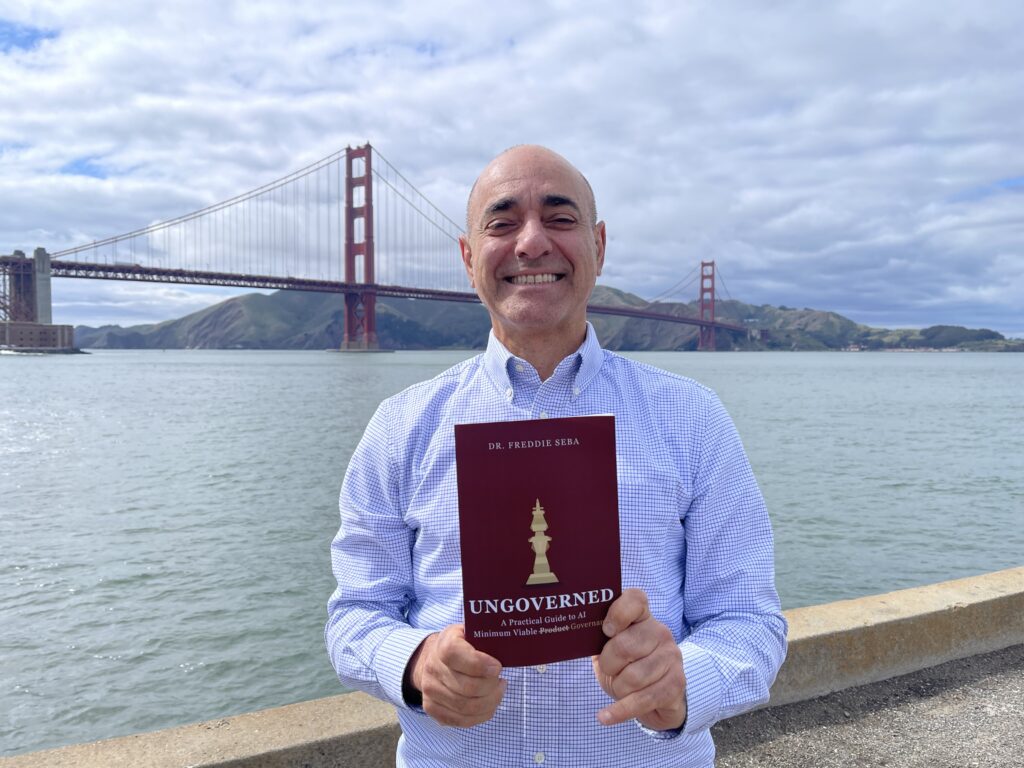
A simple structure that works from startups to enterprises. This framework is detailed in Ungoverned: A Practical Guide to AI Minimum Viable Governance.
Component 1: Inventory
What it is: Know what AI you have. Where is it? What does it do? Who’s responsible? This is the foundation — you can’t govern what you don’t see.
What to Include:
- System name & location: Where does this AI live? (cloud, on-prem, vendor-hosted?)
- What it does: Purpose in plain language. Business outcome. What would failure look like?
- Data sources: What feeds this AI? Internal data? Third-party? Sensitive data?
- Stakeholders: Who owns it? Who uses it? Who’s affected by it?
- External dependencies: Does it depend on vendor APIs? Third-party data? What if those break?
Implementation:
Start simple: a spreadsheet with 10 columns (System, Purpose, Owner, Data, Users, Risk Tier, Status, Last Review, Notes, Next Review). Takes 1-2 weeks to populate.
Why It Matters:
Half of major AI incidents happen because organizations didn’t know what AI they had. You can’t manage what you can’t see.
Component 2: Risk Tiering
What it is: Different AI systems carry different risks. Govern accordingly.
Tier 1: Mission-Critical AI
Examples: Clinical decision support, fraud detection, financial trading, autonomous vehicles
Risk Level: High (direct impact on customers, revenue, compliance)
Governance: Rigorous oversight, regular audits, real-time monitoring, incident response plan
Tier 2: Important AI
Examples: Marketing personalization, supply chain optimization, HR screening
Risk Level: Medium (impact on business operations, some compliance risk)
Governance: Moderate oversight, quarterly audits, incident protocols
Tier 3: Experimental AI
Examples: Pilots, research projects, proof-of-concepts
Risk Level: Low (limited scope, limited impact, temporary)
Governance: Light touch, experimentation allowed, escalation protocol if it goes into production
Implementation:
For each AI system in your inventory, ask: “If this failed, what would happen?” Impact + likelihood = tier. Takes 1 week.
Why It Matters:
You can’t govern everything the same way. Tier 3 experimentation doesn’t need the same oversight as Tier 1 mission-critical. Tiering lets you move fast where it’s safe and move carefully where it matters.
Component 3: Decision Rights
What it is: Who decides what? Clear decision rights = clear accountability.
Key Decisions to Define:
- Deploy new AI system: Who approves? CEO? CTO? Governance committee?
- Update AI model: Do we need approval? How much can engineering change without escalating?
- Use new data source: Who decides if we can ingest new data?
- Change AI boundaries: If an AI system’s scope changes, who approves?
- Incident response: If something goes wrong, who decides to shut it down?
- Vendor selection: How do we choose AI vendors? Who has final say?
Implementation:
Create a simple decision matrix: Decision | Tier 1 Approval | Tier 2 Approval | Tier 3 Approval. Fill in roles (engineering lead, CTO, CEO, board, etc.). Takes 1 week to workshop, set, and communicate.
Why It Matters:
When decisions are unclear, people either over-escalate (slowing everything down) or under-escalate (missing risks). Clear decision rights let people act with confidence.
Component 4: Incident Readiness
What it is: When something goes wrong, you need a playbook. Not a plan you’re making up in crisis.
Your Incident Readiness Checklist:
- Incident detection: How do we know something went wrong? What triggers an alert?
- Escalation path: Who gets notified first? Who decides if we need to shut down the AI?
- Communication plan: Who talks to customers? Regulators? Board? What do we say?
- Investigation: Who figures out what happened? How do we trace decisions?
- Remediation: How do we fix it? Revert to prior version? Retrain?
- Post-mortem: After the incident, how do we learn? What changes?
Implementation:
For each mission-critical AI system, create a 1-page incident playbook. Include: detection triggers, escalation chain, communication templates. This will take 2-3 weeks for all systems.
Why It Matters:
Most AI incidents aren’t about technology — they’re about response. A playbook means faster response, clearer communication, and less damage. The playbook also tells you what to monitor (because you know what you’re watching for).
How to Implement Seba’s AI MVG: Week-by-Week
Week 1: Inventory
Create a spreadsheet of all AI systems. Identify gaps. Get leadership to agree on the list.
Week 2: Risk Tiering
For each system, assign a tier (1/2/3). Get executive alignment on tiering criteria.
Week 3: Decision Rights
Map key decisions. Define who decides at each tier. Publish decision matrix.
Week 4: Incident Readiness
Create incident playbooks for Tier 1 systems. Communication templates. Escalation chains.
Week 5+: Operationalize & Scale
Test playbooks. Train teams. Add monitoring. Refine based on learning. Review quarterly.
Total time: 4-5 weeks to core MVG. Operationalization is ongoing.
Seba’s AI MVG in Practice: Real Examples
Healthcare Example: Diagnostic AI
System: AI model that assists radiologists in reading X-rays
Tier: Tier 1 (mission-critical, direct patient impact)
Decision Rights: CTO + CMO approve new versions. CMO makes final call on model changes affecting patient outcomes.
Incident Trigger: False negative rate exceeds 2%. System automatically alerts clinical leadership.
Incident Response: Immediately escalate. CMO decides whether to revert to the prior version or take the system offline while investigating.
Fintech Example: Fraud Detection
System: AI model that flags suspicious transactions
Tier: Tier 1 (mission-critical, compliance risk)
Decision Rights: Risk team approves new models. Finance approves vendor selection.
Incident Trigger: For example, false positive rate exceeds 5%, OR we miss 3+ actual fraud cases in a week.
Incident Response: Adjust thresholds or revert to prior model. Notify compliance. Document incident.
Higher Ed Example: Admissions Screening
System: AI model that ranks undergraduate applications
Tier: Tier 2 (important, some compliance risk around bias)
Decision Rights: Admissions team approves model changes. Compliance conducts quarterly audits for bias.
Incident Trigger: For example, a bias audit identifies racial/socioeconomic disparity exceeding 10%.
Incident Response: Pause automated recommendations. Manual review of flagged applications—Retrain model.
Talk 01: Ungoverned — The Seba AI MVG Keynote
Dr. Seba’s signature talk walks through Seba’s AI Minimum Viable Governance and why it works. Perfect for board or executive alignment.
Quick Facts
For
- Boards & Trustees
- C-Suite & Founders
- Executives & Leadership Teams
- Organizations at any AI adoption stage
Duration
- 45–60 minutes
- Can be adapted for wa orkshop (half or full day)
Audience Size
- 50–500 people
- Board only, all-hands, or executive team
Format
- Keynote address
- Executive workshop
- Board briefing
What Attendees Will Learn
✓ Why Seba’s AI MVG Works
The philosophy and practice behind Seba’s AI Minimum Viable Governance. Why perfect governance fails and how Seba’s MVG succeeds.
✓ The 4 Components
Inventory, risk tiering, decision rights, incident readiness — how to implement each, what to watch for.
✓ Real-World Examples
Healthcare, fintech, higher ed, tech companies — how Seba’s AI MVG works across industries.
✓ Implementation Timeline
Week-by-week roadmap: how to get from no governance to deployed governance in 4-5 weeks.
✓ Scaling Strategy
How to evolve from pilot governance to enterprise governance using the same framework.
✓ From Aspiration to Action
Concrete steps to move from “we want responsible AI” to “here’s how we actually govern it.”
Investment
Keynote (45–60 min): $5,000–$15,000+
Half-Day Workshop (3–4 hours): $8,000–$18,000
Full-Day Workshop (6–8 hours): $15,000–$25,000+
Investment varies by audience size, location, travel, and customization.
Book Talk 01 or Schedule Workshop
Seba’s AI MVG Resources & Templates embedded in Ungoverned book
Ready-to-use templates: Inventory spreadsheet, risk tiering matrix, decision rights table, incident playbook template.
Read Ungoverned
Ungoverned: A Practical Guide to AI Minimum Viable Governance
Dr. Seba’s complete guide to Seba’s AI Minimum Viable Governance implementation. Real-world examples, mistakes to avoid, and how to scale. Essential reading for anyone building AI governance.
Listen to Talk 01
45-60 minute keynote walking through Seba’s MVG framework. Great for board or executive alignment. Available as keynote, half-day, or full-day workshop.
Get Advisory Support
Seba’s AI MVG Advisory Workshop
Half-day or full-day workshop: We walk your team through building your organization’s Seba’s AI Minimum Viable Governance framework. Customized to your context, your AI systems, and your governance maturity.
FAQ: Seba’s AI Minimum Viable Governance
Is Seba’s AI MVG only for large enterprises?
No. Seba’s MVG scales from startups to enterprises. A 20-person startup might have 2-3 AI systems in inventory. A 5,000-person enterprise might have 200: same framework, different scale.
How long does it take to implement Seba’s MVG?
Core Seba’s AI MVG (inventory, tiering, decision rights, incident readiness): 4-5 weeks. Operationalizing it (training, monitoring, processes): ongoing. We can accelerate this with advisory support.
What if we don’t know all our AI systems yet?
That’s actually the first step of Seba’s AI MVG: discovering what AI you have. Start with what you know. As you discover more, add it to inventory. Governance evolves as your AI portfolio evolves.
Does Seba’s AI MVG work if we use third-party AI vendors?
Absolutely. Vendor AI systems go in your inventory. You tier them, define decision rights (when do you upgrade? how do you monitor?), and create incident playbooks. Governance is still your responsibility.
What if we already have some governance in place?
That’s great. Seba’s AI MVG can become your foundation — consolidating existing governance, identifying gaps, standardizing across teams. We can help audit and evolve your current framework.
Can we combine Seba’s AI MVG implementation with a keynote or workshop?
Yes, that’s a common approach. Keynote for alignment (Talk 01), then advisory workshop to build your framework (half or full day). We often bundle these.
How does Seba’s AI MVG relate to the Seba 12 Ps?
Seba’s MVG is the operational structure. The 12 Ps are the governance domains. Seba’s MVG answers “how do we do this?” The 12 Ps answer “what do we govern?” Together, they create complete AI governance.
Can we use Seba’s AI MVG for agentic AI systems?
Yes. Seba’s MVG provides the foundational structure. For agentic systems specifically, the 5 Pillars framework adds technical governance patterns. Start with Seba’s MVG, layer in agentic specifics as you scale.
Ready to Build Seba’s AI Minimum Viable Governance?
Seba’s MVG works for organizations at any stage — just starting with AI, scaling pilots, or already in production with governance gaps.
Get Started with Seba’s AI MVG | View All Pricing Options
Or schedule a 15-minute call to discuss your organization’s AI governance needs.
Next Steps
Step 1: Assess your current state
Do you have inventory? Risk tiering? Decision rights? Incident plans? Start where you are.
Step 2: Choose your approach
Keynote for alignment? Workshop to build? Advisory to implement? Or combination?
Step 3: Get a quote
Contact us, and we’ll send a proposal based on your needs.
Step 4: Schedule discovery call
15-minute call to understand your context and recommend the right approach.
Step 5: Get started
Begin implementing Seba’s MVG this week.
Related Frameworks & Talks
Talk 01: Ungoverned
45-60-minute keynote presentation on Seba’s AI MVG framework.
The Seba 12 Ps of Responsible AI Oversight
Board-level governance framework. What to oversee, decision rights, risk inventory.
Agentic AI Governance
How to apply governance when AI acts autonomously. Technical governance patterns for agents.
Ungoverned: A Practical Guide to AI Minimum Viable Governance
Dr. Seba’s book. Complete guide to Seba’s MVG implementation with real-world examples.
Explore More