I Asked Anthropic’s Own AI to Compare Anthropic’s New Governance Framework to My Book’s AI-MVG. It Didn’t Pick a Winner — It Said Both Are Needed. The “And” Is Where Your Institution Is Still Exposed.
Here is something I did not plan to post today. I asked Claude to compare Anthropic’s new governance framework to my book’s Ungoverned AI Minimum Viable Governance (AI-MVG) — expecting a diplomatic non-answer. What came back was one of the clearest framework gap analyses I have read. I have spent years arguing that AI governance failures do not begin as scandals. They begin as workflows. This confirmed it. So I am sharing it with my commentary.
As part of my ongoing AI governance research, I came across Anthropic’s newly released Advanced AI Framework (June 2026) — a serious, detailed, and genuinely timely policy document that every governance practitioner should read.
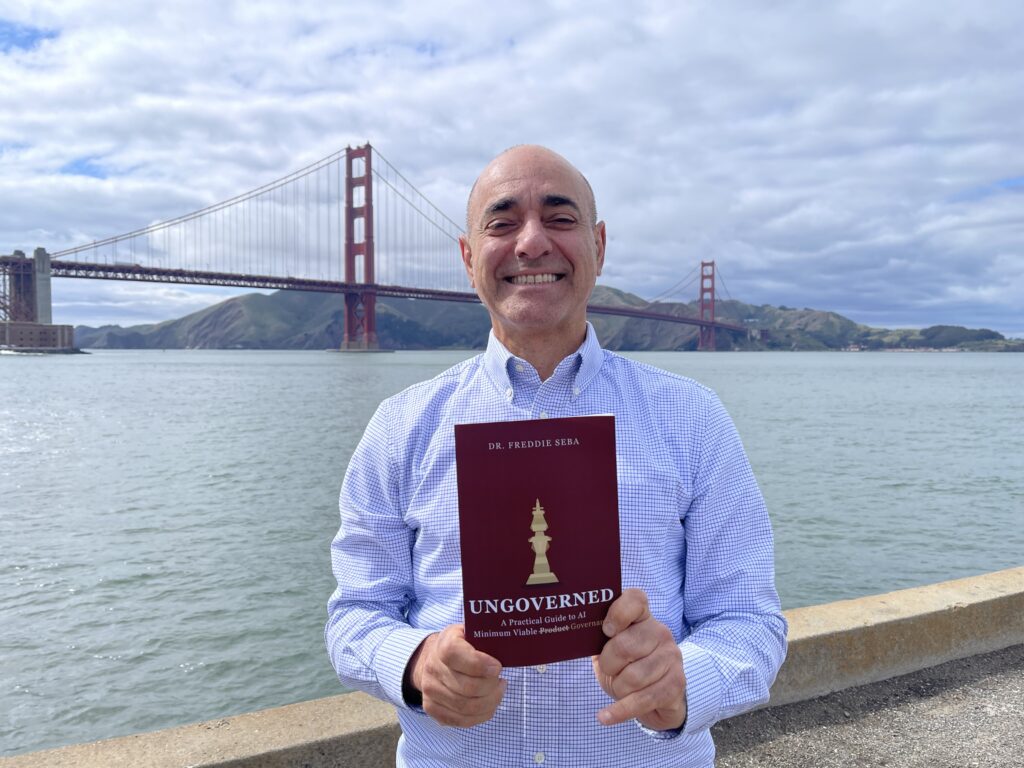
After reviewing it twice, I did something I think more leaders should try: I asked Anthropic’s own Claude (Sonnet 4.6) — one shot, no coaching — to compare Anthropic’s framework against the AI Minimum Viable Governance (AI-MVG) framework at the center of my book, Ungoverned: A Practical Guide to AI Minimum Viable Governance.
Here is what it came back with.
WHERE THEY ALIGN — AND THEY DO, MEANINGFULLY
The structural instincts of both frameworks are remarkably consistent:
- Proactive accountability over reactive compliance. Anthropic’s entire framework is built on the premise that governance must precede the incident. So is AI-MVG. Accountability is built before the incident. Compliance is assembled after it.
- Named ownership. Anthropic requires Covered Developers to identify “the corporate officer primarily accountable for the framework’s implementation.” AI-MVG requires institutions to name a governance owner before any consequential deployment goes live—same principle, different altitude.
- Evidence over assurance. Anthropic’s transparency stack — safety frameworks, six-month risk reports, system cards, independent evaluations — is designed to produce verifiable records, not compliance theater. AI-MVG calls this the shift from assurance language to proof.
- Independent evaluation. Anthropic mandates external evaluators with defined independence standards and anti-shopping provisions. AI-MVG insists institutions not self-certify risk. The logic is identical.
- Incident reporting with teeth. Anthropic requires Critical Safety Incident reporting within 15 days and imposes civil penalties for false statements. AI-MVG builds failure-mode accountability into institutional routines before those incidents occur.
The frameworks are not in competition. They operate under the same governance philosophy.
WHERE THE GAP LIVES — AND THIS IS THE “AND”
Anthropic’s framework governs the developers of frontier models and the governments that oversee them.
It says almost nothing about the hospitals, universities, financial institutions, and mission-driven organizations that deploy those models every day in consequential workflows — the exact institutions Ungoverned was written for.
Here is what Anthropic’s framework does not address:
The institutional middle layer is invisible. Anthropic defines coverage thresholds: models requiring more than 10²⁵ training FLOP, developers earning more than $500M in annual AI revenue. Institutions deploying models well below that threshold — but still making consequential decisions about students, patients, and employees — face zero governance requirements under this framework.
No deployment governance floor. Even a perfectly implemented Anthropic framework leaves every provost, board chair, CIO, and compliance officer without a structured accountability baseline for the AI tools already running inside their institution.
No due process architecture for affected individuals. Anthropic’s framework does not address procedural fairness for the student flagged by an AI detection system, the patient triaged by an algorithm, or the employee evaluated by an AI-enabled workflow.
No exit readiness requirement. AI-MVG’s core pillar of exit readiness — the institutional capacity to reverse, suspend, or offboard an AI system without organizational harm — has no equivalent in Anthropic’s framework for deploying institutions.
No governance cadence. Anthropic’s obligations are episodic. AI-MVG is designed as a routine — a governance rhythm with named owners, evidence standards, review cadence, and defined escalation paths.
THE ONE-SENTENCE VERSION
Anthropic governs what frontier developers must prove to the government.
AI-MVG governs what institutions must build before they deploy.
Those are not the same governance gap. And your institution is still exposed on the second one — regardless of how well the first is implemented.
WHY THIS MATTERS FOR LEADERS
If you are a board member, trustee, president, provost, CIO, CISO, general counsel, or senior leader in higher education, healthcare, financial services, or any mission-driven sector, Anthropic’s framework is not written for you. It is written about the companies whose tools you are already deploying.
The governance question your board will eventually face is not whether Anthropic tested its models.
It is whether you built accountability before the incident that made building it unavoidable.
That is the question Ungoverned was written to answer.
-Read the book: amazon.com/dp/B0GXSTVY6C
- Read Anthropic’s framework: anthropic.com & https://www-cdn.anthropic.com/files/4zrzovbb/website/0a58d567024a8b448ff15158ebc3625328dfcc1f.pdf
- Learn more about the author: freddieseba.com
Drafted and refined using AI-assisted tools for synthesis and clarity. Final editorial judgment and responsibility remain with the author.