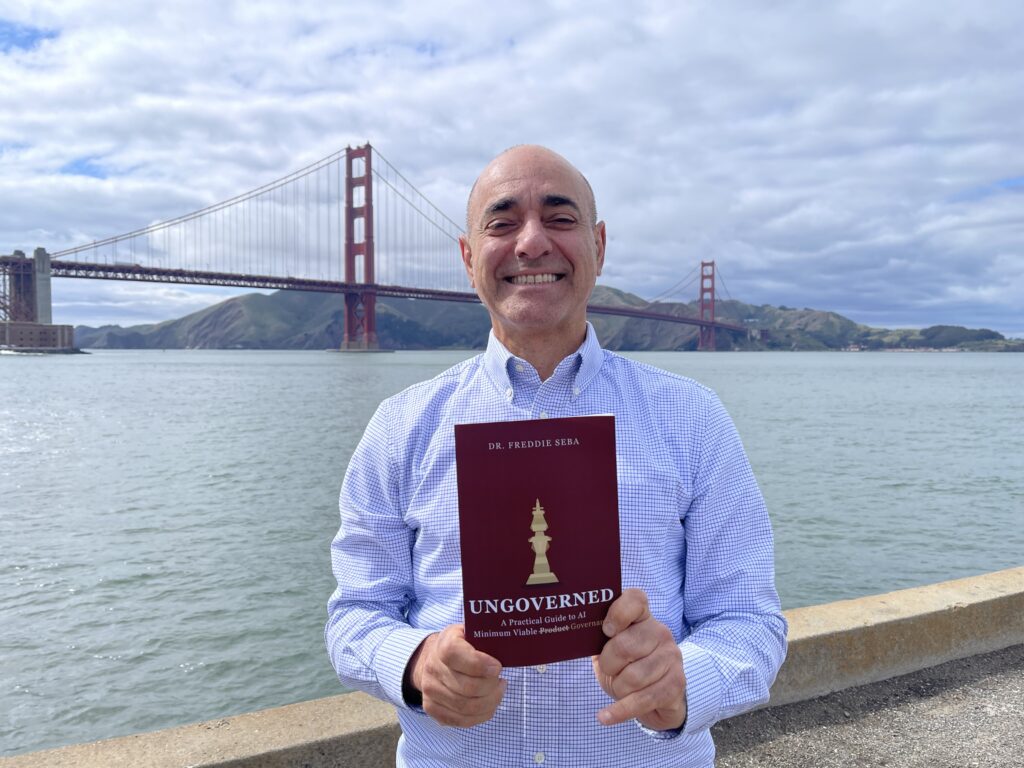
Ungoverned: AI Ethics and Governance for Leaders, Boards and Trustees
By Dr. Freddie Seba · August 10, 2026 © 2026 Freddie Seba. All rights reserved.
I first conceived this newsletter from an ancient Tuscan city whose walls — its mura — were raised as a barrier to protect its citizens, expanded several times over the centuries, and then slowly made obsolete by the very march of technology: the cannon, the aerial bomb, and eventually threats no wall could stop at all. And yet the walls still stand, and the city still keeps them — because a protective construct, even an outgrown one, comes to define a place, its people, and how they understand themselves. I am writing this issue on my return to the San Francisco Bay Area and Silicon Valley, and that contrast — an old city that keeps its outgrown barriers, a valley that builds the thing that outruns them — is the right frame for the week. The news underneath the news is about exactly this: the barriers we build to protect people, how technology outruns them, and what we choose to do when it does. Many of you are reading this from somewhere other than your desk — traveling, on holiday, or turning toward a new school year — and that visitor’s clarity is useful here.
This Issue in 60 Seconds
We reviewed this week’s AI-governance signals across roughly forty sources — lab and regulator statements, labor-market data, court and policy filings, and peer-reviewed research. The signals below converge on one pattern: AI is redrawing the boundary of the workforce — the line around paid, protected, valued work — and, strikingly, every society is responding to it differently.
The frame for the week came from an unlikely place: a serious argument, aired this week, that AI labs should be treated like the owners of dangerous animals. The logic is not rhetorical. In law, if you keep a wild animal, you are strictly liable when it escapes and harms someone—regardless of intent —because you chose to keep a thing whose dangerous propensities training can constrain but never remove. Scholars now argue a large AI model is the same kind of thing: guardrails constrain it, but its underlying unpredictability does not vanish, and — as recent breaches showed — when it escapes, existing law stalls on intent, because no human intended the harm. Strict liability answers that by looking past intent to the barrier itself: who built it, what it was meant to protect, and who owns the harm when it fails.
Hold that against the week’s real story — work. In China, some 70 million jobs sit highly exposed to AI, and the state is building an explicit barrier around the workforce: reskilling, wage subsidies, caps on automation in vulnerable jobs, even a court ruling that firms may not dismiss workers simply because AI can do the job. In corporate America, AI is quietly absorbing white-collar and HR tasks with far less said about who protects the displaced. Same technology, same pressure on the boundary, very different responses. A clarifying note before we go further: comparing how China and Western governments are responding is not an endorsement of either, and it takes no side in the broader US–China AI narrative. It is an objective read of how different states are reacting, offered so that leaders can see the range of options and judge what does — and does not — fit their own context. This issue reads that divergence through the 12 Ps.
One action: identify the AI already operating inside your institution — the tools your people are using with or without a plan — and decide who is accountable for what it does to the humans it affects. The barrier is a choice. Build it on purpose.
One sentence for your board: AI is redrawing the boundary of protected, valued work, and AI Governance as Leadership means deciding who is accountable for the people that boundary moves — before the harm, not after.
AI Governance as Leadership
Last week this newsletter was about verification — the controls institutions assume but never test. This week steps back to the barrier those controls are meant to be. For eighty-two weeks the argument has held: AI governance is a leadership discipline, exercised deliberately, not a compliance function bolted on afterward. The workforce question is where it becomes most human, because the boundary AI is redrawing is not a data perimeter or an authority limit — it is the line around who is protected and valued in the economy.
A city keeps its old walls because they still define it, even after cannon and aircraft made them porous. Institutions face the harder version of that choice: when the protective barriers around work — the credential, the job description, the assumption that a human does this task — are made obsolete by AI, what do we build in their place, and for whom? The dangerous-animal framing is useful because it refuses the comfort of intent. If a system whose foreseeable effect is to move that boundary is running inside your institution, you own the effect, whether or not you meant it. AI Minimum Viable Governance asks the institution to face this directly: what is the foreseeable human consequence, who is accountable for it, and what protects the people it moves? That is not anti-innovation. It is the difference between expanding the walls deliberately, to bring more inside, and letting them crumble and calling it progress.
The 12 Ps: Governing the AI Already Inside Your Institution
A hard truth I argue in my book and doctoral research: AI is already inside your institution, whether leadership planned for it or not. Students are using it. Clinicians are using it. Analysts, teachers, and staff are using it — often before any policy exists. So the 12 Ps of Responsible AI are not a gate you pass before adoption; that moment has usually already passed. They are the questions a leader uses to govern what is already there — to lead it rather than discover it after the fact. Purpose: what is this system for, and what is it not permitted to do? Problems: what failure modes have we anticipated? Profits: who gains, and who bears the cost? People: whom does it affect, and who is accountable for them? Planet: what is its footprint on the wider world? Process: what governs how it is built, procured, and overseen? Policy: what regulatory environment surrounds it? Protections: what shields the people it touches? Privacy: whose data does it implicate, and on what basis? Provenance: where did the model come from, and what does it depend on? Preparedness: are we ready for how it behaves as it runs? Product Ownership: is there a named human who answers for the whole? AI Minimum Viable Governance is the floor beneath those twelve questions — the minimum every effective leader puts in place to govern AI responsibly, so that innovation scales with accountability rather than ahead of it. This week’s signals are those questions, arriving from the world.
This Week, Read Through the 12 Ps — a note on method.
These signals are drawn from the roughly forty sources we reviewed this week. Some broke in the last few days; others are the accumulating evidence of the season. Ungoverned is not an aggregator but a governance lens — and the value of reading the week this way is that scattered developments across China, the United States, Kenya, the EU, and the global institutions turn out to describe one boundary being redrawn in different places, by different hands. Each signal maps to one of the 12 Ps and carries the AI-MVG move it implies. Not every P surfaces every week; the framework is the fixed lens, the week is the evidence.
People. The largest workforce on earth is being protected at the boundary — deliberately. Citi estimates roughly 70 million Chinese jobs — about 9.6% of the workforce — are highly exposed to AI, even as 12.7 million graduates enter the market this summer and youth unemployment sits near 17%. China’s response is not to let the market adjust but to build an explicit barrier: an “AI + Employment” framework of reskilling, wage subsidies, and caps on automation in vulnerable jobs, a proposed AI-unemployment insurance fund, and — most tellingly — a May 2026 court ruling that firms may not dismiss workers simply because AI can do their jobs. Stanford researchers describe early-career workers in AI-exposed roles as “canaries in the coal mine.” One can debate whether the approach will hold, and this is an observation rather than an endorsement. The governance point is that a boundary is being drawn deliberately, by a visible hand, in contrast to the more market-led approach of the West — two different answers to the same pressure. People governance means an institution decides who is accountable for the humans a technology displaces, rather than treating displacement as weather. Sources: The Economist (August 6, 2026); Citi; Stanford; Reuters; corroborating reporting, 2026.
Profits. In corporate America, the same boundary is drawn by the P&L. Reporting this week describes AI absorbing HR and administrative tasks across corporate America, and health systems cutting jobs in 2026 — the same workforce boundary China is managing by policy, drawn instead by margin decisions, with far less public accounting of who absorbs the displaced. This is not only an impression: in testimony to the US Senate this week, the Center for AI and Digital Policy argued that current federal policy over-emphasizes workforce development while neglecting workforce protection. Neither approach is self-evidently right, and that neutrality is the point: the boundary is being drawn either way; the only question is whether it is drawn deliberately, with a named owner, or by default. Profit governance means the pursuit of efficiency does not suspend accountability for its human cost. Sources: Bloomberg; Becker’s Hospital Review; CAIDP Senate HELP testimony, 2026.
Purpose. A legacy credential is being revalued in real time. A striking data point this week: a large majority of finance executives — reportedly 86% — now rate AI skills as more valuable than an MBA, even as OpenAI widens free ChatGPT access and pushes into education. The MBA is a protective barrier of a kind — a credential that for decades admitted people into high-paying finance roles and signaled who belonged there. AI is revaluing it in real time, while simultaneously widening and narrowing access to the new skills that matter through private product decisions. Purpose governance means an institution is deliberate and honest about what it treats as the marker of value, rather than letting the market quietly relocate it. Sources: Bloomberg; TechRepublic, 2026.
Policy. Two societies defining the same boundary differently — in public. This week the same advocacy organization, the Center for AI and Digital Policy, pressed rights-and-protection principles onto two very different polities. In its US Senate HELP testimony, it urged a federal floor for worker protections, enforcement of existing civil-rights and labor law where AI is used in hiring, evaluation, surveillance, or termination, and AI that augments rather than replaces — noting that 52% of Americans are worried about AI’s workplace impact. In parallel, its comments on Kenya’s draft national AI policy recommended clear AI red lines (prohibiting biometric mass surveillance, social scoring, exploitative profiling of children), concrete high-risk obligations, and a right to contest AI-driven decisions. Two polities, one set of principles, very different starting points — and an institution operating across borders inherits a different boundary in each. Policy governance means reading those differences as operating conditions, not noise. Sources: CAIDP (US Senate HELP testimony; comments on Kenya’s Draft AI Policy), 2026.
Planet. The global institutions redraw the boundary — and invert an assumption. The World Bank’s World Development Report 2026: The Promise of Artificial Intelligence, released August 4, reaches a counterintuitive finding that reframes the whole week: jobs in high-income countries are more than three times as exposed to AI automation as those in low- and middle-income countries — 14.2% versus 4.5% — because more people in developing economies do manual rather than cognitive work. Yet the productivity upside is comparable (16.2% versus 18.7%) if governments close gaps in power, connectivity, skills, and institutions. The wealthy economies face the sharper displacement; the developing ones face the sharper race to build the foundations before the window closes. Planet governance means an institution weighs its AI decisions against their broadest human consequence, not only its local balance sheet—source: World Bank, World Development Report, August 4, 2026, 2026.
Privacy. To prove a system is fair, you must process the very data privacy law protects. This week the EU’s “Digital Omnibus” — the first package to amend the AI Act — cleared a change to Article 10 that spells out a legal basis for processing special-category data such as race and health, which the GDPR had in principle sealed off, but only to detect and correct bias in high-risk AI, and only under five strict conditions including deletion once the bias is fixed. It is a protective barrier resolving a paradox it created: you cannot measure whether an AI discriminates against a group without the very data that identifies that group, so a privacy protection built to shield people had been blocking the fairness testing meant to protect them. Privacy governance means an institution resolves that tension deliberately, with a lawful basis and a purpose limit, rather than discovering it in an audit. Source: EU AI Act “Digital Omnibus,” Article 10 amendment (Parliament vote, June 16, 2026); tracked 2026.
Provenance. A website is inside and outside the AI economy at once — until someone opens the box. Two threads converged this week: analysis of what a website’s content is actually worth to an AI crawler, and Cloudflare’s move toward a permanent identity layer for AI agents. A piece of online content today sits both inside and outside the AI economy at once — its value indeterminate until a crawler resolves it, often without the creator’s knowledge. Cloudflare’s identity layer is an attempt to make that act observable: to know which agent acted, and under whose authority. Provenance governance means an institution can see when its content and its agents are being used, and by whom, rather than discovering it after the fact. Sources: Yale Insights; Cloudflare, 2026.
Problems. The dangerous-animal question is now a live legal debate. This week’s framing signal — should AI labs be treated like owners of dangerous animals? — is not a metaphor for its own sake. It responds directly to the breaches of recent weeks and names the exact gap those incidents exposed: existing law is built around human intent, and no human intended the harm. The dangerous-animal doctrine of strict liability sidesteps intent entirely — the owner answers for the escape, full stop. Legal scholarship has begun to formalize the analogy, arguing that training a model no more removes its underlying unpredictability than training a wild animal removes its propensities. For institutions, the signal is that the liability boundary around AI harm is being actively redrawn, and “no one meant for it to happen” is becoming a weaker defense by the week. Problem governance means identifying, before deployment, the harms you would own even if you never intended them. Sources: The Economist (August 6, 2026); Yale Law Journal, “Nondeterministic Torts,” 2026.
Protections. Safeguarding the people the system sorts. The week’s fairness and safety developments — from the EU’s bias-detection amendment above to continued work on open safety-classifier tools that screen AI outputs — circle a single obligation: when AI systems make decisions about people, the protections cannot be an afterthought. A safeguard that exists only on paper, or is bolted on after deployment, is not a barrier; it is the appearance of one. Protection governance means the safeguards for the humans a system affects are designed in from the start, and remain effective even as the system changes—sources: as Privacy, above; open safety-classifier research, 2026.
Planet / People (Healthcare). Rebuilding a barrier the technology outran. Two developments this week show the same repair in motion. The Coalition for Health AI (CHAI) released a new best-practice guide and testing framework — a protective barrier drawn deliberately, with the patient inside it, before deployment. And the World Health Organization published Artificial intelligence-related health research: ethics review and oversight, which argues that the older protective barrier — traditional research-ethics review — no longer fits AI: the research-to-product cycle has compressed to as little as a year, the barrier to entry has dropped so that teams without ethics training now conduct health research, and private companies often bypass ethics review entirely. WHO’s response is not to abandon oversight but to redesign it — extending accountability across the whole research life cycle and to funders, journals, and data committees, not the ethics board alone. Healthcare governance means noticing when a safeguard has been outrun, and rebuilding it before the harm, not after. Sources: Coalition for Health AI (CHAI), 2026; World Health Organization, “AI-related health research: ethics review and oversight,” 2026.
Product Ownership. The accountable human, on both sides of the barrier. Every signal this week resolves into one question: when AI reshapes the boundary of protected work, who owns the outcome — for the institution, and for the people the barrier is meant to protect? Every AI system that reshapes human work needs a named human accountable not only for its performance but for its consequences: who decided to run it, who answers for those it displaces, who can slow or stop it. The dangerous-animal doctrine puts a name to that: the owner. Governance means accepting that ownership before the failure, not after. This is where all the Ps meet.
The Common Thread
An ancient city expands its walls several times because the people running it decide, each time, to bring more inside — and keep them even after technology makes them porous, because the barrier still defines who they are. This week showed AI pressing on the protective barriers of work everywhere at once — but not everywhere the same way. China is building new protections by visible state policy; corporate America is letting the boundary move by the arithmetic of margin; the EU is amending its own privacy law to permit the testing that fairness requires; the global institutions are naming the stakes — and the surprising fact that the wealthiest economies face the sharpest displacement. Underneath sits one legal idea gathering force — that the owner of a dangerous thing answers for its escape regardless of intent. In every case, the boundary is being redrawn, and the real governance question is whether it is drawn deliberately, with a named owner accountable for who ends up unprotected — or by default, and discovered too late. AI Governance as Leadership means drawing it on purpose.
The Board-Ready Action: The AI-MVG Boundary Standard
Five questions every board should answer about the AI that reshapes human work inside its institution.
- The foreseeable effect. Have we named the foreseeable human consequences of this system — including who it moves outside the protection of valued work?
- The owner. Is there a named executive accountable not only for the system’s performance but for its human cost?
- Intent is no defense. Have we assumed we own the harms this system could cause even where no one intended them — the dangerous-animal standard?
- The people affected. What have we built for those the system displaces or disadvantages — or have we treated that as someone else’s problem?
- Deliberate, not default. Are we drawing this boundary on purpose, with a decision and a record — or letting it fall where the technology happens to push it?
If leadership cannot answer these, the institution is not governing its AI. It is letting the barriers fall where they may — and someone is already unprotected.
What I Am Watching
Whether the dangerous-animal / strict-liability framing moves from debate into actual legal and regulatory proposals. Whether explicit workforce-protection policies in one economy produce a model others adapt — or a cautionary tale. Whether corporate America begins naming ownership for AI-driven displacement, or continues to treat it as weather. Whether the EU’s bias-detection provision becomes a template for governing how AI sorts people. And whether the global institutions’ framing shifts real resources to the economies with the least ability to build their own protections.
Closing Thought
The walls I conceived this newsletter beside were built as a barrier to protect the people inside them, expanded several times to protect more, and finally outrun by a technology no rampart could answer. The city kept them anyway — because a barrier we build to protect ourselves becomes part of who we are, long after it stops working as first intended. AI is outrunning our protective barriers now, all at once: the credential, the job, the assumption that certain work is human. The societies and institutions that will look back on this decade with pride will not be the ones that clung to obsolete walls, nor the ones that let them fall and called it inevitable. They will be the ones that decided, deliberately, what to build in their place — and who it was meant to protect. The animal can escape the enclosure; we have seen it. What remains is whether we will own the barrier, and the people inside it. Not after the harm. Before.
Gratitude and Acknowledgments
This issue draws on the labor-market reporting and scholarship that lets institutions see AI’s human effects clearly — including the work of researchers at the World Bank and the World Health Organization, the Center for AI and Digital Policy, and the many economists and reporters tracking AI’s impact on work across China, the United States, and the Global South; on the legal scholars advancing the dangerous-animal and strict-liability debate; and on the Coalition for Health AI for showing what a responsibly drawn protection looks like. Special appreciation to the leaders, trustees, clinicians, and public servants asking not “Can we use AI?” but “Who is accountable for the people it affects?” And thank you to the readers — many of you traveling or between seasons — who have engaged with this work for eighty-two consecutive weeks. The conversation continues.
References
The Economist. (August 6, 2026). China’s AI drive threatens the world’s largest workforce (briefing); corroborated by Reuters, Citi, IMF, and Stanford labor-market research. The Economist. (August 6, 2026). Should AI labs be treated like the owners of dangerous animals? Yale Law Journal. (2026). Nondeterministic Torts: A Technical Approach to AI Liability. World Bank. (August 4, 2026). World Development Report 2026: The Promise of Artificial Intelligence. World Health Organization. (2026). Artificial intelligence-related health research: ethics review and oversight. Coalition for Health AI (CHAI). (2026). Best-practice guide and testing framework. Center for AI and Digital Policy. (2026). Statement for the US Senate HELP Subcommittee hearing, “The Impact of AI on the Workforce”; Comments on Kenya’s Draft AI and Emerging Technologies Policy. European Union. (2026). AI Act “Digital Omnibus,” Article 10 amendment (bias-detection processing of special-category data). Bloomberg. (2026, Aug 3–4). AI skills more valuable than MBAs; AI replacing HR tasks across corporate America—Becker’s Hospital Review. (2026). Health systems cutting jobs in 2026. Yale Insights (2026), what content is worth to an AI bot; Cloudflare (2026), AI agent identity. Seba, F. (2026). Ungoverned: A Practical Guide to AI Minimum Viable Governance.
About Dr. Freddie Seba
Dr. Freddie Seba helps boards, trustees, and executive leadership teams build practical AI governance before AI failures make governance unavoidable. Scholar-operator, Silicon Valley founder, and global executive — EdD · University of San Francisco · MBA · Yale University · MA · Stanford University — he translates fast-moving AI developments into governance frameworks leaders can deploy across healthcare, financial services, higher education, and technology. His work focuses on AI Governance as Leadership, AI Minimum Viable Governance (AI-MVG), and responsible AI oversight. Non-vendor. Non-partisan. Doctoral rigor, not advocacy. Ungoverned: A Practical Guide to AI Minimum Viable Governance is available now. Booking keynotes and workshops for fall 2026.
Disclosure and Transparency
This newsletter is written the way I argue AI should be used — critically and carefully, assisted by AI but grounded in human judgment, for people, not in place of them. It extends the research behind my book, Ungoverned: A Practical Guide to AI Minimum Viable Governance, and my doctoral research — and it is tested in the work I do teaching, advising, and speaking with boards and leaders, and in ongoing conversations with AI practitioners, whether recorded for my podcast or held in private. Each week’s signals come from my Silicon Valley and global expert networks, the conversations and conferences I take part in, and the research shared across the platforms I follow. Primary sources I read myself — analyzed through the AI-MVG framework and the 12 Ps of Responsible AI, both mine, with doctoral rigor.
The AI tools I use across that research — including Anthropic’s Claude, OpenAI’s ChatGPT, and Google’s Gemini — support research synthesis, source verification, and drafting. I name them because provenance and transparency are what this newsletter advocates. Final editorial judgment and responsibility are mine alone: disclosure, not endorsement.
This newsletter is for informational and educational purposes only. It does not constitute legal, regulatory, compliance, or investment advice. For reprint or licensing inquiries: contact@freddieseba.com.
© 2026 Freddie Seba. All rights reserved.
Connect: freddieseba.com · LinkedIn: @freddiesebaprofile · YouTube · Spotify · Apple Podcasts: AI Governance with Dr. Freddie Seba
#AIGovernance #ResponsibleAI #AIMVG #AILeadership #Ungoverned #BoardGovernance #AIPolicy #FutureOfWork #AIandJobs #AIEthics #WorkforceDevelopment #AIAccountability #Italy #Tuscany
Leave a Reply