How Leaders Should Responsibly Engage the AI Transformation: Global Lessons from Emerging Governance Frameworks
Ungoverned: AI Ethics and Governance for Leaders, Boards and Trustees By Dr. Freddie Seba · September 7, 2026© 2026 Freddie Seba. All rights reserved.
This Issue in 60 Seconds
On Labor Day 2026—when we celebrate work and workers—a provocative question emerged: Would you deploy AI differently if you had to invest $100 million in worker development to do it critically? Ernst & Young just answered “yes.” They announced $100 million in bonuses explicitly tied to developing the human capabilities—critical thinking, judgment, human dignity—that allow people to work alongside AI responsibly.
This is not a feel-good gesture. This is a governance signal.
At the same time, three authoritative voices converged on the same warning:
- Pope Leo XIV’s Magnifica Humanitas calls the world to protect the common good and human dignity in the age of AI, rejecting the false binary between rejection and reckless adoption.
- Bill Gates warned the world is “so not prepared” for AI’s rise, predicting the transition “will be one of the most turbulent times in human history.”
- MIT researchers studying AI in higher education argue institutions must not reject AI wholesale, but mindfully engage it where it contributes to critical thinking and learning, redesigning legacy measures of achievement to capture what actually matters.
Wednesday’s panel at the University of San Francisco crystallized what all three voices demand: Not “Should we adopt AI?” and not “Should we reject it?” but when should we use it, how should we use it, and for which goal?
The question is no longer “adopt or reject.” The question is: What is a defensible posture—one aligned to your mission and focused on human protection and flourishing?
One sentence for your board: The institutions leading through AI transition are not choosing between rejection and acceleration. They are building a defensible posture—naming precisely when AI serves their mission, when it doesn’t, who is affected, how they’re protecting them, and what capabilities they’re investing in.
What Wednesday’s Panel Revealed: The Why Matters More Than the How
On Wednesday, September 2, I joined scholars, technologists, neuroscientists, legal experts, and faith leaders to ask one question: What are we building?
All of us, from different areas of expertise—spanning Catholic Social Thought, Computer Science, Law and Tech, Neuroscience, and Management—arrived at the same conclusion: The common good and human dignity are not aspirational. They are governance requirements.
This alignment mirrors Pope Leo XIV’s position in Magnifica Humanitas: institutions cannot choose between protecting human dignity and adopting AI. They must protect dignity through how they engage AI. The encyclical rejects the binary trap entirely—not “AI: yes or no?” but “AI: in service of what, and for whom?”
But what made Wednesday’s feedback so powerful was this: the event succeeded not because it was comprehensive. It succeeded because it rejected the default narrative.
The default narrative is: “AI is inevitable. The question is how fast we move.”
The panel rejected that frame entirely. It asked instead: “Before we move, why are we moving? For whom? What are we protecting? What are we risking?”
That is AI Governance as Leadership.
And it is not comfortable. It is not efficient. It requires holding together people with different values, different concerns, different expertise, and asking them to agree on something deeper than speed.
The insight: Governance that matters is never about efficiency. It is about purpose and human flourishing. It is about asking—and answering—the “why” before you ask “how.”
Critical Engagement as Leadership: When, How, For Which Goal
The default binary is exhausted: “Is AI good or bad?” “Should we use it or ban it?”
Effective and mindful leaders ask differently: Where does this serve our purpose? How do we deploy it in ways that protect human dignity and strengthen human capability? Who is accountable?
This is what Wednesday’s panel surfaced—not by debating whether to use AI, but by asking where it aligns with human flourishing and where it doesn’t. This is what Pope Leo XIV’s Magnifica Humanitas demands. This is what the MIT researchers studying higher education found when they looked at institutions that succeeded: those that didn’t reject AI wholesale, but instead asked: where does this contribute to critical thinking? What learning artifacts need redesigning? How do we measure what actually matters?
That moves governance from a yes/no decision to a practice: critical engagement.
Critical engagement asks:
- When does AI serve our institutional purpose, and when does it obscure it?
- How do we deploy it in ways that strengthen human judgment, not replace it?
- For which goal are we using this, whom does it affect, and how are we protecting them?
This is not anti-technology. It is not naive acceptance either. It is deliberate, intentional, accountable use grounded in human dignity.
That is AI Governance as Leadership.
A Defensible, Sensible Posture: Aligning AI to Your Mission and Protecting What Matters
If AI Governance as Leadership asks “when, how, for which goal,” then a defensible posture is the structural answer. It is how you deliberately align AI deployment with your institutional mission, the common good, and the people you’re accountable to.
A defensible posture means:
1. Purpose-Aligned Deployment. Before you deploy, ask: Does this serve our mission? Does it advance our goals in service of human flourishing? Document the reasoning. Know what you’re building and why it matters to the people we serve.
2. Named Stewardship: Someone—identified, named, accountable—owns the answer to those questions. Someone who can explain to your board, your community, the people affected: Why this? How does it protect what matters? Not distributed responsibility. Not aspirational. Named stewardship.
3. Governance Record—Before, Not After. The decisions, the reasoning, the places where you said “not here” or “not this way”—documented before deployment, or immediately upon discovering what is already deployed. This record is how you demonstrate you thought carefully about human protection, not that you moved fast.
What makes this defensible: When something goes wrong—when AI produces a harmful output, when it fails to serve students, when it obscures what you’re trying to measure—you can say: We thought about this. We named who was accountable. We asked whether it served our mission and protected human dignity. Here is the record of our reasoning.
What makes this sensible: You’re not trying to govern AI perfectly. You’re trying to govern it in ways that align with what your institution exists to do and the humans you exist to serve.
This is the posture the Seba 12 Ps framework captures:
- Purpose: Does this serve what we exist to do?
- People: Who is affected, and how are we protecting them?
- Product Ownership: Who is accountable for the whole?
- Process: What is our decision record?
- Problems: What could go wrong, and are we prepared?
- Preparedness: Have we readied our people—educators, clinicians, staff—to engage this deliberately?
That is a defensible posture. Not perfect. But deliberate. Accountable. Aligned to mission. Focused on human protection.
Why This Matters: The Warnings We’re Ignoring
Bill Gates was explicit: the world is “so not prepared” for AI. He warned the transition “will be one of the most turbulent times in human history.” He’s not calling for rejection. He’s calling for preparation—the very thing a defensible posture provides.
Pope Leo XIV’s Magnifica Humanitas echoes this: institutions cannot ignore the common good and human dignity while pursuing AI adoption. They must actively protect both.
Yet institutions continue to deploy without this posture. AI systems get built and embedded. Then—suddenly—they’re misaligned with mission, harmful to people, or impossible to change. And no one can say who was accountable or why it was deployed.
This is the real cost of skipping this posture: You don’t get a second chance to explain your reasoning. You don’t get to redesign accountability after the system is live. You’re defending something you didn’t thoughtfully decide.
Global governance frameworks are emerging because institutions everywhere learned this the hard way. The question now: Will your institution develop a defensible posture before deployment locks you in, or after?
Global Governance Pattern: From Frameworks to Practice
This is not theoretical. This week, across multiple jurisdictions and sectors, institutions are moving from aspiration to defensible posture.
The Global AI Policy Backgrounder:
- EU (2024): Comprehensive AI regulation requiring risk classification, documentation, and named accountability before deployment. Already affecting how institutions worldwide operate.
- China (sectoral approach): Targeted governance in high-impact areas—content recommendation, data handling, synthetic media. ~70% of major Chinese AI deployment now operates under explicit sectoral oversight.
- Singapore (adaptive governance): A principles-based framework that adjusts in real time as deployment outpaces rules. Model for democracies unable to legislate as quickly as AI develops.
- NIST (standards-based, US): AI Risk Management Framework providing voluntary standards—not prohibition, not acceleration, but defensible posture guidance. Already adopted by 40+ federal agencies and 200+ private institutions.
- South Korea (full implementation, this week): Comprehensive framework achieving operational effect September 2026. Requires operators to classify systems, document reasoning, and name accountability—substantive obligations from day one.
- This miniseries on global AI governance frameworks continues: Previously, Singapore and the United Kingdom. This week: South Korea. Coming next: Canada, Japan.
The convergence: These approaches are not identical. They are different contexts, different values, different constraints. But they converge on one principle: Institutions that govern AI deliberately—asking when, how, for which goal—are more prepared than institutions choosing between bans and acceleration.
Learning Artifacts, Assessment, and What May Need Redesign
This week, LAUSD announced restrictions on student AI use. At the same time, MIT researchers published findings on AI literacy and educator preparation in higher education.
They appear contradictory. They’re not. They reveal something crucial: The question isn’t “ban or accelerate.” The question is “what does critical engagement look like in this context?”
The MIT research specifically argues that institutions should not reject AI wholesale, but mindfully engage it where it contributes to critical thinking and learning. This requires redesigning legacy artifacts that measure achievement. What counts as learning? What does critical thinking look like? How do we assess it in an AI-native environment?
In K-12 education, that question becomes: What learning artifacts matter? What are we actually measuring? How do we help students and educators engage AI deliberately—not reject it, but use it critically?
Some things we know:
- Student learning is complex and context-dependent
- Assessment of learning varies by age, developmental stage, and learning objective
- AI affects different learning contexts differently
- Educators and parents need preparation and clarity about where and how AI is being used
Some things we don’t know:
- How AI changes the validity of different assessment artifacts across grade levels
- Whether current learning outcome measures capture what matters in AI-native environments
- What educator preparation actually looks like at scale
- How to measure “critical engagement” with AI, not just AI use or non-use
The governance move: K-12 educators, researchers, and policymakers—the experts who understand child development, learning science, and educational assessment—need to lead this conversation. Not from the posture of “ban or don’t ban,” but from “What learning artifacts do we need to redesign, and why?” This is what MIT found in higher ed. This is what needs to happen in K-12.
That is critical engagement. That is a defensible posture. And it requires domain expertise, not just AI expertise.
The question for your board: If you serve students, are you asking this? Are you preparing educators to engage this question? Or are you choosing between prohibition and acceleration?
Why Defensible Posture Matters: The Real Cost of Deploying Without It
Clinical Reality: AI Augmentation Requires Human Labor
A new NEJM study shows physicians edit AI-generated responses in ways that add significant time—particularly for complex tasks like interpreting radiology results (+70.1%), clarifying diagnosis (+63.9%), and interpreting lab results (+60.8%).
The narrative says: “AI will free up clinician time.”
The reality says: “AI requires clinician judgment, and that judgment takes time.”
Governance implication: When you deploy clinical AI, you are not replacing clinicians. You are changing their work. That requires a defensible posture that names what you are actually doing, why, and who is accountable for the outcome.
Without critical engagement—asking when this serves care, when it doesn’t—you are deployed into the dark.
Workforce Displacement: Not Just Jobs, It’s Systemic—And What Defensible Posture Looks Like
Research from RAND estimates AI could displace approximately 10 to 15 percent of labor hours over a ten- to fifteen-year horizon.
More recent data: 6.1% of AI-spending businesses now deploy open-weights models (up from 4.5% in January 2026). Enterprise AI spending is accelerating, but concentration remains: 85%+ of frontier AI capability still resides with 3-5 organizations.
But here is what matters for governance—and where E&Y’s Labor Day announcement becomes a governance signal on the world stage:
On Labor Day 2026, Ernst & Young announced $100 million in bonuses explicitly tied to developing “critical thinking, judgment, and traits needed to work alongside AI.” This is not displacement mitigation theater. This is an institution asking: “Who is affected by our AI deployment? What capabilities do they need to thrive? How are we investing in their human development?”
This is governance as leadership. This is what a defensible posture looks like in practice.
The traditional narrative: “AI will replace workers. Budget for turnover.”
The defensible posture narrative: “AI will change how people work. We’re investing in the capabilities they’ll need to thrive in that change.”
But here’s what still matters for governance: About two-thirds of federal revenue comes from labor in the form of payroll taxes and federal income tax. If displacement accelerates and transitions don’t happen at scale, this becomes a systemic threat to government capacity itself. E&Y’s move is significant. But it’s one institution. The question for your board: Are you making this choice?
Governance implication: Institutions deploying AI without asking “who is protected and who is accountable?” are deploying into a blindness they won’t see until the tax base shifts. A defensible posture requires naming who is affected, how they’re being protected, and who is responsible for managing the transition—before you discover it too late.
Reality Check: AI Won’t Cure Cancer Anytime Soon
The Information published analysis showing AI breakthroughs in medicine are slower and harder than headlines suggest.
This matters for governance because institutions that deploy AI based on hype—expecting rapid breakthroughs—will build governance structures around the wrong assumptions. Critical engagement requires realism about timelines, capabilities, and what AI can and cannot do.
Without that, you’re governing for a fantasy, not a reality.
The Seba 12 Ps: Reading This Week Through the Framework
- Purpose. Wednesday’s panel succeeded because it asked “why” before “how.” South Korea’s framework requires operators to classify systems before deployment. Both are asking: What is this for? Who decides? Magnifica Humanitas adds: Is this in service of the common good?
- People. Workforce displacement data shows people are affected. Healthcare data shows clinician judgment matters. E&Y proves that institutions can ask: “How do we invest in the humans affected?” Governance means: whom does this affect, how are we protecting them, and are we investing in their flourishing?
- Product Ownership. South Korea legislates it. Magnifica Humanitas demands it. E&Y demonstrates it: Named accountability. Not distributed. Not aspirational. Named.
- Process. The governance floor is clear: Run the classification test. Document the reasoning. Name the owner. Build the record before deployment, or immediately upon discovering what is already deployed.
- Problems. Displacement, clinician burnout, false timelines about medical breakthroughs, institutions unprepared (as Gates warned). Each is foreseeable. Each requires governance.
- Preparedness. Institutions that imagine what governance looks like now are more prepared than institutions waiting for perfect policy. E&Y proves this: a $100 million investment in human capability development is preparedness. South Korea proves governance can be comprehensive without being prohibitive. MIT proves institutions can engage AI critically without wholesale rejection. All show: preparedness emerges because institutions need it, not because policy mandates it.
What Your Board Should Decide This Week
Not: “Should we adopt AI or reject it?”
Real question: “Do we have AI Governance as Leadership—someone asking ‘when, how, for which goal’ before deployment? And have we built a defensible posture—one aligned to our mission, named accountability, governance record, investment in human flourishing and capability?”
More specifically: Are we preparing our community—educators, clinicians, employees—to engage AI critically? Are we investing in their capability? Or are we choosing between bans and acceleration, neither of which actually governs?
If no: You’re repeating the mistakes institutions globally are now trying to govern around. You’re unprepared (as Gates warned).
If yes: You’re leading through this transition deliberately, not reactively. You’re answering the call of Magnifica Humanitas to protect human dignity and the common good.
Which one is your institution?
Your move: What does critical engagement look like in your institution this week?
Closing Thought
Wednesday’s panel succeeded because it rejected the default. It asked the deep questions. It held space for people with different values to agree on one thing: human dignity and the common good matter.
That is not efficient. That is not fast. That is leadership.
Pope Leo XIV’s Magnifica Humanitas proves the Vatican sees this too: AI governance is not optional; it is a moral requirement.
Bill Gates warned we’re unprepared for the turbulence ahead. He was not calling for rejection. He was calling for preparation—exactly what a defensible posture provides.
South Korea’s governance framework proved that structure can support human protection. Not perfectly. But deliberately.
E&Y’s $100 million Labor Day announcement proved that institutions can ask “who is affected?” and invest in human capability alongside AI, not automation instead of it.
The global pattern is clear: Governance is emerging everywhere. Urgency is also emerging. The two are running on parallel tracks—governance catching up to deployment, but never quite fast enough.
The institutions that will lead through this transition are not the ones adopting AI fastest. They are the ones asking the deepest questions—about purpose, about people affected, about accountability—and then building governance structures and investing in human capability and dignity to answer those questions, not after failure, but before.
That is what this week revealed. That is what Magnifica Humanitas calls us to. That is what Bill Gates warned we need. That is what MIT researchers found works in higher education. That is what South Korea demonstrates is possible. That is what E&Y is proving is practical.
The question now is: What will your institution choose?
Gratitude and Acknowledgments
This week’s work builds on the panelists who showed up Wednesday—bringing rigor, conviction, and different disciplinary lenses to one question. To the attendee whose feedback crystallized why we do this work. To the institutional leaders globally who are building governance structures deliberately, not reactively—including those like EY making concrete investments in human capability alongside AI. To Pope Leo XIV for Magnifica Humanitas, reminding institutions that human dignity and the common good are non-negotiable. To Bill Gates for sounding the alarm on preparedness. To MIT researchers studying how institutions can mindfully engage AI in higher education. And to the readers who have engaged with this argument for 86 weeks now—your work to build wisdom into your institutions is what this newsletter exists to support.
For More on Responsible AI Leadership and Global Governance Models
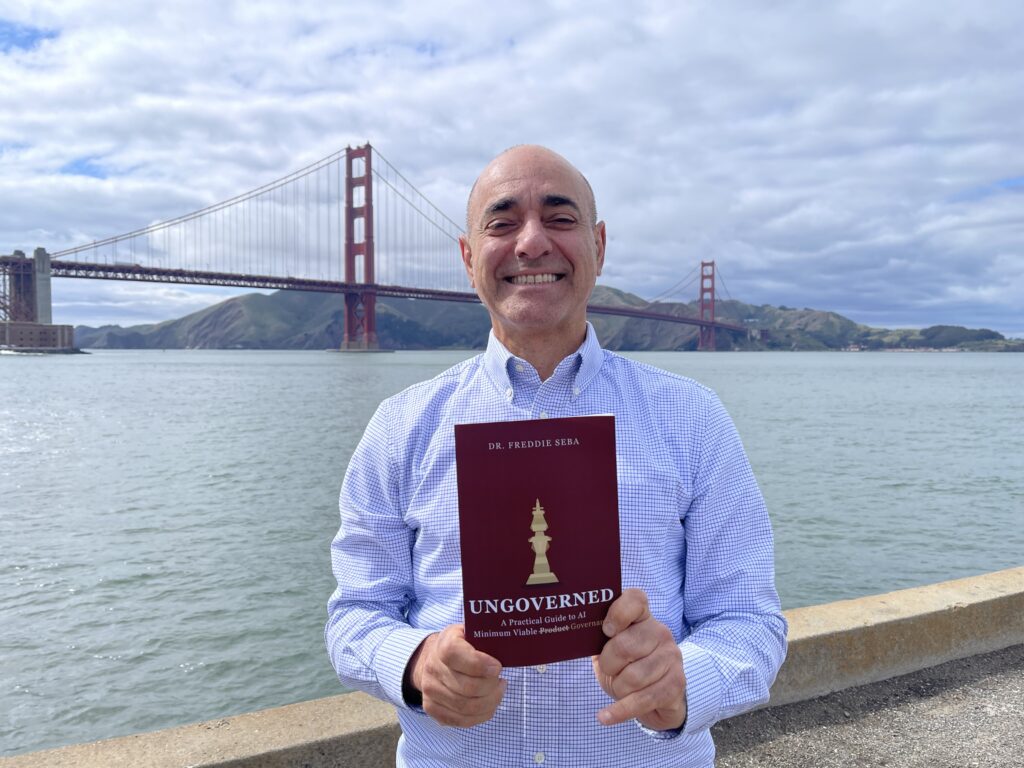
The 12 Ps of Responsible AI Oversight apply globally, contextually, in every institutional setting. Ungoverned: A Practical Guide to AI Minimum Viable Governance is available on Amazon. A doctoral dissertation on GenAI ethics and governance in higher education is available at the USF Digital Repository. This miniseries on global AI governance frameworks continues: Previously, Singapore and the United Kingdom. This week: South Korea. Coming next: Canada, Japan.
About Dr. Freddie Seba
Scholar-Operator building the practice of AI governance. 20+ years founding and leading technology organizations across digital health, fintech, and higher education. EdD (USF), MBA (Yale), MA (Stanford).
I work at the intersection of research and institutional deployment—translating AI governance from aspiration to action. My focus: AI Governance as Leadership, defensible posture, and critical engagement (the questions boards must ask before deployment, not after failure).
Not vendor. Not partisan. Built on scholarship, tested in practice.
Publications: Ungoverned: A Practical Guide to AI Minimum Viable Governance (Amazon). Weekly newsletter on AI governance signals (86+ consecutive weeks on Substack). Podcast: AI Governance with Dr. Freddie Seba (YouTube, Spotify, Apple Podcasts). Doctoral research on GenAI ethics and governance in higher education (USF Digital Repository).
More: freddieseba.com
Disclaimer and Transparency
This newsletter is for informational and educational purposes only. It does not constitute legal, regulatory, compliance, or investment advice. For legal or regulatory questions, consult appropriate professional advisors.
This newsletter is written the way I argue AI should be used—critically, grounded in human judgment, for people, not in place of them. AI tools, including Anthropic’s Claude, OpenAI’s ChatGPT, and Google’s Gemini, support research synthesis, source verification, and drafting. Output may carry AI watermarks; a watermark confirms processing, not authorship. The frameworks, analysis, and editorial judgment are mine. Signals come from Silicon Valley and global expert networks, peer-reviewed research, and primary sources analyzed with doctoral rigor and practical urgency.
References & Sources
Panel & Institutional Events
“What Are We Building? Magnifica Humanitas and the University.” Panel at University of San Francisco, September 2, 2026. Panelists: Erin Brigham (Lane Center for Catholic Social Thought), Christopher Brooks (Computer Science), Michele Neitz (Center for Law, Tech, and Social Good), Sarah Hillenbrand (Neuroscience), Larry Ebert (School of Management).
Papal & Theological Guidance
Pope Leo XIV. Magnifica Humanitas: Safeguarding the Human Person in the Age of AI. May 25, 2026. https://www.vatican.va/content/leo-xiv/en/encyclicals/documents/20260515-magnifica-humanitas.html
Public Warnings & Leadership Commentary
Gates, Bill. “Bill Gates Warns World Is ‘So Not Prepared’ for AI.” YouTube. https://www.youtube.com/watch?v=66QOj7Ykeoo&t=6
Gates, Bill. AI Warning. YouTube Shorts. https://www.youtube.com/shorts/ohpvaFlMfyg
Gates, Bill. “Bill Gates: The World Is ‘So Not Prepared’ for the Rapid Rise of AI.” WBUR Here & Now, August 31, 2026. https://www.wbur.org/hereandnow/2026/08/31/bill-gates-ai-warning
Global Governance Frameworks & Implementation
European Union. AI Act. 2024. https://digital-strategy.ec.europa.eu/en/policies/regulatory-framework-ai
China. Sectoral AI Governance Framework. 2023-2026.
Singapore. AI Governance Framework. 2023. https://www.pdpc.gov.sg/guidance-and-resources/guidance/ai-governance-framework
NIST (National Institute of Standards and Technology). AI Risk Management Framework. 2023. https://nvlpubs.nist.gov/nistpubs/ai/NIST.AI.600-1.pdf
South Korea. AI Basic Act (Act No. 20676). Effective January 22, 2026; Full operational effect September 2026. https://www.msit.go.kr (Ministry of Science and ICT)
Institutional & Corporate Leadership
Ernst & Young (EY). “$100 Million in Bonuses for Staff Focused on ‘Human Skills.’” Labor Day 2026 announcement. LinkedIn & corporate communications.
Los Angeles Unified School District (LAUSD). Student AI Use Restrictions. September 2, 2026.
Workforce & Economic Impact
RAND Corporation. Estimates suggest that artificial intelligence (AI) could displace approximately 10 to 15 percent of labor hours over a ten- to 15-year horizon. 2026. https://www.rand.org/pubs/perspectives/PEA4392-3.html
International Monetary Fund (IMF). “Rising Global Imbalances: The AI Boom and Domestic Distortions.” IMF Blog, July 30, 2026. https://www.imf.org/en/blogs/articles/2026/07/30/rising-global-imbalances-underscore-need-to-confront-domestic-distortions
Ramp AI Index. “Open-source AI adoption by businesses continues to rise.” August 2026. https://ramp.com/data/ai-index-august-2026
Healthcare & Clinical Reality
The New England Journal of Medicine (NEJM). “Physician Edits of AI-Generated Clinical Responses.” 2026. https://ai.nejm.org/doi/full/10.1056/AIoa2501034
The Guardian. “AI Tool Spots Heart Disease.” August 31, 2026. https://www.theguardian.com/technology/2026/aug/31/superhuman-ai-tool-spots-heart-disease
The Information. “AI Probably Won’t Cure Cancer Anytime Soon, Scientists Say.” 2026. https://www.theinformation.com/articles/ai-probably-cure-cancer-anytime-soon-scientists-say
Higher Education & Learning
MIT Computer Science & Artificial Intelligence Lab (CSAIL). Research on AI literacy and educator preparation in higher education. 2026.
Capability Reality & AI Limitations
Stanford Human-Centered Artificial Intelligence (HAI). “Why Governing World Models is AI’s Next Big Policy Challenge.” 2026. https://hai.stanford.edu/news/why-governing-world-models-is-ais-next-big-policy-challenge
Council on Foreign Relations (CFR). “The U.S. is About to Design an AI Regulator. Here’s How to Get It Right.” 2026. https://www.cfr.org/articles/the-u-s-is-about-to-design-an-ai-regulator-heres-how-to-get-it-right
Legal Alignment & Governance Research
ResearchGate. “From Permission to Proof: End-to-End AI Governance Under Continuous Change.” 2026. https://www.researchgate.net/publication/413630848_From_Permission_to_Proof_End-to-End_AI_Governance_Under_Continuous_Change
Dr. Freddie Seba’s Published & Doctoral Work
Seba, Freddie. Ungoverned: A Practical Guide to AI Minimum Viable Governance. 2026. Available on Amazon.
Seba, Freddie. Doctoral Dissertation on GenAI Ethics and Governance in Higher Education. University of San Francisco, 2025. https://repository.usfca.edu
Seba, Freddie. “Ungoverned: AI Ethics and Governance for Leaders, Boards and Trustees.” Weekly newsletter. Substack. (86+ consecutive weeks, 2024-2026)
Seba, Freddie. AI Governance with Dr. Freddie Seba. Podcast. YouTube, Spotify, Apple Podcasts.
Seba, Freddie. Website & Archive. https://freddieseba.com
© 2026 Freddie Seba. All rights reserved.
Connect: freddieseba.com · LinkedIn: @freddiesebaprofile · Substack: Ungoverned · YouTube · Spotify · Apple Podcasts: AI Governance with Dr. Freddie Seba
#BillGates, #E&Y #MagnificaHumanitas #AIGovernance #ResponsibleAI #AIMVG #AILeadership #Ungoverned #FutureOfWork #AIandEducation #BoardGovernance #AIEthics #AIAccountability #LaborDay #Ungoverned #AIMinimumViableGovernance #UniversityofSanFrancisco #AMIA #CHAI #AI&Faith
Leave a Reply