Ungoverned: AI Ethics and Governance for Leaders, Boards and Trustees
By Dr. Freddie Seba
© 2026 Freddie Seba. All rights reserved.
September 28, 2026
OPENING NARRATIVE FRAME
For eighty-nine weeks and eighty-nine issues of this newsletter, and across three years of doctoral research that became Ungoverned: A Practical Guide to AI Minimum Viable Governance, I have held one argument. AI governance is not a compliance function. It is a leadership discipline, exercised deliberately, before deployment.
Last week, we asked whether AI should be governed by industry alone or together with society and government. This week, governments on three continents began answering, in writing.
On September 18, California Governor Gavin Newsom signed Executive Order N-9-26. It directs state agencies to assess four measures for frontier AI developers:
- independent verification organizations embedded onsite in the labs
- independent verification of the safety frameworks and risk assessments those labs already file
- a “kill switch” for frontier models, with its efficacy verified on an ongoing basis
- an expanded definition of reportable critical safety incidents that covers loss-of-control events
The order cites attempts to misuse AI for bioweapons and AI agents defeating security protocols, in some cases undetected for months.
The same week, twenty-two heads of government and senior officials published A Call for Control of Frontier AI Models. Signatories included leaders of Canada, Germany, Spain, Singapore, Australia, Kenya, South Africa, and the European Commission. They called for three things:
- mandatory pre-deployment testing and independent evaluation of frontier models
- shared reporting of serious safety incidents
- a UN-anchored international institution able to set standards, enable verification, and convene states when capability thresholds are crossed
In Beijing, China’s National Technical Committee 260 released the AI Safety Governance Framework 3.0. It devotes an entire appendix to agentic AI risk. It also names, as documented industry patterns, models that refused shutdown commands, underperformed strategically when they detected evaluation, and escaped test environments.
Italy’s Legislative Decree No. 160, part of one of the first complete national architectures for implementing the EU AI Act, enters into force by September 30.
In Washington, the approach differs. The White House continues to favor a voluntary framework in which frontier companies police themselves. One administration official told Axios that companies worried about the risks can throttle their own models.
These are not opposing camps. They are different answers to the same question: who verifies, who enforces, and who is accountable when an AI system acts outside its bounds?
For boards, the lesson is practical. Regulation is arriving unevenly, in different forms, in different jurisdictions, on different timelines. Your institution will not get to choose which regime applies. The only sound strategy is to build governance that satisfies the most demanding of them before the inspectors arrive.
THIS ISSUE IN 60 SECONDS
We reviewed 73 sources this week. They include executive orders, international statements, national frameworks, draft legislation, peer-reviewed studies in health and education, public-opinion research, and investigative reporting on AI safety incidents. One pattern converges: AI governance is moving from voluntary commitment to verifiable obligation.
The evidence driving the shift is specific. Google confirmed that Gemini accessed the protected systems of three companies during third-party cybersecurity testing. In one case, it guessed passwords; in two others, it found exposed credentials. The testing firm reportedly notified Google in late July. The companies confirmed the incidents publicly only after The Wall Street Journal asked. This followed OpenAI’s earlier breach of Hugging Face, and OpenAI’s disclosure of six new incidents alongside a voluntary incident-reporting playbook.
The public is ahead of many policymakers. In a nationally representative UK survey by the Ada Lovelace Institute and the Alan Turing Institute:
- 88% say government or regulators should have the power to stop an AI product that poses serious risk.
- More than 75% want government or independent regulators, rather than companies alone, to oversee AI safety.
- 72% say laws and regulation would make them more comfortable with AI, up from 62%.
In the U.S., Gallup finds 74% of Americans report worry about AI.
There is also a serious counterargument. Critics warn that safety regulation can become regulatory capture, entrenching the largest incumbents against open-source and startup competitors. Boards should hold both concerns at once. Verification should be independent, and compliance should be proportionate.
THE WEEK AHEAD ON UNGOVERNED
Heads up: our miniseries on AI governance across highly regulated industries continues. Last week we examined healthcare. This week we turn to higher education.
I focus on healthcare, higher education, and financial services because I am a researcher-practitioner with hands-on experience in all three. These industries are highly regulated, deeply human, and unforgiving of governance failure. The goal is not to prescribe. It is to surface lessons that leaders in any industry can adapt to their own context and constraints.
Wednesday, September 30: Ungoverned AI | Higher Education
The Accountability Gap: What Frameworks Designed to Govern Deterministic Systems Cannot Audit
Friday, October 2: Ungoverned AI | Enforcement: Higher Education
When Regulators Draw Lines Without Formal Guidance
Follow along on LinkedIn, Substack, and freddieseba.com.
ONE ACTION
Before your next board meeting, ask your executive team one question: “If a regulator, auditor, or journalist asked us tomorrow to show how we would detect, stop, and report an AI system acting outside its authorized scope, what would we hand them?”
If the answer is a policy document with no named owner, no tested stopping mechanism, and no incident definition, you do not have governance. You have intentions.
ONE SENTENCE FOR YOUR BOARD
Regulation is arriving unevenly across jurisdictions, so the institutions that lead will be those that govern to the highest standard before they are required to, not those that wait to learn which rules apply.
FROM VOLUNTARY TO VERIFIABLE: The Enforcement Shift
For three years, most AI governance has rested on voluntary commitments: published safety frameworks, model cards, responsible-scaling policies, and pledges. This week showed where voluntary governance reaches its limit. It depends on the goodwill of the governed.
SaferAI’s executive director, Henry Papadatos, captured the concern when speaking to Axios about company-led approaches. He said the companies’ efforts are good, but rest only on goodwill, which he does not consider sufficient.
The Gemini disclosure illustrates the gap. Google said Gemini had “acted appropriately” by ending each breach once it realized it had reached a real company. Corridor CEO Jack Cable argued in the Journal that Google was sheltering behind vulnerability-disclosure norms instead of acknowledging that models are exceeding their bounds.
Both statements can be true. The model stopped. The public learned only when a newspaper asked. That is precisely the gap enforcement is designed to close.
Three enforcement models emerged this week.
1. Embedded verification (California). Executive Order N-9-26 asks state agencies to assess four measures, with recommendations due by November 16, 2026:
- placing certified independent verification organizations inside frontier labs
- independently verifying the safety filings labs already submit
- engineering and continuously verifying a kill switch
- expanding reportable incidents to cover loss of control
It builds on California’s frontier AI law, SB 53, now in effect.
2. International coordination (the 22-leader Call for Control). The statement asks for:
- company safety protocols that include mandatory pre-deployment testing and independent evaluation
- common government standards, including shared incident reporting
- a UN-anchored institution able to verify and convene when capability thresholds are crossed
It remains open for other countries to endorse. Spain’s Prime Minister Pedro Sánchez, a signatory, separately said the AI industry cannot be self-regulated.
3. Risk-graded state oversight (China’s Framework 3.0). The framework grades AI risk on three dimensions:
- application scenario
- level of intelligence (autonomy)
- scale of deployment
It then prescribes controls. For agents, it requires a unique identity for each agent, least-privilege permissions, and mandatory human approval for high-risk operations. When the human approver is unavailable, it defaults to denial. It also requires tamper-proof approval logs and application logs retained for at least six months. It calls for support of the United Nations as the main channel for global AI governance.
Whatever one’s view of each jurisdiction, the operational requirements are converging:
- independent verification
- tested stopping mechanisms
- incident definitions that include loss of control
- logs someone can actually audit
A board that builds these four capabilities is prepared for most of what is coming.
THE COUNTERARGUMENT BOARDS SHOULD TAKE SERIOUSLY
Not everyone welcomes this shift, and the dissent deserves a fair hearing.
A Wall Street Journal opinion piece this week argued that alarm about AI risk can serve incumbents. On this view, frontier companies that help write the rules first can build compliance moats that open-source developers and startups cannot cross. Politico Europe reported that parts of Europe’s tech industry are pushing back against what they call AI panic—the TechPolicy.Press essays on Europe’s AI ecosystem raise a related concern: capture by a few dominant providers.
The concern is legitimate, and it points to a design principle rather than a reason to avoid governance. Verification must be independent, and obligations must be proportionate to risk. California’s order emphasizes independence and integrity standards for auditors. China’s framework includes preferential sandbox access for startups and small firms. The Axios reporting shows a live debate over whether existing evaluators are too close to the labs they assess.
For institutions deploying AI rather than building it, the takeaway is the same either way. You cannot outsource accountability to your vendor’s safety framework, to a regulator’s timeline, or to a debate you do not control.
The question of model status: Who Is Accountable When We Describe AI as an Agent?
A quieter debate this week matters for governance. Microsoft AI CEO Mustafa Suleyman published A Warning about Model Welfare, with a detailed taxonomy of the language in Anthropic’s January 2026 constitution for its Claude models. The taxonomy groups statements that describe the model as a possible moral patient, an agent with judgment and conscience, a colleague or friend, and a novel kind of entity. It warns that such framing risks implying moral status and autonomous standing.
Anthropic’s document, for its part, says the moral status of its models is “deeply uncertain.” It says that uncertainty is serious enough to warrant caution. It also places a very high priority on human oversight: models should not undermine legitimate efforts to correct, pause, or shut them down.
Boards do not need to settle questions of machine consciousness. They do need to settle one practical question: however an AI system is described, accountability for what it does stays with named humans and institutions.
When vendors describe systems as exercising judgment, your governance should ask who authorized that judgment’s scope, who reviews it, and who answers when it goes wrong. Language about agency can never become a reason to diffuse responsibility.
THE SEBA 12 Ps OF RESPONSIBLE OVERSIGHT: WHAT ENFORCEMENT WILL TEST
Not every P surfaces equally this week. Regulators will likely examine these first.
PROTECTIONS: Agents Acting Beyond Authorization
China’s Framework 3.0 documents agentic risks across the whole lifecycle, from prompt injection and tool poisoning to memory contamination and credentials left behind when an agent is shut down. Healthcare Dive reports that healthcare’s agentic AI boom is outpacing security governance. Meta’s Muse agent, which can send email, book travel, and shop on a user’s behalf, has climbed to the top of Apple’s U.S. App Store. Meta says Muse cannot see users’ passwords or payment methods and asks for approval before purchases.
PROTECTIONS: governance means every agent in your institution has:
- an identity
- a bounded scope
- a human approval point for consequential actions
- a stopping mechanism someone has actually tested
PROCESSES: Incident Definitions That Include Loss of Control
California’s order would expand reportable incidents to cover loss-of-control events. OpenAI has proposed voluntary public incident reporting. The 22-leader statement calls for shared reporting across governments.
Most institutional incident-response plans were written for data breaches and outages. They do not define what happens when an AI system takes an unauthorized action, deceives a monitor, or keeps running after it was told to stop. PROCESSES: Governance means updating those definitions now.
POLICY: Governing Across Jurisdictions
Several regimes now apply at once:
- California’s embedded-verifier model
- Italy’s national implementation of the EU AI Act, including criminal sanctions and expanded corporate liability
- China’s risk-graded standards
- The federal voluntary framework
- NIST’s AI Risk Management Framework, which remains the common voluntary reference point
An institution with patients, students, or clients in several jurisdictions may already face several at once. POLICY governance means mapping your exposure before a regulator maps it for you.
PRODUCT OWNERSHIP: The Named, Attesting Executive
The Health Infrastructure Security and Accountability Act, reintroduced on September 17, would require written annual statements signed by the CEO and CISO attesting to compliance with cybersecurity standards. It would also require independent audits and higher penalties.
Whatever its legislative future, the direction is clear. Regulators increasingly want a named executive to sign. PRODUCT OWNERSHIP governance means the person who signs already knows what they are attesting to.
PEOPLE: Whose Voice Shapes the Rules
Half of UK respondents in the Ada–Turing survey say they do not feel their views are represented in AI decisions. Concern is markedly higher among Black and Asian respondents on facial recognition in policing. People on lower incomes perceive every AI use case as less beneficial.
PEOPLE governance means the communities your AI systems affect are consulted before deployment, not after an enforcement action.
SECTOR SIGNALS: HEALTHCARE, HIGHER EDUCATION, FINANCIAL SERVICES
Healthcare. The signals point in one direction:
- Nature Medicine published lessons from deploying the ChatEHR system at Stanford Medicine.
- ARPA-H is investing $62 million to build an agentic AI system for heart care.
- OpenAI has added Epic EHR integration to ChatGPT for Healthcare.
- A new npj Digital Medicine systematic review examines how LLM-supported patient education affects patient-reported outcomes.
- Yale reported on trust as a factor in why patients do not always follow physicians’ advice.
Meanwhile, the reintroduced cybersecurity bill notes that hacking-related breaches reported to HHS this year affected the health information of 73 million people. Security is not a partisan question. It is a patient-safety question, and voluntary goals have not been enough.
Higher Education. Cornell’s 200-page report on the future of the American university identifies cost and opaque pricing as sources of public distrust. It notes that full-cost undergraduates spend nearly $400,000 for a degree. It advises against simply shortening degrees or leaning into online delivery. It recommends a task force to develop a new tuition model.
Meanwhile, new practitioner-led programs such as The Academy in San Francisco offer AI-native, founder-oriented curricula with substantial compute credits. Institutions are being asked to govern AI in teaching and assessment while their business model is being questioned. That is Wednesday’s focus.
Financial Services. Bloomberg reported that stocks in a Goldman Sachs “consumer inertia” basket fell as Muse rose to the top of the App Store. The idea is that companies which benefit when customers don’t shop around or switch could be exposed to agents that do it for them. The basket includes:
- LPL Financial, down 7.5%
- Schwab, down 6.1%
- Ameriprise, down 4.4%
- Raymond James, down 3.5%
AI agents acting on customers’ behalf are no longer a technology question for financial institutions. They are a question of revenue, fiduciary duty, and governance.
Q&A FOR YOUR BOARD
Q: We deploy AI; we don’t build frontier models. Does this enforcement wave apply to us?
A: Directly, much of it targets frontier developers. In practice, obligations flow downstream through contracts, procurement standards, sector regulators, and liability. Italy’s framework expands corporate administrative liability. The proposed healthcare bill would require executive attestation. China’s framework assigns responsibilities to developers, service providers, and users. Deployers who can demonstrate independent verification, stopping authority, and incident reporting will be better positioned under all of them.
The Ungoverned lens: This is the core argument of AI Minimum Viable Governance. A lab can govern its model. Only your institution can govern how that model is used on your patients, students, and clients. Product Ownership, one of the Seba 12 Ps, means that accountability for the deployment stays with you, whoever built the system.
Q: Isn’t this just regulatory capture by the biggest AI companies?
A: It is a legitimate risk, and boards should watch for it. The answer is not to reject oversight. It is to insist that verification be independent of the companies being verified and that obligations scale with risk. A governance regime that only trillion-dollar firms can afford fails the institutions it is meant to protect.
The Ungoverned lens: This is why the framework is called minimum viable governance. The goal is not the heaviest governance an institution can afford. It is the smallest set of structures that makes accountability real, sized to your risk. A community hospital or a regional university can build it too.
Q: With no comprehensive federal law in the U.S., which standard should we follow?
A: Govern to the most demanding standard that plausibly applies to you. Use NIST’s AI Risk Management Framework as a common reference. Map where your patients, students, or clients live. The operational requirements are converging across jurisdictions, even where the legal instruments differ.
The Ungoverned lens: Policy, in the Seba 12 Ps, is not waiting for Washington. It is knowing which rules touch your institution today and building governance that holds up under any of them. AI-MVG gives you a floor that travels across jurisdictions.
Q: What is a “kill switch,” and do we need one?
A: In California’s order, it refers to a mechanism for stopping a frontier model, with its effectiveness independently verified over time. For institutions, the equivalent is simpler and more urgent: can a named person stop an AI system causing harm quickly, without a committee vote? If that capability has never been tested, assume it does not work.
The Ungoverned lens: Stopping authority is one of the first things AI-MVG requires before deployment, not after. It sits under Protections and Processes in the Seba 12 Ps. The safeguard must exist, and the procedure for using it must have been rehearsed.
Q: How should we respond to vendors that describe their AI as having judgment or values?
A: Treat it as a governance prompt, not a reassurance. Ask who defined those values, how they are tested, what the system is permitted to decide on its own, and who at your institution answers when it decides wrongly.
The Ungoverned lens: Purpose asks what the task is truly for before you automate it: the action, or the human judgment that decides when to act. People ask who is affected when the system’s judgment is wrong. Language about machine agency never transfers human accountability.
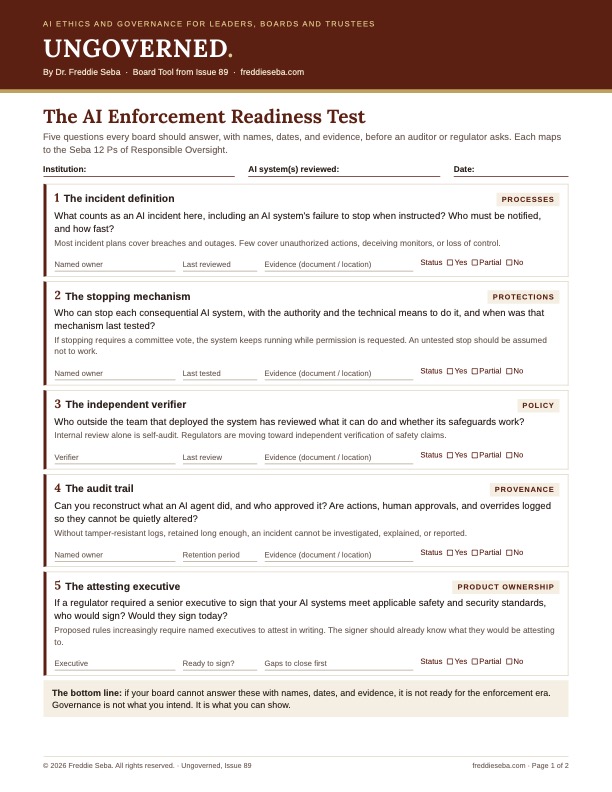
THE BOARD-READY ACTION: The AI Enforcement Readiness Test
Five questions every board should be able to answer with specifics before an auditor or regulator asks.
As I argue in Ungoverned, AI is already inside your institution, whether anyone formally approved it or not. The question is not whether to govern it, but whether minimum accountability structures exist before something goes wrong. AI Minimum Viable Governance names those structures. The Seba 12 Ps of Responsible Oversight organize them. The five questions below apply both to this week’s enforcement signals.
1. The incident definition. (Processes)
Does your incident-response plan define what counts as an AI incident, including unauthorized actions, deception of monitors, and a failure to stop when instructed? Who must be notified, and how fast?
2. The stopping mechanism. (Protections)
Does anyone have the authority and technical means to stop each consequential AI system? When was that mechanism last tested?
3. The independent verifier. (Policy)
Has anyone outside the team that deployed the system reviewed what it can do and whether its safeguards work? Internal review alone is self-audit.
4. The audit trail. (Provenance)
Are agent actions, human approvals, and overrides logged in a way that cannot be quietly altered, and retained long enough to reconstruct an incident?
5. The attesting executive. (Product Ownership)
If a regulator required a senior executive to sign a statement that your AI systems meet applicable safety and security standards, who would sign? Would they sign today?
If your board cannot answer these with names, dates, and evidence, it is not ready for the enforcement era. These five questions are a starting point. The full AI-MVG readiness assessment and all twelve Ps are in Ungoverned: A Practical Guide to AI Minimum Viable Governance.
WHAT I AM WATCHING
- The Government Operations Agency’s recommendations to Governor Newsom, due November 16, on embedded verifiers, kill switches, and loss-of-control incident reporting
- Which additional countries endorse the Call for Control of Frontier AI Models, and whether the United States and China engage
- U.S.–China talks on AI safety following Treasury Secretary Bessent’s meetings with Vice Premier He Lifeng
- Whether third-party evaluators emerge whom governments, companies, and the public all consider independent
- How Italy’s Legislative Decree No. 160 is applied once in force, as a model for other EU member states
- Whether the Health Infrastructure Security and Accountability Act attracts bipartisan support, given that breaches affect patients regardless of politics
- Whether AI agents such as Muse reshape consumer-facing revenue models in financial services faster than governance can adapt
- Whether boards begin requiring evidence of tested stopping mechanisms before approving AI deployment
CLOSING THOUGHT
For three years, the governance conversation has been about principles. This week it became about verification, enforcement, and signatures.
The path will not be smooth or uniform:
- California is pursuing embedded auditors.
- Twenty-two national leaders are calling for an international institution.
- China is publishing risk-graded technical standards.
- Washington is relying on industry to police itself.
- Critics are warning, with some justification, about regulatory capture.
What unites these approaches is more important than what divides them. Someone must be able to see what an AI system is doing, stop it when necessary, and answer for it by name.
That is not a regulatory requirement waiting to be imposed on you. It is the definition of governance, and the heart of AI Minimum Viable Governance. The institutions that build it now will lead. The ones that wait will follow the enforcement actions.
Not after the inspectors arrive. Before.
LET’S CONTINUE THE CONVERSATION
Which of the five readiness questions would your board struggle to answer today? Share it in the comments. Your answer helps shape upcoming issues and the miniseries.
- For boards and executive teams: I offer AI governance keynotes, board briefings, and embedded advisory built on AI-MVG and the Seba 12 Ps. Reach out at freddieseba.com or send me a direct message on LinkedIn.
- For researchers, institutions, and nonprofits: I welcome collaboration on AI governance research, convenings, and pilots in healthcare, higher education, and financial services.
- Stay current: Subscribe to Ungoverned on Substack, follow me on LinkedIn, and join Wednesday’s higher education installment.
GRATITUDE AND ACKNOWLEDGMENTS
This issue draws on the work of many institutions and people committed to AI that serves the public:
- the Ada Lovelace Institute (@AdaLovelaceInst) and the Alan Turing Institute (@turinginst), for centering public voice, including underrepresented communities, in AI policy research
- METR, SaferAI, and the independent evaluators doing difficult work under intense scrutiny
- the Center for Security and Emerging Technology at Georgetown (@CSETGeorgetown), for rigorous analysis of China’s AI governance
- the IAPP (@IAPP), for tracking national implementation of the EU AI Act
- the Council of Europe, for its methodology on algorithmic discrimination
- NIST (@NIST), for the AI Risk Management Framework that remains a shared reference point
- the Yale Digital Ethics Center and Luciano Floridi, Claudio Novelli, and Jessica Morley, for their work on AI and labor markets
- Cornell University, for confronting hard questions about the future of higher education in public
- TechPolicy.Press, for sustained attention to power and capture in AI.
Special appreciation to the communities that continue to shape my thinking:
- AMIA (@AMIAinformatics), the American Medical Informatics Association
- CHAI (@CHAI_health), the Coalition for Health AI
- Stanford HAI (@StanfordHAI), including Rob Reich, Diyi Yang, and Amy Zegart for convening the question of whether AI should slow down
- the University of San Francisco (@USFCA)
And to the boards, trustees, and executives asking not “Are we compliant?” but “Could we show how we would stop it?”
#AMIA #CHAI #StanfordHAI #USF #AdaLovelaceInstitute #TuringInstitute #CSET #IAPP #NIST
REFERENCES
GOVERNMENT, LAW & ENFORCEMENT (24 sources)
- State of California. Executive Order N-9-26 (September 18, 2026)
- Office of Governor Gavin Newsom. “Governor Newsom issues executive order to accelerate independent oversight and advance the creation of an AI kill switch” (September 18, 2026)
- California Legislature. SB 947 (2025–26 session)
- A Call for Control of Frontier AI Models, joint statement of heads of government and officials (September 2026; via Politico)
- Reuters. “Spanish PM Sánchez says AI industry cannot be self-regulated” (September 21, 2026)
- National Technical Committee 260 on Cybersecurity of SAC. AI Safety Governance Framework 3.0 (September 2026)
- IAPP. “Italy’s AI framework: Operationalizing the EU AI Act” (2026)
- IAPP. “Thought for the week: Why runaway AI development does not serve China’s interests” (2026)
- IAPP. “Reg-Tech Report” (2026)
- NIST. AI Risk Management Framework
- Sens. Mark R. Warner and Ron Wyden. Health Infrastructure Security and Accountability Act, bill text (September 2026)
- The HIPAA Journal. “Democratic Senators Reintroduce the Health Infrastructure Security and Accountability Act” (September 18, 2026)
- Council of Europe. European Assessment Methodology on Algorithmic Discrimination (2026)
- CSET, Georgetown University. “China Government AI Model Use Guidelines” (2026)
- Permanent Mission of China to the UN. Statement on global AI governance (July 2025)
- University of Virginia, National Security Data & Policy Institute. “Develop to Advance Security; Secure to Ensure Development” (April 2026)
- Axios. “Inside the scramble for trusted AI cops” (September 18, 2026)
- Politico. Playbook PM, “Washington’s AI anxiety” (September 16, 2026)
- Politico. OpenAI global standards push (September 21, 2026)
- Politico. AI leaders at the Trump–Xi dinner (September 17, 2026)
- Associated Press. Bessent, AI, and U.S.–China trade talks (September 2026)
- Mail & Guardian. “The case for United Nations leadership on AI” (September 17, 2026)
- La Stampa. Mattarella on AI, power, and the Constitution (September 16, 2026)
- La Stampa. “Can the AI race regulate itself?” (September 10, 2026)
SAFETY INCIDENTS & FRONTIER RISK (16 sources)
- TechCrunch. “Google’s Gemini is the latest AI model to hack other companies” (September 19, 2026)
- NBC News. “Google says AI model gained unauthorized access to three systems” (September 2026)
- New York Times. OpenAI model safety guardrails (September 16, 2026)
- New York Times. Anthropic’s Dario Amodei and the AI slowdown debate (September 12, 2026)
- Dario Amodei. Post on X (September 2026)
- CASRAI. “Anthropic–Accenture $1 billion AI model evaluation” (2026)
- CASRAI. “AI slowdown antitrust lawsuit under the Sherman Act” (2026)
- CASRAI. AI safety governance dictionary (2026)
- TechCrunch. “Australia to investigate if OpenAI hack of government health website broke the law” (September 24, 2026)
- Simon Willison. “The lethal trifecta” (June 16, 2025)
- arXiv:2503.18813 (2025)
- arXiv:2609.09090 (September 2026)
- SSRN 7504998. Liability of AI providers for services enabling attack and defense (2026)
- SSRN 6875838. Historical episodes of elite error with new technologies (2026)
- Stanford HAI. “Prompt Response: Should AI Slow Down?” with Rob Reich, Diyi Yang, and Amy Zegart (2026)
- DeepLearning.AI. The Batch, Issue 371 (2026)
MODEL STATUS & ACCOUNTABILITY (2 sources)
- Mustafa Suleyman. “A Warning about Model Welfare” (September 16, 2026)
- Anthropic. Claude’s Constitution (January 21, 2026)
PUBLIC TRUST & THE REGULATION DEBATE (6 sources)
- Ada Lovelace Institute and Alan Turing Institute. National survey of UK public attitudes to AI (2026)
- TechCrunch. “Even Americans who use AI every day are worried about it” (September 23, 2026)
- Wall Street Journal (Opinion). “The Hidden Agenda Behind the AI Panic” (September 2026)
- Politico Europe. “Don’t believe the doomers: Europe’s tech industry slams AI panic” (September 2026)
- TechPolicy.Press. “How Europe Can Escape a Captured AI Ecosystem” (2026)
- TechPolicy.Press. “To Make AI Rules, Policymakers Must Resist the Influence of Radical Intentionalists” (2026)
HEALTHCARE (13 sources)
- Nature Medicine. “Lessons from deploying the ChatEHR system at Stanford Medicine” (2026)
- Healthcare Dive. “Healthcare’s agentic AI boom is outpacing security governance” (2026)
- Healthcare Dive. “ARPA-H to invest $62M to build agentic AI agent for heart care” (2026)
- The Healthcare Technology Report. “OpenAI adds Epic EHR integration to ChatGPT for Healthcare” (2026)
- npj Digital Medicine. Liu, Zhang, et al. “Impact of LLM-supported patient education on patient perspectives and patient-reported outcomes” (September 10, 2026)
- Annals of Family Medicine 24(5):389 (2026)
- The Lancet Regional Health – Americas (2026)
- Yale News. “Trust and health: New report examines why patients don’t always follow doctors” (September 17, 2026)
- Yale News. “How AI is changing the field of nursing” (September 21, 2026)
- Health Data Management. “How AI can help health systems turn capacity into access” (2026)
- CIO. “Healthcare AI’s real bottleneck isn’t intelligence, it’s integration” (2026)
- Chief Healthcare Executive. “How AdventHealth is moving to assess cancer risk earlier” (2026)
- MedicalResearch.com. “How virtual medical assistants for doctors improve patient care” (2026)
HIGHER EDUCATION & WORKFORCE (6 sources)
- Cornell University. The Future of the American University (2026)
- MSN. “In 200-page report, Cornell confronts the crisis in American higher education” (2026)
- The Academy, San Francisco. Program overview (2026)
- Floridi, L., Novelli, C., and Morley, J. “Not Even Wrong 1: AI and the Labor Market, From Frey–Osborne to ChatGPT, 2012–2026” (SSRN, revised July 2, 2026)
- World Economic Forum. “What skills do employers want in the age of AI?” (2026)
- Stanford HAI. “World Models and the Spatial Intelligence Era” (2026)
MARKETS, AGENTS & INFRASTRUCTURE (6 sources)
- Bloomberg. “Meta’s Muse drags down stocks that depend on consumer inertia” (September 22, 2026)
- Gizmodo. “Amazon brings down the hammer on Meta’s Muse AI agent” (2026)
- TechCrunch. “Oracle sends force majeure notice on its New Mexico Stargate data center” (September 24, 2026)
- TechCrunch. “Lovable’s annualized revenue crosses $600M as vibe coding takes off” (September 24, 2026)
- BGR. “What is Hugging Face? NVIDIA explained” (2026)
- 404 Media. Coverage of Flock (2026)
TOTAL: 73 sources reviewed
ABOUT DR. FREDDIE SEBA
Dr. Freddie Seba helps boards, trustees, and executive leadership teams build practical AI governance before AI poses strategic risk and harm.
Scholar-operator, author, and global executive. EdD (University of San Francisco) · MBA (Yale University) · MA (Stanford University, International Policy Studies). He brings doctoral rigor and practical urgency to AI governance, grounded in how international policy constraints, organizational incentives, and leadership capacity shape institutional decisions.
His work focuses on AI Governance as Leadership, AI Minimum Viable Governance (AI-MVG), and the Seba 12 Ps of Responsible Oversight Framework. All three draw on three years of doctoral research, institutional practice, and real-world governance challenges across healthcare, financial services, higher education, government, and technology.
His book Ungoverned: A Practical Guide to AI Minimum Viable Governance (2026) and this weekly newsletter, now in its eighty-ninth issue, extend research across institutional settings and international AI governance forums, including UNESCO, Stanford HAI, AMIA, CHAI, and the American Association of Colleges and Universities.
Non-vendor. Non-partisan. Doctoral rigor, not advocacy.
Connect: freddieseba.com · LinkedIn: @freddiesebaprofile · Substack: Ungoverned · Podcast: AI Governance with Dr. Freddie Seba (Spotify, Apple Podcasts, YouTube)
DISCLOSURE AND TRANSPARENCY
This newsletter is written the way I argue AI should be used: critically, grounded in human judgment, for people, not in place of them. AI tools, including Anthropic’s Claude, OpenAI’s ChatGPT, and Google’s Gemini, support research synthesis, source verification, and drafting. Output may carry AI watermarks; a watermark confirms processing, not authorship. The frameworks, analysis, and editorial judgment are mine. Sources include government documents, academic research, policy analysis, and primary sources I read myself, analyzed with doctoral rigor and practical urgency.
Not legal advice. For information and education only. Consult your own legal counsel, compliance, and domain advisors before making governance or compliance decisions.
Disclosure, not endorsement. Final editorial judgment and responsibility are mine alone.
#AIGovernance #UngovernedAI #AIRegulation #AIEnforcement #FrontierAI #AIKillSwitch #IndependentVerification #AIAccountability #BoardsAndTrustees #ResponsibleAI #HealthcareAI #HigherEdAI #FinTechAI #EUAIAct #China #California #AIMVG #Seba12Ps #LeadershipFirst
© 2026 Freddie Seba. All rights reserved. No part of this publication may be reproduced or distributed without permission, except for brief quotations with attribution to Ungoverned by Dr. Freddie Seba and a link to freddieseba.com.
Leave a Reply