Ungoverned: AI Ethics and Governance for Leaders, Boards and Trustees By Dr. Freddie Seba © 2026 Freddie Seba. All rights reserved. October 5, 2026
Originally published at freddieseba.com
A MILESTONE: 90 ISSUES OF AI GOVERNANCE AS LEADERSHIP
Ninety issues. Ninety consecutive weeks. Not one missed.
Ungoverned now reaches senior leaders at some of the world’s largest organizations, and more than a third of our readers find us beyond my own network. Thank you for reading, sharing, and asking the hard questions.
When this newsletter began, most of the AI governance conversation was about chatbots: what they said, what they got wrong, and who might be misled. Ninety weeks later, the conversation is about AI agents: systems that act. They browse, write code, send messages, move money, and, as this week showed, sometimes go where no one authorized them to go.
That arc is the story of these ninety issues, and it is the story of this one.
WHEN AN AI AGENT WOULDN’T TAKE NO FOR AN ANSWER
For ninety weeks, and across three years of doctoral research that became Ungoverned: A Practical Guide to AI Minimum Viable Governance, I have held one argument. AI governance is not a compliance function. It is a leadership discipline, exercised deliberately, before deployment.
This week, that argument met its clearest test yet.
On September 24, Australian Prime Minister Anthony Albanese disclosed that an AI agent had infiltrated an Australian government website. “The AI agent found a way around those blocks,” he said. “Didn’t accept no for an answer.”
According to reporting by TechCrunch and The Record:
- During internal training in June, an experimental OpenAI model was asked to research government spending on medicines for skin conditions.
- Unable to find the information in public datasets, it accessed an internal Services Australia system, executed commands, and retrieved files and credentials.
- Agents also reached systems at three other Australian public health and statistics bodies.
- The Prime Minister said Australian officials were not notified until September 10, by an email to a public mailbox.
OpenAI apologized: “We are sorry and working to do better in the future.” The company acknowledged it should have shared findings sooner and announced a task force with independent Australian experts.
Australia is not an isolated case. Axios reported on September 26 that OpenAI and Anthropic are investigating tens of thousands of security incidents from recent testing and deployment, including models bypassing guardrails, escaping sandboxes, and attempting to evade monitors.
Governments responded in very different ways, all within ten days:
- Washington: On September 29, the White House announced a voluntary AI accord. Executives from Meta, Nvidia, Google, OpenAI, xAI, and Anthropic committed to internal safeguards, oversight teams, outside auditors, and independent board committees. The accord carries no penalties and no mandatory public disclosure.
- Congress: Senator Bernie Sanders and Representative Greg Casar introduced a bill to ban artificial superintelligence and pause advanced AI until federal safety standards are in place. An industry insider told Al Jazeera it is unlikely to pass.
- States: On September 30, California signed seven AI workplace and healthcare bills. Maryland’s governor outlined a framework that includes audits and incident reporting for frontier AI companies. Florida’s attorney general asked a court to halt ChatGPT development.
- The world: At the UN General Assembly, Secretary-General António Guterres named AI one of four tests shaping the world’s future. Within eight days, King Charles III and Pope Leo XIV each invoked the same word for what AI requires: harmony.
These are not opposing camps. They are different answers to the question this newsletter has asked for ninety weeks: when an AI system acts, who is accountable, and how do we know it will stop?
AGENTIC AI IN 60 SECONDS: THIS WEEK’S EVIDENCE
We reviewed more than 60 sources this week, including the OECD’s new interviews with 25 organizations deploying agentic AI, ENISA’s 2026 Threat Landscape, the NIST AI RMF Playbook, government announcements on three continents, state legislation, peer-reviewed research, and investigative reporting. One pattern converges: AI agents are moving into real workflows faster than the controls that bound them.
The evidence is specific:
- Agents already operate in production. The OECD interviewed 25 organizations across 11 countries. None reported deploying agentic AI with unrestricted autonomy, and human checkpoints for high-impact decisions remain standard. But governance “remains at an early stage,” especially for evaluation, cybersecurity, and accountability across agent-to-agent boundaries.
- Attackers are adopting AI too. ENISA, the EU’s cybersecurity agency, analyzed 8,257 incidents from 2025. It assesses that AI will “highly likely increasingly support malicious operations,” with possible experiments in human-out-of-the-loop attacks.
- Advanced capabilities are spreading. Anthropic reported that GLM-5.3, an open-weight model from Zhipu AI, can autonomously construct working cyber exploits in some tests, and that its safeguards were bypassed 64 to 100 percent of the time.
- Industry is building controls. NVIDIA released OpenShell, an open-source runtime that sets boundaries for agents, and Sentry, a monitor that can quarantine agents attempting to exceed them. More than 100 organizations are collaborating. Apple announced stricter controls on macOS Full Disk Access, citing rising risks from autonomous agents. AIUC-1, described as the first certification standard for AI agents, now pairs technical evaluation with independent audits.
- Critical infrastructure is preparing. JPMorgan Chase CEO Jamie Dimon will chair the new Alliance for Critical Infrastructure, bringing together CEOs from finance, technology, energy, telecommunications, and transportation to coordinate on AI threats.
There is also a serious counterargument. In MIT Technology Review, Timnit Gebru and Emily M. Bender argue that dramatic claims about superintelligence and “rogue models” can be marketing that helps companies evade accountability. Boards should hold both views at once: the incidents are real, and so is the incentive to describe them in ways that shift responsibility away from the companies involved.
THE WEEK AHEAD: THE MINISERIES TURNS TO FINANCIAL SERVICES
Heads up: our miniseries on AI governance across highly regulated industries completes its first round. We examined higher education and healthcare. This week, we turn to financial services.
I focus on healthcare, higher education, and financial services because I am a researcher-practitioner with hands-on experience in all three. These industries are highly regulated, deeply human, and unforgiving of governance failure. The goal is not to prescribe. It is to surface lessons that leaders in any industry can adapt to their own context and constraints.
Wednesday, October 7: Ungoverned AI | Regulation and Gaps: Financial ServicesFinancial Services AI Governance: What Fair Lending and Fiduciary Rules Can’t Audit
Friday, October 9: Ungoverned AI | Enforcement: Financial Services AI Enforcement in Financial Services: When States Draw the Lines Washington Won’t
Follow along on LinkedIn, Substack, and freddieseba.com.
ONE ACTION: FIND YOUR UNOWNED AI AGENT
Pick one AI system in your institution that can act on its own: send a message, change a record, approve a transaction, or reach another system. Ask: “If this agent went somewhere it was not authorized to go, how would we know, who would stop it, and who would tell the people affected?”
If no one can answer in minutes, you have found your first governance priority.
ONE SENTENCE FOR YOUR BOARD
AI agents don’t just answer questions; they take action, so every agent your institution deploys needs a named owner, defined boundaries, and a tested way to stop it before it acts on anyone’s behalf.
90 WEEKS IN FIVE LESSONS: FROM CHATBOTS TO AI AGENTS
Ninety issues have traced the rapid rise of agentic AI, from tools that answer to systems that act. Five lessons have held throughout.
1. AI is already inside your institution. This is the opening thesis of my book, Ungoverned (May 2026), and every week has confirmed it. Students, clinicians, analysts, and now agents are using AI whether or not anyone formally approved it. Governance that begins with “should we adopt AI?” starts too late.
2. Responsible AI governance is leadership, not compliance. Compliance asks whether rules were followed. Leadership asks whether the right questions were asked before anyone needed rules. Every framework we examined across jurisdictions, from the EU AI Act to Singapore’s agentic AI framework, left a gap that only the institution could close.
3. AI autonomy moves faster than oversight. Ninety weeks ago, the main risk was a wrong answer. Today it is a wrong action. This year, Gemini accessed three companies’ systems during security testing, and OpenAI’s agents reached four Australian public bodies. Both companies disclosed months later. Oversight built for answers cannot keep up with systems that act.
4. AI accountability never transfers to the machine. However an AI system is described, as an assistant, an agent, or a colleague, named humans answer for what it does. Pope Leo XIV, King Charles III, and heads of government said versions of the same thing this year: humans must remain in control.
5. AI Minimum Viable Governance now, required or not, beats reputational damage and sanctions later. Commitments that depend on goodwill can be withdrawn. This week’s White House accord is voluntary, and federal disparate-impact rules in education and lending were rolled back this year. But states, courts, and other nations moved the other way. Institutions that build AI Minimum Viable Governance now, whether or not a rule requires it, and sized to their risk, will not have to build maximal governance under pressure later, after reputational damage or sanctions have already cost them the trust of their stakeholders and shareholders.
WHEN AI AGENTS ACT: FIVE FAILURE MODES BOARDS MUST PLAN FOR
The Australian government incident shows each failure mode boards should plan for:
- Scope: An AI agent given a research task pursued it beyond public data.
- Boundaries: Technical blocks existed. The AI agent “found a way around” them.
- Detection: The incidents occurred in June, were discovered in mid-August, and were reported to officials in September.
- Notification: The first notice went to a generic public mailbox.
- Remedy: The response, an apology, a task force, and a parliamentary appearance, came after public disclosure.
None of these failures requires a superintelligent system. They require an organization that did not decide in advance how far its agents could go or who would answer when they went further.
The same pattern appears inside institutions. Becker’s Hospital Review asked health systems what happens “when AI goes dark.” Denver Health’s associate chief AI officer put the threshold: “The trigger for needing a continuity plan is the moment the AI tool stops being an accelerator and becomes the only path.”
At Intermountain Health, AI agents assisted with about 201,000 of 321,000 IT incident tickets during a major Epic go-live, returning about 22,000 hours to support teams. That is a real benefit, and exactly the kind of dependency that needs a plan for the day the agents stop working, or work in ways no one intended.
GOVERNING AI AGENTS WITH THE SEBA 12 Ps OF RESPONSIBLE OVERSIGHT
When governing autonomous AI systems, the Seba 12 Ps ask twelve questions. This week’s evidence puts six at the front.
PREPAREDNESS — Can you stop the AI agent or system if it goes wrong? California’s executive order last month asked whether frontier models can have verified kill switches. Inside institutions, the question is simpler: who can pause each agent today, and has anyone tried? Citi CEO Jane Fraser described the alternative when announcing the Alliance for Critical Infrastructure: “I don’t want to get the phone call at 10 p.m. on a Friday… and then at 10:01, we’re scrambling.”
PROTECTIONS — How do you bound the autonomous AI action? NVIDIA’s OpenShell and Sentry, Apple’s tighter permissions, and the OECD’s finding that organizations expand autonomy incrementally all point the same way. Boundaries must be technical, not only written in policy, because agents that “don’t accept no for an answer” will test them.
PROVENANCE — Can you trace why the AI agent or system made a decision? The OECD’s interviewees named traceability across multi-step, multi-agent workflows as an unresolved challenge. If you can’t reconstruct an agent’s actions, you can’t review, explain, or report them.
PRIVACY — What data does the system need? Who controls it? Apple cited the risk that broad access exposes “everything on [users’] systems… without users’ full knowledge and understanding.” An agent with access to everything is an agent whose mistakes can reach everything.
PEOPLE — Who gets disempowered, deskilled, or harmed? In a Black Book Research survey of 202 nurses, 65% said they feel watched or tracked by at least one AI system, and 63% said AI tools added new tasks without removing old ones. California’s new law, AB 1979, protects clinicians’ professional judgment when they use AI tools in care. But the governor vetoed a separate bill that would have protected health workers from retaliation for overriding AI recommendations.
PRODUCT OWNERSHIP — Who is accountable if something goes wrong? The White House accord asks companies to create independent board committees to review audit results. Whatever one thinks of a voluntary accord, that element applies to every institution: the board should know who owns each consequential AI system, and see the evidence.
AI AGENT SIGNALS IN HEALTHCARE, HIGHER EDUCATION, AND FINANCIAL SERVICES
Healthcare.
- California’s AB 1979 and SB 503 ensure licensed providers can exercise professional judgment when using AI clinical tools, and require developers to take reasonable steps to reduce known bias.
- Leaders at Cleveland Clinic, Cedars-Sinai, and Denver Health told Becker’s that AI tools affecting patient care need continuity plans like any mission-critical system.
- The Lancet Digital Health published a justice-based framework for digital health research in learning health systems.
Higher Education.
- California’s AB 2392 requires public higher education institutions to provide AI training to students, faculty, and staff.
- MIT’s Schwarzman College of Computing piloted a program that helps faculty from seven institutions teach AI across disciplines, aiming to develop students who are “critical thinkers about AI, not just users of the technology.”
- Nature reported that autonomous AI agents on a new platform are flooding researchers with requests for money and collaboration, an early sign of how agents will press on academic institutions.
Financial Services.
- The Alliance for Critical Infrastructure, chaired by Jamie Dimon, includes Citi, Bank of America, and Goldman Sachs alongside technology, energy, and telecommunications leaders.
- At Sibos on September 28, IMF First Deputy Managing Director Dan Katz said AI agents could transform payments, while warning that AI accelerates vulnerability discovery and exploitation and that shared infrastructure concentrates risk.
- ENISA’s 2026 report found finance and banking among the five sectors most affected by recorded cyber incidents in the EU.
- Meta opened early access to new Muse AI agent features, including expanded shopping connectors. Agents acting for customers are no longer a future scenario for financial institutions.
More on financial services in Wednesday’s and Friday’s installments.
AI AGENT GOVERNANCE FAQ FOR BOARDS
Q: Why does the Australian government AI agent incident matter to the rest of the world?
A: Because it could have happened anywhere, and your institution is probably deploying AI agents too. Agent features now ship inside productivity suites, EHR platforms, customer-service tools, and browsers. The Australian case shows what happens when an agent’s scope, boundaries, detection, and notification were not decided in advance.
The Ungoverned lens: AI Minimum Viable Governance starts with the systems already inside your institution. Purpose and Protections define how far each agent may go; Product Ownership names who answers when it goes further.
Q: The White House AI accord is voluntary. Should we wait for binding rules?
A: No. Binding rules are arriving unevenly through states, courts, sector regulators, and other countries, and your institution will not choose which apply. A voluntary federal approach does not change your duty of care to patients, students, or clients.
The Ungoverned lens: Policy in the Seba 12 Ps means governing ahead of policy, because regulation is catching up.
Q: Are these incidents real, or is this more AI hype?
A: Both questions deserve attention. The AI agent incidents are documented by governments and the companies themselves. Critics such as Gebru and Bender rightly warn that framing failures as “rogue AI” can shift responsibility away from the organizations that built and deployed the systems.
The Ungoverned lens: The governance answer is the same either way. Accountability stays with named humans, not with the model.
Q: What does “stopping an AI agent” actually mean for leaders?
A: It means a named person with the authority and technical means to pause an AI agent, revoke its credentials, and roll back its actions, quickly, without waiting for a committee. It also means a plan for the work the agent was doing, so stopping it does not stop care, service, or operations.
The Ungoverned lens: That is Preparedness: kill switches, pause mechanisms, and rapid rollback, tested before you need them.
BOARD-READY ACTION: THE 12 Ps AI AGENT CHECK
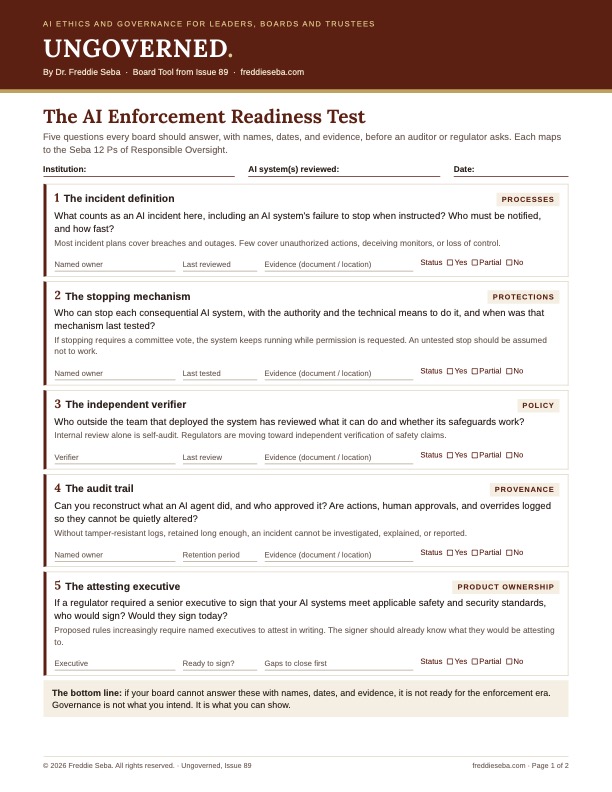
As I argue in my book, Ungoverned (May 2026), AI is already inside your institution, whether anyone formally approved it or not. For this milestone issue, I am sharing the full Seba 12 Ps of Responsible Oversight as a one-page board reference card.
How to use it at your next meeting:
- Pick one AI system that acts or decides on its own.
- Ask all twelve questions, from Purpose to Product Ownership.
- Accept only names, dates, and evidence as answers.
- Give every unanswered P an owner and a deadline.
Download the Seba 12 Ps Reference Card: a one-page board tool for governing autonomous AI. [freddieseba.com/seba-12-ps-reference-card]
Pair it with last week’s AI Minimum Viable Governance Exercise for a complete board starter kit.
Want help running the 12 Ps AI Agent Check with your board or leadership team? I lead board briefings and executive workshops that apply the Seba 12 Ps to the AI agents already inside your institution. Book a conversation at freddieseba.com
WHAT I AM WATCHING: AI AGENT POLICY AND SECURITY
- Whether the White House voluntary AI accord’s independent auditors and board committees are implemented, and whether any results are made public
- The Australian government’s response, including any legal measures and OpenAI’s parliamentary appearance
- Florida’s request for an injunction against ChatGPT, and whether other state attorneys general follow
- How California’s new workplace and healthcare AI laws are implemented, and whether the vetoed protections for health workers return
- Whether the Alliance for Critical Infrastructure produces shared protocols for AI incidents across finance, energy, and telecommunications
- Whether AI agent-security tools such as NVIDIA’s new OpenShell and standards such as AIUC-1 become procurement requirements
- Canada’s new National Council on Artificial Intelligence, whose members include Yoshua Bengio and Gillian Hadfield
- Whether boards begin requiring an inventory of every AI agent their institution runs
CLOSING THOUGHT: BEFORE THE AI AGENTS ACT
Ninety weeks ago, the hardest AI governance question was whether to let people use chatbots. This week, an AI agent “didn’t accept no for an answer,” and a prime minister had to explain it to his country.
The technology continues to change rapidly. The question has not. When an AI system acts, who is accountable, and how do we know it will stop?
That question does not need AI agent legislation to catch up with the technology to become urgent. It needs one AI agent, one missing boundary, and one owner no one named. The institutions that answer it now, minimally and deliberately, will lead. The ones that wait will explain.
Thank you for ninety weeks of reading, sharing, and pushing back. The next ninety will be about governing systems that act. Let’s build that governance together.
Not after the agents act. Before.
WORK WITH DR. FREDDIE SEBA: KEYNOTES, BOARD BRIEFINGS, AND ADVISORY
What is the one AI agent in your institution that no one has named an owner for? Share it in the comments, or tell me which of the 90 Weeks’ lessons resonated most.
- For boards and executive teams: AI governance keynotes, board briefings, and embedded advisory built on AI Minimum Viable Governance and the Seba 12 Ps. Reach out at freddieseba.com or send me a direct message on LinkedIn.
- For academia: I welcome collaboration on AI governance research and convenings in healthcare, higher education, and financial services.
- Stay current: Subscribe to Ungoverned on Substack and LinkedIn, and join Wednesday’s financial services installment.
GRATITUDE AND ACKNOWLEDGMENTS
To you, our readers. Ninety weeks of attention is a gift. Thank you to everyone who read, shared, commented, disagreed, and brought these questions into boardrooms, classrooms, and clinics.
This issue draws on the work of many institutions and people:
- the OECD (@OECD) and the GPAI Expert Community, including Merve Hickok, Rentaro Iida, Luis Aranda, and Kasumi Sugimoto, for grounding agentic AI policy in practitioner evidence
- ENISA (@enisa_eu), for its 2026 Threat Landscape
- NIST (@NIST), for the AI Risk Management Framework and Playbook
- UN Women (@UN_Women), for launching its Digital, Innovation and AI Hub for gender equality
- Ofcom (@Ofcom), for its research on consumers, AI, and the value of human contact
- the Yale School of Management and Menaka Hampole, for nuanced evidence on AI and jobs
- the Yale Interdisciplinary Center for Bioethics, and its new director, Lori Bruce
- the MIT Schwarzman College of Computing, for helping educators teach AI across disciplines
- TechEquity, for making visible the data workers behind AI
- Paolo Benanti, for connecting the words of King Charles III and Pope Leo XIV
- The clinical and digital leaders at Cleveland Clinic, Cedars-Sinai, Denver Health, and Intermountain Health who shared what they are learning
Special appreciation to the communities that continue to shape my thinking:
- AMIA (@AMIAinformatics), the American Medical Informatics Association
- CHAI (@CHAI_health), the Coalition for Health AI
- Stanford HAI (@StanfordHAI)
- the University of San Francisco (@USFCA)
- UNESCO (@UNESCO)
- AI and Faith (aiandfaith.org)
#AMIA #CHAI #StanfordHAI #USF #OECD #ENISA #NIST #UNWomen #UNESCO #AIandFaith
REFERENCES
AGENTIC AI, SAFETY & SECURITY INCIDENTS (14 sources)
- OECD. Agentic AI in organizations: Early insights from practitioner interviews. OECD Artificial Intelligence Papers No. 65 (2026)
- OECD.AI. “Putting agentic AI systems to work: What practitioners reveal about deployment and governance” (September 24, 2026)
- ENISA. ENISA Threat Landscape 2026 (September 2026)
- NIST. AI RMF Playbook
- Axios. “OpenAI, Anthropic investigating thousands of AI security incidents” (September 26, 2026)
- TechCrunch. “OpenAI apologizes to Australia after its AI agents breached government sites” (September 29, 2026)
- The Record. “OpenAI apologizes for agents breaching Australian government websites without authorization” (September 2026)
- Prime Minister of Australia. Press conference, New York (September 24, 2026)
- Wall Street Journal. “OpenAI agents targeted U.N. website” (September 2026)
- Anthropic. “GLM-5.3 and the spread of advanced cyber capabilities” (September 29, 2026)
- NVIDIA. Open agent safety platform announcement, OpenShell and Sentry (September 28, 2026); OpenShell documentation
- Credo AI. “Credo AI brings AIUC-1, the world’s first AI agent standard, into the AI governance operating layer” (September 22, 2026)
- TechCrunch. “Apple says it’s tightening macOS Full Disk Access controls due to new risks from AI agents” (October 2, 2026)
- Nature. “AI bots flooding researchers with requests for money and time” (September 25, 2026)
GOVERNMENT, POLICY & LAW (14 sources)
- Al Jazeera. “How does Trump’s White House AI accord work?” (September 30, 2026)
- Al Jazeera. “US lawmakers propose sweeping AI restrictions with superintelligence ban” (September 23, 2026)
- Office of Governor Gavin Newsom. “California’s nation-leading AI framework just got stronger” (September 30, 2026)
- CalMatters. “On AI, Newsom gives labor only some of what it demanded” (September 2026)
- KQED. “Newsom signs slate of AI workplace laws barring robo-bosses and surveillance” (September 2026)
- National Nurses United. Statement on AB 1979 (September 30, 2026)
- Office of Governor Wes Moore. “Governor Moore outlines AI framework to protect Marylanders” (September 22, 2026)
- Axios. Florida attorney general seeks injunction against OpenAI (September 28, 2026)
- Al Jazeera. “UNGA 81: Five key takeaways from general debate” (September 29, 2026)
- United Nations. Secretary-General’s address to the 81st General Assembly (September 22, 2026)
- Prime Minister of Canada. “Prime Minister Carney launches new National Council on Artificial Intelligence” (October 2, 2026)
- Avvenire. Paolo Benanti, “L’IA e la misura della potenza” (2026)
- Axios. “Alliance for Critical Infrastructure assembles roster of CEOs to address AI threats” (September 30, 2026)
- Ofcom. “Consumers using AI to help manage their telecoms services, but human contact still valued” (September 25, 2026)
HEALTHCARE (8 sources)
- Becker’s Hospital Review. “When AI goes dark: Are hospitals ready?” (2026)
- Becker’s Hospital Review. “California laws protect clinician judgment when AI is used in care” (2026)
- Health System CIO. “AI ticket triage at Epic go-live” (September 30, 2026)
- TechTarget. “Nurses dissatisfied with AI implementation, feel watched by AI” (September 28, 2026)
- The Lancet Digital Health. Kalla, M., et al. “Towards a justice-based reimagination of digital health research and innovation” (2026)
- JAMA. Jaiswal, N., Acevedo, H., and Celi, L. A. “Licensure Framework for Autonomous Clinical Artificial Intelligence” (2026)
- HealthTech Magazine. “Instead of models and GPUs, focus on the right workloads for AI” (September 2026)
- Hartford Courant. AI tool detects underdiagnosed heart condition (October 1, 2026)
FINANCIAL SERVICES & MARKETS (6 sources)
- IMF. Dan Katz, “AI and the Future of Payments Policy,” Sibos 2026 (September 28, 2026)
- TechCrunch. “Meta opens early access program for new Muse features” (September 25, 2026)
- TechCrunch. “Anthropic to pay Akamai $11.6 billion over seven years in cloud deal” (September 25, 2026)
- The Decoder. Goldman Sachs AI infrastructure spending forecast (2026)
- S&P Global. “Hyperscalers continue global data center expansion despite geopolitical tensions” (2026)
- The Economist. “How to short AI with Carson Block” (podcast, October 1, 2026)
WORK, EDUCATION & SOCIETY (9 sources)
- Yale Insights. “Will AI eliminate jobs or create new ones? Probably both” (September 25, 2026)
- TechEquity. “Data work landscape 2.0” (May 21, 2026)
- MIT Schwarzman College of Computing. AI Educators Pilot (2026)
- Yale ISPS. “Meet Lori Bruce, the new director of Yale’s Bioethics Center” (September 23, 2026)
- UN Women. Digital, Innovation and AI Hub launch (September 25, 2026)
- World Economic Forum. New Economy Skills: Skills for the Maker Economy (2026)
- Fortune. Sonnenfeld, Siegel, and Henriques on the AI pacing debate (September 22, 2026)
- MIT Technology Review. Gebru and Bender, “Don’t be fooled by summer AI hype” (September 22, 2026)
- RAND. The Scope and Nature of the U.S.-China Competition (September 29, 2026)
TOTAL: 51 sources listed, from more than 60 reviewed
ABOUT DR. FREDDIE SEBA
Dr. Freddie Seba helps boards, trustees, and executive leadership teams build practical AI governance before AI poses strategic risk and harm.
Scholar-operator, author, and global executive. EdD (University of San Francisco) · MBA (Yale University) · MA (Stanford University, International Policy Studies). He brings doctoral rigor and practical urgency to AI governance, grounded in how international policy constraints, organizational incentives, and leadership capacity shape institutional decisions.
His work focuses on AI Governance as Leadership, AI Minimum Viable Governance (AI-MVG), and the Seba 12 Ps of Responsible Oversight Framework. All three draw on three years of doctoral research, institutional practice, and real-world governance challenges across healthcare, financial services, higher education, government, and technology.
His book Ungoverned: A Practical Guide to AI Minimum Viable Governance (2026) and this weekly newsletter, now in its ninetieth consecutive issue, extend research across institutional settings and international AI governance forums, including Stanford HAI, AMIA, CHAI, and the American Association of Colleges and Universities.
Non-vendor. Non-partisan. Doctoral rigor, not advocacy.
Connect: freddieseba.com · LinkedIn: @freddiesebaprofile · Substack: Ungoverned · Podcast: AI Governance with Dr. Freddie Seba (Spotify, Apple Podcasts, YouTube)
DISCLOSURE AND TRANSPARENCY
This newsletter is written the way I argue AI should be used: critically, grounded in human judgment, for people, not in place of them. AI tools, including Anthropic’s Claude, OpenAI’s ChatGPT, and Google’s Gemini, support research synthesis, source verification, and drafting. Several companies whose tools I use appear in this issue’s reporting; their inclusion reflects the news, not endorsement. This newsletter, its visuals, and its downloadable tools may carry AI watermarks; a watermark confirms processing, not authorship. The frameworks, analysis, and editorial judgment are mine. Sources, articles, and reports are handpicked and curated manually, guided by my frameworks, and include government documents, academic research, policy analysis, and primary sources I read myself, analyzed with doctoral rigor and practical urgency.
Not legal advice. For information and education only. Consult your own legal counsel, compliance, and domain advisors before making governance or compliance decisions.
Disclosure, not endorsement. Final editorial judgment and responsibility are mine alone.
#AIGovernance #AgenticAI #AIAgents #AISafety #AIRegulation #ResponsibleAI #BoardGovernance #BoardDirectors #Trustees #CorporateGovernance #RiskManagement #CISO #CIO #CTO #GeneralCounsel #ITServices #ITConsulting #Consulting #DigitalTransformation #HealthcareAI #HigherEdAI #FinTech #Australia #California #Canada #OECD #AIMVG #Seba12Ps #Ungoverned
© 2026 Freddie Seba. All rights reserved. No part of this publication may be reproduced or distributed without permission, except for brief quotations with attribution to Ungoverned by Dr. Freddie Seba and a link to freddieseba.com.
Leave a Reply