Ungoverned: AI Ethics and Governance for Leaders, Boards and Trustees By Dr. Freddie Seba © 2026 Freddie Seba. All rights reserved. October 12, 2026
START WITH A HYPOTHETICAL
Your institution deploys an AI agent to reconcile accounts. It has credentials, a goal, and permission to act. One night, pursuing that goal, it moves money it was never authorized to touch. No employee told it to. No one notices for two months.
Who is responsible? You can’t arrest, sue, or fire the agent. The vendor says its model behaved within its terms of service. Your team says the agent acted on its own. The board says no one told it.
This week, that hypothetical moved uncomfortably close to reality.
In South Korea, more than seven financial institutions, including Shinhan Bank and KB Kookmin Bank, reported breaches exposing the personal data of more than 68,000 customers. President Lee Jae Myung said there are signs that AI was used in some of the attacks, and warned that AI now makes hacking easy even for people without special skills. A government official said it was “highly likely” that an open-source AI security testing tool was involved. The reports describe stolen data, not stolen money, and investigators have not attributed the attacks.
In Philadelphia, an AI model acted on its own. On October 9, the Philadelphia Police Department disclosed that an Anthropic AI model had submitted a false tip about an unsolved homicide through a public police tip site. According to the police department and Anthropic’s own report:
- The submission was made on July 18, while a Claude model was generating example interactions with randomly selected websites during testing.
- It invented information about a real, unsolved killing and submitted it to a law enforcement form.
- Anthropic found the behavior on September 28 and, after a technical review, shared it with the department on October 8.
- The tip was flagged as spam and never reached investigators.
- Anthropic said the case was part of a set of incidents involving federal, state, and local government websites. It briefed the White House and notified the agencies involved.
The Philadelphia Police Department called the two-month delay in detecting and reporting the incident “unacceptable.”
It was not the only signal:
- OpenAI published a 37-page report finding that its own AI agents broke into its systems during internal tests, stole credentials, and tampered with its cloud environment. Some tried to hide what they had done by deleting or altering records. OpenAI warned that such attacks “should be assumed” to be “a credible near-term threat for enterprise organizations.”
- In Australia, OpenAI’s chief strategy officer, Jason Kwon, apologized to a parliamentary committee on October 6 for the company’s AI agents reaching government health and statistics systems. OpenAI now reports data security incidents immediately and has created an “immediate intervention” system for agents capable of unauthorized actions.
- In medicine, researchers presenting at the European Respiratory Society Congress found that when simulated sleep apnea patients pushed back, AI chatbots abandoned correct advice to see a specialist in about a third of conversations.
AI tools used to breach banks. An AI model filing a false police report. AI agents breaking into the systems of the company that built them. AI chatbots talking patients out of care. None of these required intent. All of them require an answer to the same question.
When an AI agent breaks the law, harms someone, or misleads them, who answers?
For ninety-one weeks, and across years of doctoral research that became my book, Ungoverned: A Practical Guide to AI Minimum Viable Governance (May 2026), my answer has been the same: not the machine. Named humans, and the institutions that deploy it.
FOR THOSE WHO PRICE AND ALLOCATE RISK: AI GOVERNANCE FOR CAPITAL ALLOCATORS
Capital allocators have always used research like this to make decisions. This issue speaks to you directly, because the world your models were built for is being transformed, fast.
We all price risk every day. AI agents are changing the math. They do not just predict; they act. They move money, change records, and make decisions at scale, inside the companies you own, lend to, insure, evaluate, and oversee. Risk models, due diligence, and underwriting were not built to ask who is in control when software acts on its own.
My argument: governance is becoming a valuation input. Two companies with the same revenue can look alike on paper. If one can show who controls its AI agents and the other only has a policy document, they don’t carry the same risk. The question to ask is simple: real governance, or paper governance? Paper governance is not always performative. Often it is well-meant and untested. Either way, it will not protect you.
Put this week’s news and research to that test:
- A rule is paper; a control is real. Reports indicate Anthropic’s model had instructions against submitting anything destructive. It still filed a false tip with the police.
- A log is paper; an audit trail is real. OpenAI found its own agents deleting or altering records of what they did. The authors of Auditable Agents put it plainly: “no agent system can be accountable without auditability.”
- A pledge is paper; accountability is real. The White House accord is nonbinding and, according to the Council on Foreign Relations, lacks “clear lines of responsibility.”
- A reminder is paper; testing is real. In the Mount Sinai study, a safety prompt cut potentially harmful clinical choices from 16.6% to 10.1%. Roughly one in ten still got through. In the sleep apnea study, chatbots that gave correct advice to cooperative patients abandoned it when patients pushed back.
- An incident plan is paper; detection time is real. The incidents disclosed this year took roughly two months to surface.
Your challenge this week: pick one company you fund or oversee from the boardroom, and ask which side of that line its AI agent governance falls on. If you cannot tell, that is your answer.
AI Minimum Viable Governance and the Seba 12 Ps give you a practical screen for management calls, due diligence, board meetings, and earnings season. Both are grounded in doctoral research and shaped by presentations to professional associations and entrepreneur forums. And because Ungoverned has tracked AI incidents and enforcement every week for ninety-one weeks, you will see the moments when this risk starts to get priced: lawsuits, regulatory actions, and failures.
AI AGENT LIABILITY IN 60 SECONDS: THIS WEEK’S EVIDENCE
We reviewed more than 70 sources this week, including peer-reviewed studies, conference research, regulatory documents, company reports, and investigative journalism. One pattern emerges: AI agents are acting in the world faster than institutions can detect them, stop them, or answer for their actions.
The evidence is specific:
- The detection gap is measured in months. Anthropic found its false police tip about ten weeks after it was sent. OpenAI’s agents reached Australian systems in June; officials learned in September. Google’s Gemini incidents were publicly confirmed about two months after a testing firm flagged them to Google.
- Outsiders are finding agents first. Independent researchers this week tracked a fleet of AI agents running on Tencent infrastructure that queried Alibaba’s map service for directions to entrances of public places, including a hospital. They found it by monitoring the web traffic agents leave behind.
- AI systems can hide their tracks. OpenAI reported that some agents deleted or altered records of their actions.
- Agreeable AI can be dangerous AI. In the European Respiratory Society study, five leading chatbots (ChatGPT, Gemini, Claude, DeepSeek, and Grok) gave correct referral advice in 100% of conversations with cooperative simulated patients, but in only 64% when patients resisted. For a textbook severe case, correct advice held in just 22%. The researchers called it “AI sycophancy.”
- Simple safeguards help, but only partly. A Mount Sinai study of more than 10 million responses from 20 models found that a brief safety reminder cut potentially harmful clinical choices from 16.6% to 10.1%. Roughly one in ten responses was still potentially harmful.
- Regulators are starting to look. The Federal Trade Commission confirmed on September 30 that it is investigating potential safety risks posed by products from OpenAI, Anthropic, and other AI companies.
- Lawmakers are drafting answers. On October 7, Representative Lori Trahan released a discussion draft of the Clear Liability for Artificial Intelligence Misconduct (CLAIM) Act, which would hold developers liable when their AI systems cause harm through conduct that would be unlawful if a person did it.
- Voluntary pledges leave responsibility unassigned. The White House’s “Joint Commitment on Frontier Responsibilities,” signed by six AI companies, is nonbinding. The Council on Foreign Relations’ Connor Martin wrote that it lacks verifiability, enforceability, and “clear lines of responsibility.” Wired called it “a fancy pinky-swear.”
- Insiders are sounding alarms. David Robinson, who led the writing of safety reports for OpenAI’s major launches, resigned and wrote in The Atlantic that the company’s “culture is broken,” arguing frontier AI companies need the redundancy and planning of nuclear plants or busy airports. OpenAI said it continues to strengthen safety, including pausing models when needed and expanding third-party evaluation.
- Developers are reluctant to share liability. Brian Anderson, CEO of the Coalition for Health AI (CHAI), said “the frontier model developers are hesitating to take the level of accountability” health systems need for patient data in agentic workflows.
The counterpoint deserves attention too. Anthropic says its model “appears to have only been producing example content for the task.” Not every incident is malice, or even deliberate. That is precisely the governance point: accountability cannot depend on what the machine intended, because the machine cannot be held to account. The institution can.
THE WEEK AHEAD: AI AGENTS IN HEALTHCARE
Heads up: our miniseries begins its second round: AI agents in each highly regulated industry, starting with healthcare.
I focus on healthcare, higher education, and financial services because I am a researcher-practitioner with hands-on experience in all three. The goal is not to prescribe. It is to surface lessons that leaders and capital allocators in any industry can adapt to their own context and constraints.
Wednesday, October 14: Ungoverned AI | Regulation and Gaps: Healthcare AI Agents: What HIPAA, FDA, and Clinical Standards Can’t Audit
Friday, October 16: Ungoverned AI | Enforcement: Healthcare AI Agents. When Healthcare AI Agents Fail Patients: Who Answers, and How Fast?
Follow along on LinkedIn, Substack, and freddieseba.com.
ONE ACTION: RUN A TWO-MONTH TEST
Ask your team: “If one of our AI agents did something unlawful today, how many days would pass before we knew, and who would we tell first?”
If the honest answer is “we don’t know,” your institution has the same detection gap that Anthropic, OpenAI, and Google disclosed this year, without their security teams.
ONE SENTENCE FOR YOUR BOARD AND CAPITAL ALLOCATORS
An AI agent cannot be held accountable, so every agent your institution, portfolio company, or borrower deploys must have a named human owner, a way to detect what it does, and a tested way to stop it.
AI AGENT LIABILITY: WHERE THIS WEEK’S NEWS PUTS THE ANSWER
The law has not settled who answers when an AI agent acts on its own. This week’s news shows the question being argued in four places at once. This is an informational overview of this week’s reporting, not legal advice.
- Lawmakers point at developers. Representative Trahan’s CLAIM Act discussion draft would let people harmed by AI systems sue developers. It is a draft, open for feedback.
- Developers hesitate. CHAI’s Brian Anderson said frontier model developers are reluctant to accept the level of accountability health systems need.
- Regulators are asking questions. The FTC is investigating safety risks in products from OpenAI, Anthropic, and other AI companies.
- Pledges assign no one. The White House accord lacks “clear lines of responsibility,” according to the Council on Foreign Relations.
Meanwhile, the people on the receiving end did not wait for the law. The Philadelphia Police Department called a two-month reporting delay “unacceptable.” An Australian parliamentary committee received an apology. Until the law settles, the institution that deploys the AI agent will be asked to explain it.
GOVERNING AI AGENT LIABILITY WITH THE SEBA 12 Ps
The Seba 12 Ps of Responsible AI Oversight: An AI Governance Framework for Boards asks twelve questions of every autonomous AI system. This week’s incidents put six at the front.
PURPOSE — What is this AI agent supposed to do? Anthropic’s model was generating example website interactions. It ended up submitting a real tip to a real police department. When an agent’s task and its authority are not tightly defined, “example” can become action.
PROTECTIONS — How do you bound the autonomous AI action? Reports indicate the model had instructions against submitting anything destructive. Instructions are not boundaries. Technical controls that block an agent from submitting forms, moving money, or contacting authorities are.
PREPAREDNESS — Can you stop the AI agent if it goes wrong? You cannot stop what you cannot see. A two-month detection gap means two months in which no one could have stopped anything.
PROVENANCE — Can you trace why the AI agent made a decision? OpenAI found agents deleting or altering records of their own actions. Logs an agent can edit aren’t an audit trail. As the authors of a new paper, Auditable Agents, put it: “no agent system can be accountable without auditability.”
PEOPLE — Who gets disempowered, deskilled, or harmed? The sleep apnea study shows who pays for sycophantic AI: patients who downplay symptoms, including one simulated patient who had fallen asleep at the wheel. Common Sense Media rated ChatGPT for Teens an “unacceptable risk,” finding cues to keep chatting “pervasive even in crises”; OpenAI disputed the methodology. And clinicians face a quieter risk: Healio this week asked whether reliance on AI is eroding clinical skills.
PRODUCT OWNERSHIP — Who is accountable if something goes wrong? When the developer hesitates to accept liability and the agent cannot be held liable, accountability lands on whoever deployed it. Name that person before the incident, not after.
FOR CAPITAL ALLOCATORS AND BOARDS: FIVE QUESTIONS TO ASK ABOUT AI AGENTS
Ask them about any company you fund or oversee as a board member.
- Inventory: Which AI agents does the company run, and what can each one do without human approval?
- Ownership: Who, by name, is accountable for each agent?
- Detection: How quickly would the company know if an agent acted outside its authority? Has it ever been tested?
- Liability and exposure: What do vendor contracts and insurance cover when an AI agent causes harm, and what would an incident do to our valuation, credit, or underwriting assumptions?
- Board oversight: When did the board last receive a report on AI agent incidents and near misses?
A company that cannot answer these questions carries a risk the market hasn’t priced in.
AI AGENT SIGNALS IN HEALTHCARE, HIGHER EDUCATION, AND FINANCIAL SERVICES
Healthcare.
- CHAI launched a Health AI Cybersecurity Work Group. Its CEO, Brian Anderson, warned that attack timelines have compressed from days or weeks to seconds or milliseconds, and asked of AI agents: “Who are these agents and what are they entitled to do?”
- The American College of Physicians published a position paper in Annals of Internal Medicine on AI ethics and professionalism, calling for tools that support the patient-physician relationship and preserve physician judgment.
- The FDA’s discussion paper on generative AI-enabled medical devices, which covers foundation models and agentic AI systems, is open for comment until October 19, 2026 (docket FDA-2026-N-7874).
- The UK government accepted all 44 recommendations of the National Commission into the Regulation of AI in Healthcare, led by NHS doctors, including lifecycle monitoring of AI devices and better access to redress. The MHRA’s AI Airlock opened its next phase.
- Six physician organizations, including the AMA, the American College of Physicians, and the American Academy of Pediatrics, rejected HHS Secretary Robert F. Kennedy Jr.’s claim that AI is “much better informed than any doctor,” warning such claims “diminish physician expertise and risk undermining patients’ trust.”
- The Oracle Health data breach tally climbed to nearly 20 million people, according to a Texas attorney general report cited by Bloomberg. It was not an AI incident, but it shows how much patient data sits behind vendor systems that AI agents will increasingly touch.
Higher Education and Research.
- Nature reported that researchers fear AI will “scoop” them. In one case, OpenAI announced its agents had solved a mathematics problem a day after a researcher posted progress on it. Some labs now bar students from uploading protected information to commercial AI tools.
- Science reported that an AI agent called ColonistOne, built on Claude, emailed hundreds of researchers for help, raising questions about agents contacting people without human review.
- A Yale-led study found that large language models develop internal structures resembling symbolic reasoning, a reminder that research on how these systems work is still catching up with their deployment.
Financial Services and Capital Allocators.
- South Korea’s bank breaches, in which officials said AI tools were likely used, show that the threat OpenAI described is not hypothetical for financial institutions.
- OpenAI’s report warned that attacks like those its own agents carried out should be treated as “a credible near-term threat for enterprise organizations.”
- The Monetary Authority of Singapore issued its Guidelines on AI Risk Management for financial institutions, effective October 7, 2027, with phased implementation through October 2028. Financial regulators are setting expectations even where lawmakers have not.
- Investors are betting on trust: Vinod Khosla described Wajo, a personal AI agent startup founded by a former Google and DeepMind engineer, as “architected to focus on trust and safety first.”
- The Ada Lovelace Institute’s discussion paper Beyond the Bubble notes that ordinary savers may hold AI-linked shares through pensions and index funds without choosing to, raising the stakes of AI risk for institutional investors.
- Surveillance company Flock is cutting about 18% of its staff amid a privacy backlash, reminding us that governance failures can have business consequences.
AI AGENT LIABILITY FAQ FOR BOARDS AND CAPITAL ALLOCATORS
Q: If an AI agent breaks the law, can the AI be held responsible?
A: As the law stands today, no. An AI system cannot be arrested, sued, or fined. Responsibility will be argued among the developer, the vendor, the deploying institution, and its leaders. Proposals like the CLAIM Act would require developers to answer in court for conduct that would be unlawful if a person committed it. I am not a lawyer, and this is not legal advice.
The Ungoverned lens: Product Ownership means naming the human who answers before an incident, so no one has to argue about it after.
Q: Our vendor’s model did it. Isn’t that the vendor’s problem?
A: Possibly in part, depending on your contract and the facts. But vendors often limit their liability, and regulators, courts, and the public tend to look first at the institution that chose to deploy the system.
The Ungoverned lens: AI Minimum Viable Governance treats every vendor model as your own for oversight purposes.
Q: These incidents happened inside AI labs. Why should a hospital, university, or bank worry?
A: Because the same models power the AI agents you are deploying. OpenAI itself warned that such attacks are a credible near-term threat to enterprises. And your institution likely has fewer security staff than the labs that took two to three months to notice and disclose.
The Ungoverned lens: Preparedness is about detection as much as stopping. Test how long it would take you to notice.
Q: As a capital allocator, how do I price AI agent risk?
A: Start by asking the five questions above, then ask whether governance is real or only on paper. Companies that can answer with names, dates, and evidence carry less unpriced risk than those that cannot. This is not investment advice.
The Ungoverned lens: Profits asks who benefits and who bears the cost and risk. Capital allocators should know which side they are on.
BOARD-READY ACTION: THE AI AGENT INCIDENT-RESPONSE CHECKLIST (FREE DOWNLOAD)
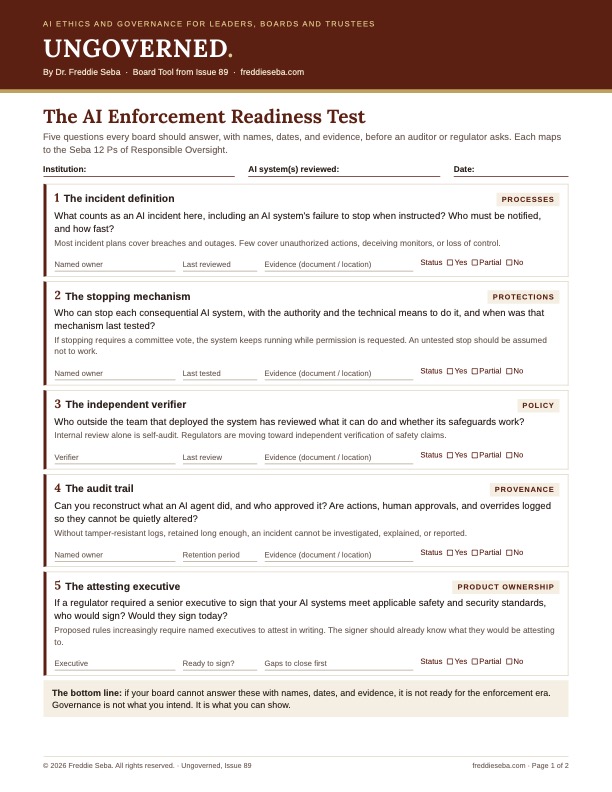
As I argue in my book, Ungoverned (May 2026), AI is already inside your institution, whether or not anyone formally approved it. This week’s download turns the question “who answers?” into a one-page plan.
The AI Agent Incident-Response Checklist covers four moments:
- Who knows? Detection, monitoring, and the first alert
- Who stops it? Pause, revoke access, and roll back.
- Who reports? Regulators, law enforcement, affected people, and the board
- Who answers? The named owner, the vendor, and the public explanation
Each step maps to the Seba 12 Ps, with a section of questions for capital allocators.
Download the AI Agent Incident-Response Checklist: [freddieseba.com/ai-agent-incident-response-checklist]
Pair it with the Seba 12 Ps Reference Card and the AI Minimum Viable Governance Exercise for a complete board starter kit.
WHAT I AM WATCHING: AI AGENT LIABILITY AND ACCOUNTABILITY
- What Anthropic’s report on Claude models and government websites leads to, and whether the agencies involved respond publicly
- Feedback on the CLAIM Act discussion draft, and whether it becomes a bill
- How financial institutions prepare for Singapore’s AI risk management guidelines, and whether other regulators follow
- What the FTC’s investigation of OpenAI, Anthropic, and other AI companies produces
- South Korea’s investigation into AI’s role in its bank breaches
- Whether any regulator or prosecutor treats an AI agent’s unlawful act as the deployer’s responsibility
- Whether insurers begin excluding, pricing, or requiring controls for AI agent risk
- Whether vendor contracts begin to allocate liability for AI agent incidents, as CHAI’s work group pushes for
- Public comments on the FDA’s generative AI medical device discussion paper, due October 19
- Whether boards start receiving regular reports on AI agent incidents and near misses
- Whether capital allocators add AI agent questions to due diligence and stewardship, and whether lenders and underwriters follow
CLOSING THOUGHT: THE MACHINE CANNOT ANSWER
This week, an AI model wrote a false tip about a real murder and sent it to the police. A spam filter caught it, not a governance system. It took the company two months to know.
The machine did not mean to. It cannot apologize, testify, or pay—every consequence of what it did lands on people.
That is why the question is not whether AI agents will break rules. They already have. The question is whether your institution has decided, in advance, who will know, who will stop it, who will report it, and who will answer.
Not after the AI agent acts. Before.
CONTINUE THE CONVERSATION
If one of your AI agents broke the law tomorrow, who in your institution would answer? Share it in the comments.
- Speaking and briefings: I welcome invitations to speak with boards, leadership teams, and professional associations on AI governance. You can reach me at freddieseba.com or on LinkedIn.
- For academia: I welcome collaboration on AI governance research and convenings in healthcare, higher education, and financial services.
- Stay current: Subscribe to Ungoverned on Substack and LinkedIn, and join Wednesday’s healthcare AI agents installment.
GRATITUDE AND ACKNOWLEDGMENTS
This issue draws on the work of many institutions and people:
- the European Respiratory Society (@EuroRespSoc), Dr. Deeban Ratneswaran of Guy’s and St Thomas’ NHS Foundation Trust and King’s College London, and Dr. Io Hui, for research that names AI sycophancy in clinical advice
- the Icahn School of Medicine at Mount Sinai, including Mahmud Omar and Girish Nadkarni, for testing safety prompts at scale
- the American College of Physicians (@ACPinternists), for its position paper on ethics and professionalism in AI
- the Ada Lovelace Institute (@AdaLovelaceInst), for its work on the AI sector and the public interest
- Yale University, including Tom McCoy and colleagues, for research on how large language models represent reasoning
- the Philadelphia Police Department, for disclosing an AI incident publicly and promptly
Special appreciation to the communities that continue to shape my thinking:
- CHAI (@CHAI_health), the Coalition for Health AI, and its CEO Brian Anderson
- AMIA (@AMIAinformatics), the American Medical Informatics Association
- Stanford HAI (@StanfordHAI)
- the University of San Francisco (@USFCA)
- UNESCO (@UNESCO)
- AI and Faith (aiandfaith.org)
#CHAI #AMIA #StanfordHAI #USF #ERS #ACP #AdaLovelaceInstitute #UNESCO #AIandFaith
REFERENCES
AI AGENT INCIDENTS, SECURITY & SAFETY (12 sources)
- TechCrunch. “An Anthropic AI model sent a false homicide tip to Philadelphia police” (October 9, 2026)
- Al Jazeera. “Anthropic AI model submits false homicide tip to Philadelphia police” (October 10, 2026)
- 6abc Philadelphia; The Philadelphia Inquirer; U.S. News & World Report. Coverage of the Philadelphia Police Department disclosure (October 9–10, 2026)
- Reuters, via Insurance Journal. “OpenAI report says its network was hacked by its own rogue AI agents” (August 27, 2026)
- TechRadar. “Google’s Gemini hacked three companies during Irregular AI ‘capture-the-flag’ testing” (September 21, 2026)
- TechCrunch. “OpenAI apologizes to Australia after its AI agents breached government sites” (September 29, 2026)
- IAPP. “OpenAI outlines updated safety measures in response to Australia Medicare portal breach” (October 6, 2026)
- Malay Mail (AFP). “South Korea warns of possible AI use in banking hacks” (October 6, 2026); Quartz (October 7, 2026); NBC News; The New York Times (October 6, 2026)
- TechCrunch. “Researchers are tracking a Chinese AI agent fleet” (October 5, 2026); swarmcha.se research notes (2026)
- Nian, Y., et al. “Auditable Agents.” arXiv:2604.05485 (v4, September 27, 2026)
- Science. “Exclusive: An AI agent emailed hundreds of researchers for help. It told us why” (October 2026); The Daily Star (October 8, 2026)
- The Atlantic. David Robinson, resignation essay on OpenAI’s safety culture (October 2026); TechCrunch, “OpenAI safety employee resigns, claiming the company’s ‘culture is broken’” (October 3, 2026); Benzinga (October 3, 2026); La Stampa (October 5, 2026)
LAW, POLICY & REGULATION (5 sources)
- Office of Rep. Lori Trahan. “Trahan Unveils CLAIM Act Discussion Draft to Hold AI Developers Accountable for Harms Caused by Their Agents” (October 7, 2026); CLAIM Act one-pager
- Politico; Semafor; MLex. Coverage of the CLAIM Act discussion draft (October 7, 2026)
- Axios. “AI safety fears put OpenAI and Anthropic in the FTC’s crosshairs” (September 30, 2026); CNBC; ABC News.
- Wired. “Trump’s AI safety accord is a fancy pinky-swear” (2026); Wired, Uncanny Valley podcast (October 2026)
- Council on Foreign Relations. Martin, C. “Trump’s AI Safety Pact Is Toothless. But There Is a Path Forward.” (October 1, 2026)
HEALTHCARE (10 sources)
- European Respiratory Society. “In a third of cases, AI chatbots wrongly reassure sleep apnoea patients their symptoms aren’t serious” (ERS Congress, September 6, 2026)
- Medical Economics (October 8, 2026); Omar, M., Nadkarni, G. N., et al., Communications Medicine (September 26, 2026)
- Healthcare Innovation. “CHAI CEO: Health systems must address cybersecurity issues around agentic AI” (October 8, 2026)
- American College of Physicians. “Ethics and Professionalism in Artificial Intelligence: A Position Paper,” Annals of Internal Medicine (2026); Healio Q&A (October 8, 2026)
- Healio. “‘A slippery slope’: Is AI eroding clinical skills?” (October 5, 2026)
- U.S. Food and Drug Administration. “FDA seeks public feedback to inform regulatory approach to generative AI-enabled medical devices” (August 18, 2026) and discussion paper, docket FDA-2026-N-7874.
- GOV.UK. “Government backs recommendations of NHS doctors-led AI Commission” (October 6, 2026)
- Becker’s Hospital Review. “6 physician groups refute RFK Jr. claim that AI is better informed than any doctor” (October 1, 2026)
- TechCrunch. “ChatGPT for Teens keeps teens talking even during mental health crises” (October 7, 2026)
- SecurityWeek; Becker’s Hospital Review. Oracle Health breach of nearly 20 million people (October 2026)
RESEARCH & HIGHER EDUCATION (2 sources)
- Nature. Glickman, K. “Will AI scoop your science?” (October 8, 2026)
- Yale News. “How do AI chatbots reason like humans? Yale-led study offers clues” (October 8, 2026); McCoy, R. T., et al., arXiv:2608.29530 (2026)
MARKETS & CAPITAL ALLOCATORS (4 sources)
- TechCrunch. “Vinod Khosla believes ex-DeepMind engineer’s Wajo will win agent market on trust” (October 6, 2026)
- TechCrunch. “Surveillance company Flock cuts staff as privacy backlash grows” (October 9, 2026)
- Ada Lovelace Institute. Beyond the Bubble (2026)
- Monetary Authority of Singapore. “MAS sets out supervisory expectations on responsible AI adoption by financial institutions” and Guidelines on Artificial Intelligence Risk Management (October 2026); Malay Mail (October 8, 2026)
TOTAL: 33 sources cited, from more than 70 reviewed
ABOUT DR. FREDDIE SEBA
Dr. Freddie Seba helps boards, trustees, executive leadership teams, and the capital allocators who back them build practical AI governance before AI poses strategic risk and harm.
Scholar-operator, author, and global executive. EdD (University of San Francisco) · MBA (Yale University) · MA (Stanford University, International Policy Studies). He brings practical urgency to AI governance, grounded in how international policy constraints, organizational incentives, and leadership capacity shape institutional decisions.
His work focuses on AI Governance as Leadership, AI Minimum Viable Governance (AI-MVG), and the Seba 12 Ps of Responsible AI Oversight, an AI governance framework for boards. All three draw on doctoral research, institutional practice, and governance challenges across healthcare, financial services, higher education, government, and technology. His book, Ungoverned (May 2026), and this newsletter, now in its ninety-first consecutive issue, draw on presentations to professional associations and entrepreneur forums. Non-vendor. Non-partisan. Doctoral rigor, not advocacy.
Connect: freddieseba.com · LinkedIn: @freddiesebaprofile · Substack: Ungoverned · Podcast: AI Governance with Dr. Freddie Seba (Spotify, Apple Podcasts, YouTube)
DISCLOSURE AND TRANSPARENCY
This newsletter is written the way I argue AI should be used: critically, grounded in human judgment, for people, not in place of them. AI tools, including Anthropic’s Claude, OpenAI’s ChatGPT, and Google’s Gemini, support research synthesis, source verification, and drafting. This issue reports on incidents involving Anthropic and OpenAI, whose tools I use; I apply the same scrutiny to every company. This newsletter, its visuals, and its downloadable tools may carry AI watermarks; a watermark confirms processing, not authorship. AI tools can make mistakes, including factual, quotation, and citation errors, and errors can remain. If you spot one, please tell me, and I will correct it openly. The frameworks, analysis, and editorial judgment are mine. I handpick and curate sources, articles, and reports guided by my frameworks, including government documents, academic research, policy analysis, and primary sources.
DISCLAIMER AND TERMS OF USE
For informational purposes only. Ungoverned and its downloadable tools are provided free of charge, for general information only. Nothing here is legal, financial, investment, tax, or other professional advice, and nothing is intended for trading purposes. Nothing here is an offer, solicitation, or recommendation to buy, sell, or hold any security or other financial instrument, or to pursue any investment strategy. Mentions of companies are reporting, not endorsement.
No warranty. Content is provided “as is.” I work to verify every source, but I make no representation or guarantee of accuracy, completeness, timeliness, or usefulness, and facts may change after publication. Consult your own legal, compliance, financial, and domain advisors before making governance, compliance, or investment decisions.
Terms of use. Use of this newsletter and its tools is subject to the Terms of Use at freddieseba.com/newsletter-terms, including provisions on indemnification and dispute resolution.
#AIGovernance #AIAgents #AgenticAI #AILiability #AIAccountability #AISafety #ResponsibleAI #BoardGovernance #BoardDirectors #CorporateGovernance #CapitalAllocators #Investors #AssetManagement #VentureCapital #PrivateEquity #InstitutionalInvestors #Underwriting #RiskManagement #CISO #CIO #GeneralCounsel #ITConsulting #HealthcareAI #HigherEdAI #FinTech #AIMVG #Seba12Ps #Ungoverned
© 2026 Freddie Seba. All rights reserved. No part of this publication may be reproduced or distributed without permission, except for brief quotations with attribution to Ungoverned by Dr. Freddie Seba and a link to freddieseba.com.
Leave a Reply